
Unlocking Multiplication, Your Go-To Guide for Beginners
Multiplication often feels like a daunting hurdle for young learners (and sometimes their parents!). But it doesn't have to be a struggle. At its heart, multiplication is just a faster way to count.
Whether you are a student just starting out or a parent looking for tips on how to teach multiplication, this guide will break down the basics, offer clear visual examples, and provide fun tools to master those basic multiplication facts.
What is Multiplication? (The "Shortcut" for Counting)
Before we memorize charts or look at flashcards, it’s crucial to understand why we need multiplication. It usually clicks during a real-life moment when counting by ones just takes too long.
Picture this common scenario: You are getting ready for a big family dinner and ask your child to help set the table with plates.
You say, "Please set the table neatly. Make three rows of plates, and put four plates in each row."
They carefully lay them out in a perfect grid. Then you ask, "Great job! Now, exactly how many plates are on the table?"
They start counting, pointing at each one painstakingly: "One, two, three, four... five, six, seven..." By the time they reach the end, they might sigh and say, "Mom, Dad, counting these one by one takes forever! Isn't there a faster way to figure out the total?"
Yes, there is!
That exact moment—when counting items one by one becomes tedious—is when multiplication steps in to save the day.
Find out some common things to count in your house. Make it tedioous for them, while you come up with an answer immediately. Make them ask how. And whe they ask how, your job is done.
At its heart, multiplication is just a clever shortcut for repeated addition. Instead of counting $1+1+1+1...$, or even adding the rows ($4 + 4 + 4$), multiplication speeds this up by simply asking for "3 groups of 4."
We write this shortcut as: $3 \times 4 = 12$.
Visualizing with Arrays
Visuals are powerful tools for multiplication for beginners. An "array" creates a grid of items to show the math.
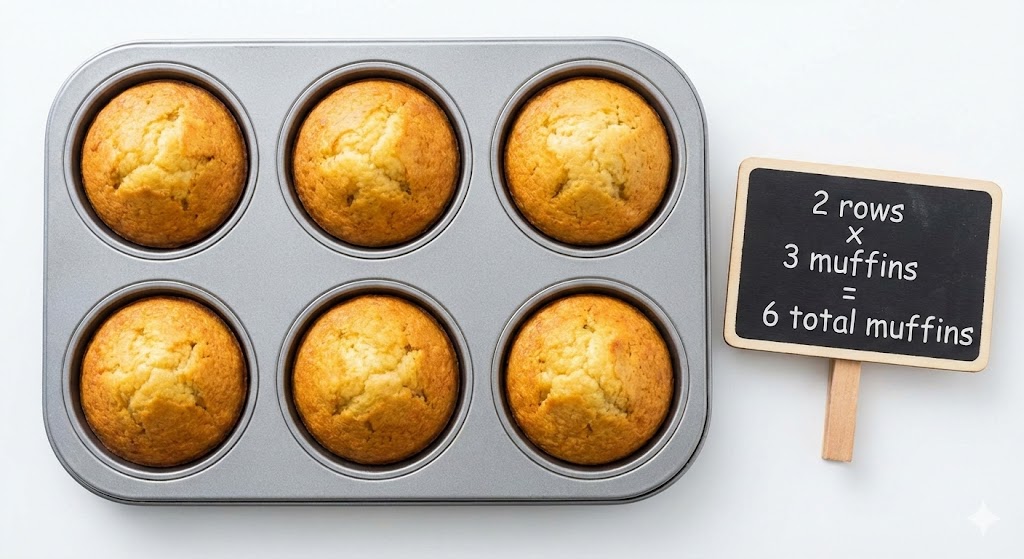
Imagine a tray of muffins. If you have 2 rows, and each row has 3 muffins, you can count them one by one ($1, 2, 3, 4, 5, 6$), or you can multiply the rows by the columns ($2 \times 3 = 6$).
Breaking Down the Facts: The 0-5 Times Tables
Mastering basic multiplication facts starts with small steps. You don't need to learn $12 \times 12$ on day one. Let's look at the "starter pack" tables.
The Zero Property (The "Zero Hero")
Any number multiplied by zero is always zero.
- $0 \times 5 = 0$
- $100 \times 0 = 0$
- Think: If you have 5 empty plates, how many cookies do you have? None.
The Identity Property (The "Mirror")
Any number multiplied by one stays the same.
- $1 \times 4 = 4$
- $9 \times 1 = 9$
The Twos (Doubling)
Multiplying by 2 is just doubling the number.
- $2 \times 3 = 6$ (Double 3)
- $2 \times 4 = 8$ (Double 4)
The Fives (High Fives)
Multiplying by 5 follows a rhythmic pattern: 5, 10, 15, 20... The answer always ends in a 0 or a 5.
- $5 \times 3 = 15$
- $5 \times 4 = 20$
Make Learning Fun: Gamify the Process
Rote memorization can be boring. One of the best ways to solidify these facts is through gameplay.
We highly recommend the Multiplication Game on Roblox.
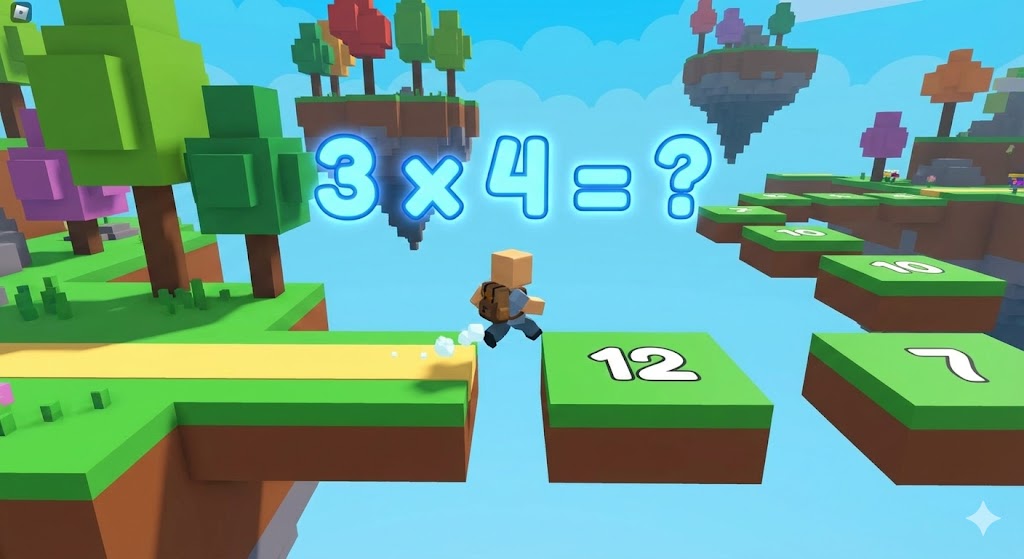
This isn't just a flashcard app; it is an engaging platformer game.
- How it works: You navigate obstacles and levels, but to progress, you must solve multiplication problems.
- The Routine: Playing for just 15 minutes a day can significantly improve recall speed and accuracy without making it feel like "homework."
Free Printable Practice Worksheets
Ready to put pen to paper? Here are three simple worksheets to practice the concepts we discussed.
Worksheet 1: The "Two" Times Table
Instructions: Solve the following by doubling the number.
- $2 \times 1 =$ ___
- $2 \times 2 =$ ___
- $2 \times 3 =$ ___
- $2 \times 5 =$ ___
- $2 \times 10 =$ ___
(Answer Key: 2, 4, 6, 10, 20)
Worksheet 2: The "Five" Times Table
Instructions: Count by fives to find the answer.
- $5 \times 1 =$ ___
- $5 \times 2 =$ ___
- $5 \times 3 =$ ___
- $5 \times 4 =$ ___
- $5 \times 5 =$ ___
(Answer Key: 5, 10, 15, 20, 25)
Worksheet 3: Mixed Practice (0-5)
Instructions: Remember the rules for Zero and One!
- $4 \times 0 =$ ___
- $3 \times 1 =$ ___
- $2 \times 4 =$ ___
- $5 \times 2 =$ ___
- $1 \times 8 =$ ___
(Answer Key: 0, 3, 8, 10, 8)
Final Thoughts
Multiplication unlocks a new world of math. By starting with repeated addition, using visual arrays, and mixing in fun games like the Roblox platformer, you will build a solid foundation. Keep practicing, and remember: every expert started as a beginner!