
A Bloom's Taxonomy Approach to learn Math
Many parents and educators view math as a binary: you either "get it" or you don't. But math proficiency isn't a single switch; it’s a ladder. In the world of pedagogy, this ladder is known as Bloom’s Taxonomy.
When we apply Bloom’s Analysis to math, we stop asking "Why did they get this wrong?" and start asking "At which cognitive level did the breakdown happen?"
Problem
Consider the image below
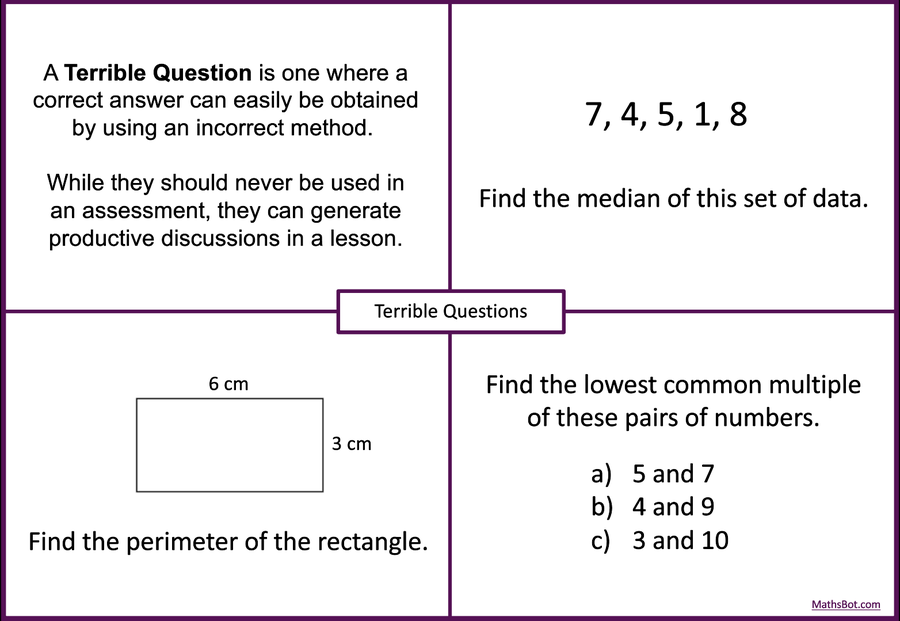
(credit: Mathsbot)
First think of why these are bad problems.
They are bad problems because they allow the student to get to the right answer without understanding the underlying concepts.
Top Left: 1,4,5,7,8. Happens that the median was already at the middle from the get go. So, without sorting, the pupil can find the right answer.
Bottom Left: Area=Perimeter. So, the pupil can compute area and get the right answer.
Bottom Right: Those are coprime pairs, their lcm is their product. No need to understand lcm.
So the student may score 100% but be wrong in all. We need to understand if the studeents understood the concept and to what level. Bloom's taxonomy helps us with that.
Breaking Down the Levels
Bloom’s Taxonomy categorizes learning into six levels of increasing complexity. For a child learning a concept like Simple Interest ((I=P×R×T)), the journey looks like this:
- Remember: Can they recall the formula? (I=P×R×T).
- Understand: Can they explain what "Principal" or "Rate" actually means in their own words?
- Apply: Can they calculate the interest if you give them the numbers for a standard loan?
- Analyze: If the interest doubled but the Rate stayed the same, can they figure out which other variable changed?
- Evaluate: Can they look at two different bank offers and justify which one is better for a 5-year period?
- Create: Can they design a mini "lending system" for their classroom to manage a toy exchange?
Identifying the Struggle: Where is the "Leak"?
Most kids get stuck because we ask them to Apply before they truly Understand, or we demand they Analyze when they are still struggling to Remember.
-
The "Careless Error" Myth: Often, what looks like a "silly mistake" is actually a breakdown at the Analyze level—the child knows the formula (Remember) and the steps (Apply) but fails to see how the parts of a complex word problem relate to each other.
-
The "Word Problem" Wall: If a child can solve 25*4 but can't solve "If 4 pens cost ₹25 each...", their struggle isn't with math; it’s at the Understand level (translating language to logic).
How to fix it: Once you identify the level, you "downshift." If they can't solve the word problem, stop the drills. Go back to the Understand phase using visual aids or physical objects until the concept clicks.
Try it out for your kid with our AI enabled diagnostic report: AI Diagnostic Report
Why Don't Indian Schools Use This More?
Despite the global success of Bloom’s framework, many Indian classrooms remain resistant to it for several structural reasons:
- The "Syllabus Sprint": With massive amounts of content to cover for board exams, teachers are often forced to move at the speed of the fastest student, prioritizing Application (solving the sum) over Evaluation or Creation.
- Exam-Centricity: Competitive exams like JEE or NEET historically rewarded speed and pattern recognition. This creates a "shadow curriculum" where rote-memorizing "types" of problems is more efficient than deep analysis.
- High Student-Teacher Ratios: In a class of 40–60 students, it is nearly impossible for a single teacher to perform a manual Bloom’s Analysis for every child’s worksheet.
- Assessment Design: Most school tests are 80% "Recall" and "Application." Since students aren't tested on "Creation" or "Evaluation," these levels are often ignored in daily practice.
The AI Frontier: How EdTech Can Bridge the Gap
This is where the next generation of EdTech companies has a massive opportunity. AI doesn't just grade a math problem; it can perform a Cognitive Audit.
1. Dynamic Diagnostic Worksheets
Instead of a static PDF, AI-driven platforms can use item response theory to tag every question by its Bloom's level. If a child misses three "Analyze" questions but gets all "Apply" questions right, the AI can instantly pivot to remedial content focused on logical breakdown rather than more calculation practice.
2. AI "Socratic" Tutors
LLMs can be programmed to act as mentors that refuse to give the answer. If a student is stuck at the Understand level, the AI can ask: "If the 'Rate' is the 'speed' at which your money grows, what happens if we slow that speed down?" This pushes the student up the pyramid through dialogue.
3. Automated Gap Analysis for Teachers
EdTech products can provide teachers with a "Bloom's Heatmap." Instead of seeing that "Rahul got 60%," a teacher sees: "Rahul is 100% proficient at Remembering and Applying, but 0% proficient at Evaluating." This allows for high-precision classroom intervention.
4. Generative "Create" Tasks
AI can help students reach the top of the pyramid-Create-by generating personalized projects. For a child interested in cricket, the AI could generate a task: "Design a points system for a local tournament that balances runs scored against wickets taken using these algebraic constraints."
By moving away from "Right vs. Wrong" and toward a Bloom-based analysis, we can turn math from a source of anxiety into a structured journey of cognitive growth.