
An Alternative to Khan Academy
For over a decade, the "Khan Academy model"—short video lectures followed by multiple-choice questions—has been the gold standard for digital education. When we say edtech, we generally mean some sort of video content delivery system with some smattering of gamification. It democratized access to quality explanations and allowed students to learn at their own pace. But there was a problem. When I gave my kid access to Khan Academy and left her to learn, she got some gamification points, but she did not learn maths. Just like how no one who has used Duolingo has ever learnt a language. Something was broken. The "watch-and-quiz" approach is becoming the "old school" of the digital age.
The initial euphoria surrounding the "video era" of EdTech is giving way to a more nuanced, evidence-based skepticism. Educators, cognitive scientists, and policy makers are increasingly recognizing that "watching" is not synonymous with "learning." This is especially true in the Indian context, a civilization with a deep-rooted historical legacy of mathematical rigor and a contemporary education system that demands high-stakes performance. The "Khan Academy way"—teaching through videos and testing through multiple-choice questions is not enough.
1. Math is a Performance Sport, Not a Spectator Sport
The fundamental flaw in the video-centric approach is the "illusion of competence." When a student watches a beautifully produced video of a tutor solving a complex calculus problem, they feel they understand it. And this is an easy escape for the parent as well as the kid. Put on Khan Academy on the tab and the kid is occupied for half an hour. Parent feels kid is learning. Kid feels its better than reading the text book where the kid has to do the work. This is passive recognition. However, when faced with a blank sheet of paper, that understanding often evaporates.
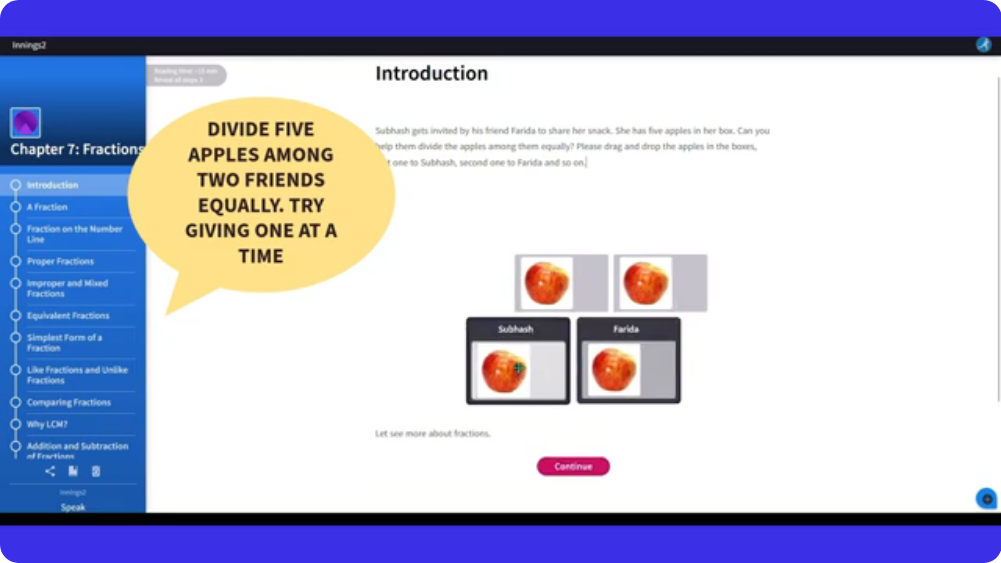
The approach pioneered by platforms like Innings2 Books flips this script. Instead of reading a textbook or watching a screen, the student "does" the textbook.
This approach aligns with the Constructivist theories of learning and the specific exigencies of the National Education Policy (NEP) 2020.
- Active Manipulation: Instead of seeing a static graph of a sine wave, students drag sliders to see how frequency affects the curve in real-time.
- Embedded Scaffolding: Instead of a video followed by a quiz, the "quiz" is the content itself. Every step of a derivation requires student input, ensuring the brain never enters "autopilot mode."
- Instant Feedback: In a video, you might not realize you're lost until the 10-minute mark. In an interactive textbook, you know you’re lost the second you provide an incorrect input on a step-by-step calculation.
2. The Failure of the "Adapted" Curriculum
A significant critique of global giants is their approach to the Indian market. For years, the strategy has been to "map" or "adapt" US-centric content to the CBSE or ICSE syllabus.
While mathematical principles are universal, the pedagogy, problem-density, and cultural context are not. Go search for Khan academy content for CBSE. You will find the same videos just cut and pasted as per the CBSE curriculum. Why should our students have second hand content.
Topics are rearranged, but the underlying pedagogical philosophy—often focused on "conceptual intuition" at the expense of "procedural mastery"—remains American. This creates a dissonance for the Indian student preparing for board exams or the IIT-JEE, where procedural fluency and the ability to handle complex, multi-step problems are non-negotiable. The reliance on adapted foreign tools serves to dilute the inherent strengths of the Indian system, replacing a culture of "doing mathematics" with a culture of "watching mathematics."
- Depth vs. Breadth: Indian competitive exams (JEE, NEET) and Board exams require a level of math and depth that "adapted" videos often gloss over.
- Native Logic: Indian students are trained in specific mental models. When a platform is "written from scratch" for the Indian context, it respects these local pedagogical strengths rather than trying to overwrite them with a Western "casual" learning style.
3. Why India Deserves "Native" Tools
India produces some of the most analytically rigorous students in the world. It is a paradox that we often rely on educational software designed for a different demographic and then retrofitted for us.
Using our own tools and curriculum means:
- Aligned Rigor: Building content that matches the "difficulty curve" of the CBSE syllabus from day one.
- The Tech-First Advantage: Using modern browser capabilities to create simulations that go far beyond what a YouTube embed can offer.
- Indigenous Mastery: Leveraging our own tools to educate our kids ensures that the learning process feels like an extension of the classroom, not a foreign addition.
The US Common Core curriculum, upon which Khan Academy is based, has often been criticized for its "spiral" approach and lack of computational intensity in early grades. In contrast, the Indian curriculum emphasizes a linear, deep-dive progression—moving from arithmetic fluency to complex algebraic manipulation and formal geometric proof with a speed and intensity that often outpaces Western equivalents.
4.The Limits of Instructionism (The Khan Academy Model)
Instructionism, rooted in behaviorist psychology, views education as the transmission of knowledge. The teacher (or video) delivers content, and the student receives it. Learning is measured by the ability to recall this content during a test.
Mechanism: Explanation $\rightarrow$ Reception $\rightarrow$ Recall.
The Flaw: In mathematics, knowledge is not a list of facts to be memorized; it is a system of logic to be internalized. One cannot simply "be told" how to think mathematically. The neural connections required for mathematical reasoning are built through active struggle and manipulation, not passive listening.
The "Old School" Trap: Watching a video is a low-cognitive-load activity. The brain can process the audiovisual stream without deeply encoding the logical structures. This leads to the phenomenon where students "binge-watch" math videos, feeling productive, but retain very little.
5.The Power of Constructionism (The Innings2 Model)
Constructionism, a theory developed by Seymour Papert (building on Jean Piaget), posits that learning is most effective when the learner is actively constructing a meaningful object or system.
In the digital age, this means the learner should be building, manipulating, and exploring the math, not just consuming it.
Mechanism: Interaction $\rightarrow$ Observation $\rightarrow$ Deduction $\rightarrow$ Internalization.
The "Doing" Paradigm: The Innings2 platform is built on this "Concept-First Pedagogy".10 Instead of explaining a concept and then asking a question, the system presents a tool—a "Math Canvas"—and invites the student to explore. For example, to understand the area of a circle, the student might engage with a dynamic visualization where the circle is sliced and rearranged into a rectangle, physically demonstrating the derivation of $\pi r^2$
Cognitive Activation: Research confirms that interactive textbooks generate a medium-to-large effect size on mathematical achievement (g=0.55), significantly outperforming static or video-based instruction. This is because the act of manipulation—dragging a vertex, resizing a shape, swiping a number line—requires the brain to constantly predict and verify outcomes, a process that creates deep, durable learning.
6. Conclusion: Moving From "Consuming" to "Building"
The move toward interactive textbooks represents a shift in the power dynamic of education. It moves the student from the role of a "viewer" to the role of a "participant." In the context of Math and Science, this isn't just a minor improvement—it is the difference between passing an exam and truly mastering a discipline.
It makes no sense to learn in the "adapted" way when we can build the "native" way. It is time to stop watching the lecture and start doing the textbook.