

Enhanced Curriculum Support
This is a comprehensive educational resource designed to provide students with the tools and guidance necessary to excel. This support system is structured to cater to various aspects of learning, ensuring that students are well-prepared for academic challenges and practical applications of mathematical concepts. Some are the key benefits are mentioned below:
Comprehensive Learning: This holistic approach helps students gain a thorough understanding of the subject. Practical Application: The resources encourage students to apply mathematical concepts to real-life scenarios, enhancing their practical understanding and problem-solving skills.
Critical Thinking and Reasoning: Value-Based and HOTS questions promote critical thinking and reasoning abilities. These skills are crucial for students to tackle complex problems and make informed decisions.
Exam Preparedness: Sample Question Papers and NCERT Exemplar Solutions provide ample practice for exams. They help students familiarize themselves with the exam format and types of questions, reducing exam anxiety.
Ethical and Moral Development: Value-Based Questions integrate ethical and moral lessons into the learning process, helping in the overall development of students' character and social responsibility. By incorporating these diverse elements, Enhanced Curriculum Support aims to provide a robust and well-rounded knowledge, preparing students for both academic success and real-world challenges.
Sample Questions/ Previous year Questions
SecA
1. A bag contains 4 red balls and 6 blue balls. A ball is drawn randomly from the bag. What is the probability that the ball drawn is red?
2. A die is thrown once. Find the probability of getting a number greater than 4.
3. A card is drawn from a well-shuffled deck of 52 cards. Find the probability that the card drawn is a face card (King, Queen, or Jack).
4. What is the probability of getting an even number when rolling a fair die?
SecB
1. A box contains 20 tickets numbered from 1 to 20. One ticket is drawn at random. Find the probability that the number on the ticket is:
(a) a prime number,
(b) a multiple of 4.
2. Two dice are thrown simultaneously. Find the probability that the sum of the numbers appearing on both dice is 7.
3. A bag contains 5 white balls, 3 black balls, and 2 red balls. If one ball is drawn at random from the bag, find the probability that the ball drawn is:
(a) white,
(b) neither black nor red.
4. A coin is tossed 3 times. What is the probability of getting exactly 2 heads?
SecC
1. A card is drawn from a well-shuffled deck of 52 playing cards. Find the probability that the card drawn is:
(a) a spade,
(b) not a face card,
(c) a red queen.
2. A bag contains 3 red balls, 5 green balls, and 4 yellow balls. Two balls are drawn randomly one after the other without replacement. Find the probability that:
(a) both balls are green,
(b) the first ball is red and the second is yellow.
3. A die is thrown twice. Find the probability that:
(a) the sum of the numbers appearing on the dice is 9,
(b) at least one number is a 6,
(c) the two numbers are the same.
SecD
1. In a class of 40 students, 25 are girls and 15 are boys. The names of all students are written on identical slips of paper and placed in a box. A slip is drawn at random. What is the probability that the name drawn is:
(a) a girl,
(b) a boy?
If 5 more boys join the class and a slip is drawn again, how does the probability of selecting a boy change?
2. A bag contains 4 white balls, 5 red balls, and 7 green balls. Three balls are drawn at random. Find the probability that:
(a) all three balls are white,
(b) exactly one ball is white,
(c) at least one ball is red.
3. Two cards are drawn simultaneously from a well-shuffled deck of 52 playing cards. Find the probability that:
(a) both cards are kings,
(b) one is a king and the other is a queen,
(c) both are face cards.
4. A box contains 6 blue, 5 red, and 4 green balls. Two balls are drawn at random one after the other without replacement. Find the probability that:
(a) both balls are of the same color,
(b) the first ball is blue and the second is red,
(c) neither ball is green.
Value Based Questions
Problem1
Situation: A company organizes a charity raffle where 200 tickets are sold, and 5 prizes are to be won. The company has pledged that all the money collected will be donated to a local orphanage. Raj, a student who strongly believes in supporting such causes, buys 4 tickets to support the charity.
1. What is the probability that Raj wins at least one prize?
2. What values does Raj display by participating in this charity event?
Problem2
Situation: In a school, students are encouraged to help others in need. During a winter drive, students were given colored cards—red, blue, and green. The students with red cards are responsible for collecting donations, blue cards for distributing winter clothes, and green cards for organizing the event. Out of 30 students, 10 received red cards, 12 received blue, and 8 received green.
1. If a student is selected randomly, what is the probability that the student received a blue card?
2. What values are the students demonstrating through this winter drive initiative?
Problem3
Situation: In a city, there is a blood donation camp where volunteers are randomly selected for different tasks: reception, guiding donors, and medical assistance. Out of 50 volunteers, 20 are assigned to the reception, 15 to guiding donors, and 15 to medical assistance. Neha, who values community service, participates in this camp.
1. If a volunteer is selected randomly, what is the probability that the volunteer is assigned to guiding donors?
2. What values are exhibited by Neha and the other volunteers through their participation in this event?
Problem4
Situation: A wildlife conservation group organizes a tree plantation drive, where each participant is randomly assigned a specific species of tree to plant. Out of 60 participants, 25 are assigned to plant neem trees, 20 to plant mango trees, and 15 to plant banyan trees. A local student, Meera, joins the initiative to help preserve the environment.
1. If a participant is selected randomly, what is the probability that the participant is assigned to plant a banyan tree?
2. What environmental values does Meera promote by participating in the tree plantation drive?
HOTS
Q1
1. A bag contains 5 red balls, 7 blue balls, and 8 green balls. Two balls are drawn at random without replacement.
(a) What is the probability that both balls drawn are of the same color?
(b) If it is known that the first ball drawn is red, what is the probability that the second ball is also red?
(c) How would the probability change if the number of balls of each color were doubled? Provide a reasoned explanation for your answer.
Q2
2. A box contains 20 cards numbered from 1 to 20. A student randomly picks one card.
(a) What is the probability that the card shows a prime number?
(b) If a card is drawn and it shows an odd number, what is the probability that it is also a prime number?
(c) Analyze how the probabilities would be affected if the range of the cards was from 1 to 40 instead of 1 to 20. Explain the mathematical reasoning behind your analysis.
Q3
3. In a game, players have to pick a marble from a box containing 10 white marbles, 12 black marbles, and 8 red marbles. If a player picks a white marble, they win a bonus round. The marbles are replaced after each pick.
(a) What is the probability that a player picks a white marble in the first two attempts?
(b) If the player picks a marble and it is not white, what is the probability that they will pick a white marble on their second attempt?
(c) Extend the scenario where the box contains 30 marbles of each color. How would this impact the probability calculations? Explain your reasoning with mathematical steps.
Q4
4. A lottery has 100 tickets, and 5 prizes are to be won. A person buys 4 tickets.
(a) What is the probability that this person wins at least one prize?
(b) If the person wins one prize, what is the probability that they win more than one prize?
(c) Suppose the lottery expands to 500 tickets and 20 prizes. How would this change the probability of winning at least one prize for the same number of tickets purchased? Explain the effect with reasoning and calculation.
Q5
5. In a class of 30 students, 18 are girls and 12 are boys. A committee of 4 students is to be formed randomly.
(a) What is the probability that the committee will consist of exactly 2 girls and 2 boys?
(b) What is the probability that all 4 students in the committee are girls?
(c) If the total number of students is doubled while maintaining the same ratio of boys to girls, how would the probabilities change? Justify your answer with calculations and explanations.
NCERT Exemplar Solutions
Questions
1. An ordinary deck of cards contains 52 cards divided into four suits. The red suits are diamonds and hearts and black suits are clubs and spades. The cards J, Q, and K are called face cards. Suppose we pick one card from the deck at random.
(a) What is the sample space of the experiment?
(b) What is the event that the chosen card is a black face card?
2. Suppose that each child born is equally likely to be a boy or a girl. Consider a family with exactly three children.
(a) List the eight elements in the sample space whose outcomes are all possible genders of the three children.
(b) Write each of the following events as a set and find its probability :
(i) The event that exactly one child is a girl.
(ii) The event that at least two children are girls
(iii) The event that no child is a girl
3. (a) How many two-digit positive integers are multiples of 3?
(b) What is the probability that a randomly chosen two-digit positive integer is a multiple of 3?
4. A typical PIN (personal identification number) is a sequence of any four symbols chosen from the 26 letters in the alphabet and the ten digits. If all PINs are equally likely, what is the probability that a randomly chosen PIN contains a repeated symbol?
5. Probability that a truck stopped at a roadblock will have faulty brakes or badly worn tires are 0.23 and 0.24, respectively. Also, the probability is 0.38 that a truck stopped at the roadblock will have faulty brakes and/or badly working tires. What is the probability that a truck stopped at this roadblock will have faulty breaks as well as badly worn tires?
6. An urn contains twenty white slips of paper numbered from 1 through 20, ten red slips of paper numbered from 1 through 10, forty yellow slips of paper numbered from 1 through 40, and ten blue slips of paper numbered from 1 through 10. If these 80 slips of paper are thoroughly shuffled so that each slip has the same probability of being drawn. Find the probabilities of drawing a slip of paper that is
(a) blue or white
(b) numbered 1, 2, 3, 4 or 5
(c) red or yellow and numbered 1, 2, 3 or 4
(d) numbered 5, 15, 25, or 35;
(e) white and numbered higher than 12 or yellow and numbered higher than 26.
7. Four candidates A, B, C, D have applied for the assignment to coach a school cricket team. If A is twice as likely to be selected as B, and B and C are given about the same chance of being selected, while C is twice as likely to be selected as D, what are the probabilities that
(a) C will be selected?
(b) A will not be selected?
8. A team of medical students doing their internship have to assist during surgeries at a city hospital. The probabilities of surgeries rated as very complex, complex, routine, simple or very simple are respectively, 0.15, 0.20, 0.31, 0.26, .08. Find the probabilities that a particular surgery will be rated
(a) complex or very complex;
(b) neither very complex nor very simple;
(c) routine or complex
(d) routine or simple
9. In a large metropolitan area, the probabilities are .87, .36, .30 that a family (randomly chosen for a sample survey) owns a colour television set, a black and white television set, or both kinds of sets. What is the probability that a family owns either anyone or both kinds of sets?
10. A die is loaded in such a way that each odd number is twice as likely to occur as each even number. Find P(G), where G is the event that a number greater than 3 occurs on a single roll of the die.
11. One urn contains two black balls (labelled B1 and B2) and one white ball. A second urn contains one black ball and two white balls (labelled W1 and W2). Suppose the following experiment is performed. One of the two urns is chosen at random. Next a ball is randomly chosen from the urn. Then a second ball is chosen at random from the same urn without replacing the first ball.
(a) Write the sample space showing all possible outcomes
(b) What is the probability that two black balls are chosen?
(c) What is the probability that two balls of opposite colour are chosen?
12. A bag contains 8 red and 5 white balls. Three balls are drawn at random. Find the Probability that
(a) All the three balls are white
(b) All the three balls are red
(c) One ball is red and two balls are white
13. If the letters of the word ASSASSINATION are arranged at random. Find the Probability that
(a) Four S’s come consecutively in the word
(b) Two I’s and two N’s come together
(c) All A’s are not coming together
(d) No two A’s are coming together
14. A card is drawn from a deck of 52 cards. Find the probability of getting a king or a heart or a red card.
15. Determine the probability p, for each of the following events.
(a) An odd number appears in a single toss of a fair die.
(b) At least one head appears in two tosses of a fair coin.
(c) A king, 9 of hearts, or 3 of spades appears in drawing a single card from a well shuffled ordinary deck of 52 cards.
(d) The sum of 6 appears in a single toss of a pair of fair dice
16. If A and B are two candidates seeking admission in an engineering College. The probability that A is selected is .5 and the probability that both A and B are selected is at most .3. Is it possible that the probability of B getting selected is 0.7?
17. The probability of intersection of two events A and B is always less than or equal to those favourable to the event A.
18. The probability of an occurrence of event A is .7 and that of the occurrence of event B is .3 and the probability of occurrence of both is .4.
19. The probability that a student will pass his examination is 0.73, the probability of the student getting a compartment is 0.13, and the probability that the student will either pass or get compartment is 0.96.
Case Based Questions
Question 1
A school conducted a mathematics exam for 100 students. The number of students scoring different ranges of marks is given below:
| Marks Range | 0-20 | 21-40 | 41-60 | 61-80 | 81-100 |
|---|---|---|---|---|---|
| No. of Students | 10 | 20 | 30 | 25 | 15 |
A student is chosen randomly.
(1) What is the probability that the selected student scored above 60 marks?
(2) Find the probability that the selected student scored between 21 and 60 marks.
(3) If the student passes the exam by scoring at least 40 marks, what is the probability that the selected student has passed?
Sol
(1) 0.4 (or 40%)
(2) 0.5 (or 50%)
(3) 0.7 (or 70%)
Question 2
Mr. Alex bought a pack of playing cards for his children to learn to play cards so that they can even play on line as well with their friends since they have no chances of moving out in the pandemic. But the children knew nothing about playing cards or different kinds of suits in it. So, Mr. Alex thought of explaining both his children the different suits as well as colours of cards. So, he spread out all the cards in an organized manner and explained.
A standard deck of 52 playing cards consists of 4 suits i.e:

with 13 kinds in each suit.
In the picture above, the four rows are the four suits. The clubs are all in the first row, followed by the spades, then the hearts, and last the diamonds. Among the 13 kinds, we find the numbers from 2 to 10, and four are other kinds. The A stands for ace, the J for jack, the Q for queen, and the K for king. The jack, queen, and king are often referred to as face cards.
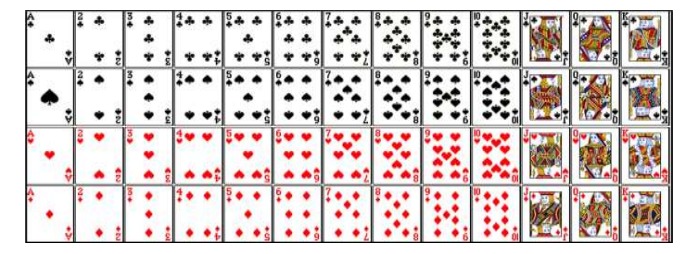
Based on your understanding of the above case study, answer all the five questions below:
(1) The cards were shuffled thoroughly and one card is drawn from the deck, what is the probability of getting a king of red colour ?
(2) Find the probability of getting a face card.
(3) If queen of diamond is drawn and put aside, what is the probability that the second card is a queen ?
(4) What is the probability of getting the six of clubs ?
(5) If kings of all four suits are removed, and one card is drawn, then what is the probability of getting a non-ace ?
Sol
(1) P(King of Red) =
(2) P(Face Card) =
(3) P(Queen on second draw) =
(4) P(Six of Clubs) =
(5) P(Non-Ace) =