

Curves
Take a piece of paper and just start doodling randomly whatever comes to your mind. The results of your random doodling are called
Important Note:
‘Curve’ in everyday usage means “not straight”. In Mathematics, a curve can be straight.
We can draw some of these drawings without lifting the pencil from the paper and without the use of a ruler. These are all classified as curves and have different types.
- Curves
- Based on Presence of Intersection Points
Simple Curves Non-Simple Curves
- Based on Presence of Intersection Points
If a curve does not cross itself, then it is called a simple curve. A simple curve changes its direction but does not cross itself.
It can be open and closed. If a curve does cross itself, it is a non-simple curve.
Examples for simple closed curves -Circle, ellipse.
Out of the seven below given figures, classify as "Simple"/ "Not Simple" / "Open" Curve.
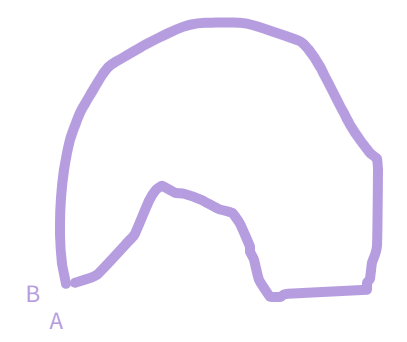
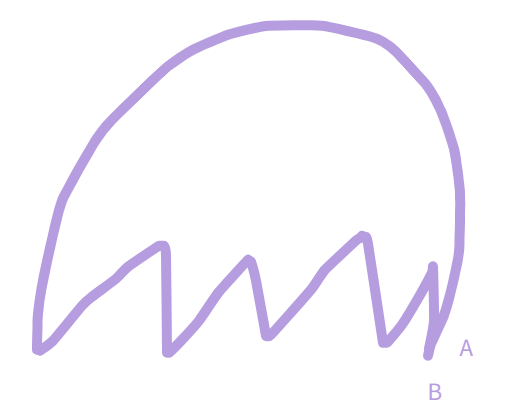
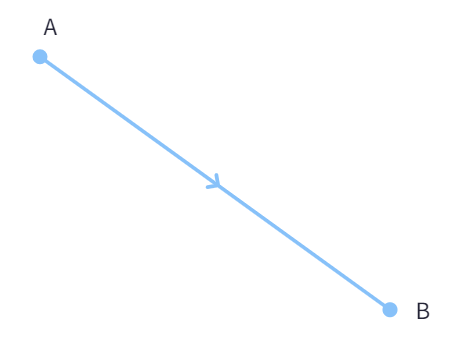
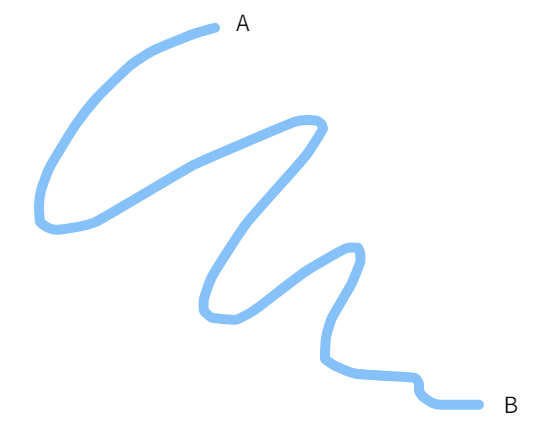
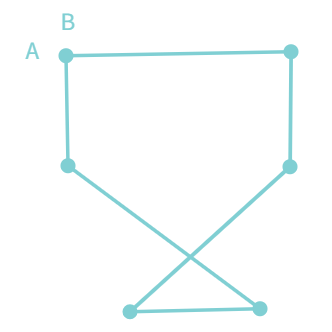
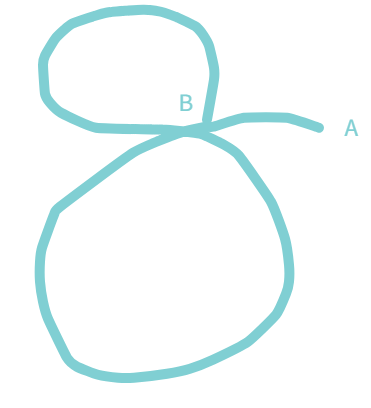
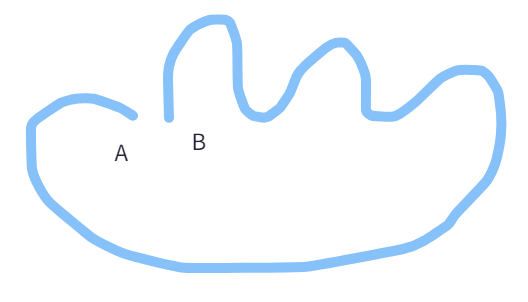
Let's see in detail?
Position in a figure
Think about this: When we see a house or a building, there is often a fence or a compound wall that separates the building from the road and the rest of the surrounding land. A division like that causes the land to be separated into parts- inside the fencing, exactly on the fence and outside the fence. We cannot enter the building without crossing the fence or the gate/ main entrance of the building.
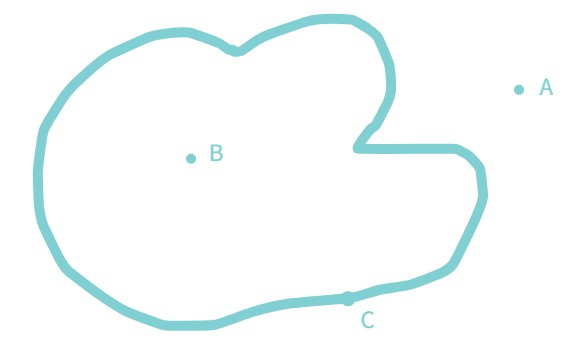
Similarly, when we have a closed curve on a piece of paper and we randomly select points, we can classify the points into three types:
- (i) interior (‘inside’) points
- (ii) boundary (‘on’) points
- (iii) exterior (‘outside’) points
In the below given figure, B is the
The interior of a curve together with its boundary is called its region.
Polygons
A figure is a polygon if it is a simple
Distinguish the following figures as a polygon or not:
Sides, vertices and diagonals
Polygon with six sides i.e. Hexagon
The line segments forming a polygon are called its Sides
Above polygon ABCDEF has the sides: AB, BC, CD, DE EF and FA.
The corners are usually named in order.
The meeting point of a pair of adjacent sides is called its vertex .
Sides EF and FA meet at F, so F is a vertex of the polygon ABCDEF. So, are points like A, B,C etc.
Any two sides with a common end point are called the adjacent sides of the polygon.
Are the sides AB and BC adjacent?
How about AF and DC?
The end points of the same side of a polygon are called the adjacent vertices. Vertices E and D are adjacent, whereas vertices A and D are not adjacent vertices.
Consider any pairs of vertices which are not adjacent and join them with a line segment.
The line segment joining two non-adjacent vertices in a polygon is called the diagonal of the polygon.
So, in the above figure- AD, BE, CF etc. are diagonals.
How many total diagonals does the polygon have?
If we try to join adjacent vertices with a line segment, what is the result? The line segment will be a