

Equivalent Fractions
Equivalent fractions are the fractions that have different numerators and denominators but are equal to the same value. For example, 2/4 and 3/6 are equivalent fractions, because they both are equal to the
A fraction is a part of a whole. Equivalent fractions represent the same portion of the whole.
These fractions are
All these fractions are Equivalent?
1. Are
Drag and drop the equivalent fractions of
Identify the fractions in each. Are these fractions equivalent?
(i)
(ii)
(iii)
(iv)
Why do the equivalent fractions represent the same part of a whole?
How can we obtain one from the other?
Let see an example?
- To obtain equivalent fractions of a fraction, we have to either multiply or divide the same number in both the numerator and denominator.
- Let us multiply 2 in both the numerator and denominator and then we find the fraction is
- Simplifying this fraction then the fraction is
- Let us multiply 3 in both the numerator and denominator.
- Multiply the fractions and the fraction is
. - Simplifying this fraction then we get the fraction is
- Let us multiply 4 in both the numerator and denominator.
- Multiply this fraction then we get the answer is
- Divide the fraction again and we get the fraction as
- Hence, we have found the equivalent fractions of
1 2
Rajni says that equivalent fractions of
- To obtain equivalent fractions of a fraction, we have to either multiply or divide the same number in both the numerator and denominator.
- Let us multiply 2 in both the numerator and denominator and then we find the fraction is
- Simplifying this fraction then the fraction is
- Let us multiply 3 in both the numerator and denominator.
- Multiply the fractions and the fraction is
. - Simplifying this fraction then we get the fraction is
- Let us multiply 4 in both the numerator and denominator.
- Multiply this fraction then we get the answer is
- Divide the fraction again and we get the fraction as
- Hence equivalent fractions of
1 3
Do you agree with her?
Rajni is correct in her method of finding equivalent fractions because she follows the rule that to get an equivalent fraction, you multiply both the numerator and the denominator of a given fraction by the same number.
Find five equivalent fraction for below numbers.
(i)
(ii)
(iii)
(iv)
Is there any other way to obtain equivalent fractions?
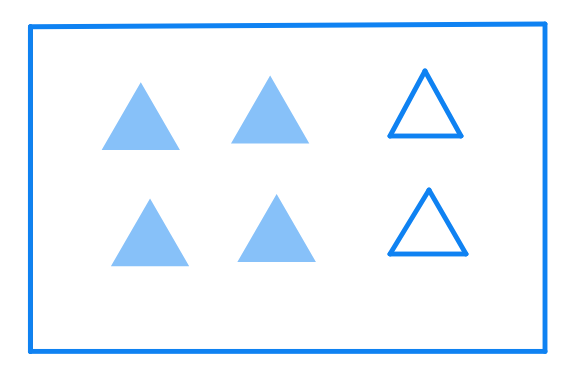
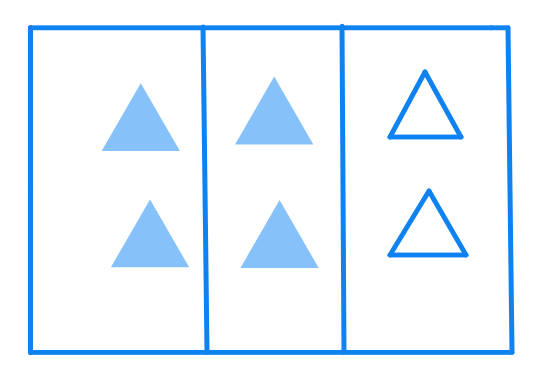
These include equal number of shaded things i.e.
To find an equivalent fraction, we may divide both the numerator and the denominator by the same number.
One equivalent fraction of
Can you find an equivalent fraction of
- We divide both the numerator and the denominator of
9 15 and then we get the fraction is - Divide the fraction with 3
- Hence
is the required equivalent fraction. - We found the answer.
Find the equivalent fraction of
- We know 2 × 3 =
. - This means we need to multiply both the numerator and the denominator by 3 to get the equivalent fraction.
- We get the fraction is
. is the required equivalent fraction.
Find the equivalent fraction of
- We divide both the numerator and the denominator of
15 35 and then we get the fraction is - divide the fraction with 5
- Hence
is the required equivalent fraction..
Let us now note an interesting fact about equivalent fractions. For this, complete the given table.
| Equivalent fractions | Product of the numerator of the 1st and the denomenator of the 2nd | Product of the numerator of the 2nd and the denomenator of the 1st | Are the products equal ? |
|---|---|---|---|
| 1 × 9 = | 3 × 3 = | ||
| 4 × 35 = | 5 × 28 = | | |
| | | ||
| | 2 × | | |
| | 7 × 24 = | |
What do we infer?
The product of the numerator of the first and the denominator of the second is
This rule is helpful in finding equivalent fractions.
Find the equivalent fraction of
Given the fraction
How do we do it?
A fraction is said to be in the simplest (or lowest) form if its numerator and denominator have no common factor except 1.
The shortest way to find the equivalent fraction in the simplest form is to find the HCF of the numerator and denominator, and then divide both of them by the HCF.
The equivalent fractions given here are quite interesting.
Each one of them uses all the digits from 1 to 9 once!
Try to find two more such equivalent fractions.
To find such fractions, we need to create fractions where both the numerator and the denominator use unique digits from 1 to 9 and the fractions are equivalent.
1. Write the simplest form.
(i)
- It can be observed that
is the highest common factor of 15 and 75. - Divide the numerator and denominator by the highest common factor 15.
- Hence, we get the fraction is
. - We have found the answer.
(ii)
- It can be observed that
is the highest common factor of 16 and 72. - Divide the numerator and denominator by the common factor 8.
- Hence, we get the fraction is
. - We have found the answer.
(iii)
- It can be observed that
is the highest common factor of 17 and 51. - Divide the numerator and denominator by the common factor 17.
- Therefore, we get the fraction is
. - We have found the answer.
(iv)
- It can be observed that
is the highest common factor of 42 and 28. - Divide the numerator and denominator by the common factor 14.
- Therefore, we get the fraction is
. - We have found the answer.
(v)
- It can be observed that
is the highest common factor of 80 and 24. - Divide the numerator and denominator by the common factor 8.
- Therefore, we get the fraction is
. - We have found the answer.
2. Is