
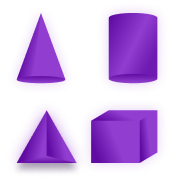
Drawing Solids on a Flat Surface
We have already seen in the previous sections, how when depicting real life 3-D objects on a piece of paper, often the diagram becomes two dimensional. However, using visual illusion, we can draw a solid shape so that the diagram is distorted to look like a three-dimensional object.
There are
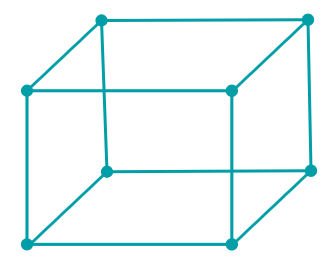
Here, we have a diagram of a cube.
What can be said about it?
It gives a clear depiction of how a cube looks like when viewes from the front.
We also do not see certain faces. In the diagram drawn here, the lengths are not necessarily equal as they should be in a cube, yet we are able to recognise the object as a cube. Such a sketch of a solid is called an oblique sketch of that solid.

In the oblique sketch we make the following observations:
The sizes of the front face and its opposite face are the
The edges, which are all equal in a cube, appear so in the sketch. However, the actual measures of edges are not taken into consideration.
Similarly, we can make one for a cuboid:
Step 1
Step 2
Step 3
Step 4
In the oblique sketch above, did you note the following?
(i) The sizes of the front faces and its opposite are
(ii) The edges, which are all
You could now try to make an oblique sketch of a cuboid (remember the faces in this case are rectangles)
Note: You can draw sketches in which measurements also agree with those of a given solid. To do this we need what is known as an isometric sheet. Let us try to make a cuboid with dimensions 4 cm length, 3 cm breadth and 3 cm height on given isometric sheet.
The second type of sketch for making 3-D depictions of objects is using an isometric sheet. On these sheets, we draw sketches where the measurements agree with that of the real-life measurement values of the object. These sketches are called isometric sketches.
An isometric dot sheet is a sheet which divides the paper into small equilateral triangles made up of dots or lines. The last point in every alternate row is missing. We can use these sheets whenever we want to draw sketches having the real-life dimension values.
Let us try to draw an isometric sketch of a cuboid of dimensions 4 × 2 × 2 i.e. length, breadth and height are 4, 2, 2 units respectively.
The diagram drawn will look something like the following:
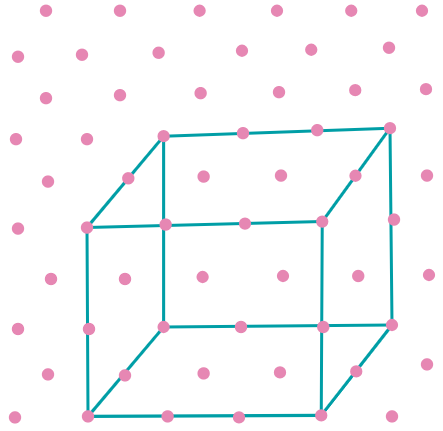
The process would look something like this:

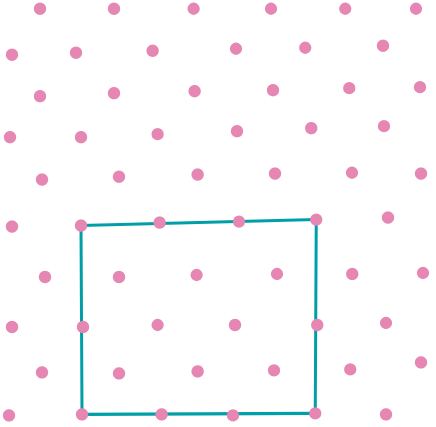
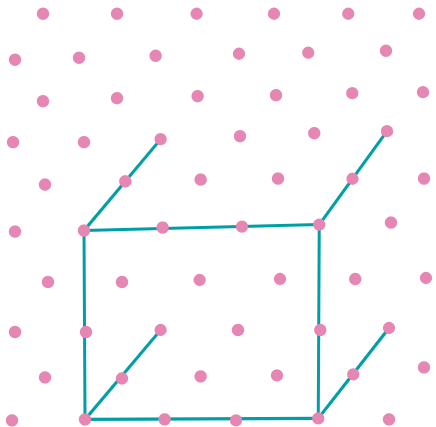
Note: In case of an isometric sketch, the measurements have the same dimension values, which is not necessarily the case, in an oblique sketch.
Here is an oblique sketch of a cuboid [Fig]. Draw an isometric sketch that matches this drawing.
How many units have you taken along (i) ‘length’?
(ii) ‘breadth’?
(iii) ‘height’?
Do they match with the units mentioned in the oblique sketch?