
Exercise 14.1
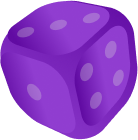
1. A dice has six faces numbered from 1 to 6. It is rolled and the number on the top face is noted. When this is treated as a random trial.
a) What are the possible outcomes?
b) Are they equally likely? Why?
c) Find the probability of a composite number turning up on the top face.
Sol:
(a) Number of possible outcomes of a dice are the total numbers on each face:
∴ Number of outcomes =
(b) Yes, they are equally likely because when the dice is rolled for a large number of times, the probability of each outcome to occur becomes
(c) Composite numbers between 1 and 6 are:
Total number of composite numbers =
Total number of possible outcomes =
∴ Probability of a composite number =
(c) Composite numbers is any positive integer
∴ Number of possible composite numbers in a dice are
∴ Number of possible outcomes =
Total number of outcomes in a dice is
2. A coin is tossed 100 times and the following outcomes are recorded:
Head: 45 times, Tails: 55 times from the experiment
a) Compute the probability of each outcomes.
b) Find the sum of probabilities of all outcomes.
Sol:
Given, A coin was tossed
Total number of heads =
Total number of tails =
(a) ∴ P(heads) = Number of outcomes of head/Total number of outcomes =
∴ P(tails) = Number of outcomes of tails/Total number of outcomes =
(b) Sum of probability of all outcomes =
3. A spinner has four colours as shown in the figure. When we spin it once, find
a) At which colour, is the pointer more likely to stop?
b) At which colour, is the pointer less likely to stop?
c) At which colours, is the pointer equally likely to stop?
d) What is the chance the pointer will stop on white?
e) Is there any colour at which the pointer certainly stops?
Sol:
Given, Total number of outcomes =
Number of outcomes for blue =
Number of outcomes for red =
Number of outcomes for yellow =
Number of outcomes for green =
∴ P(blue) = Number of possible outcomes for blue/Total number of outcomes =
P(red) =
P(yellow) =
P(green) =
(a) Since P(red) =
(b) Since P(yellow) =
(c) Since P(blue) =
(d) P(white) = Number of possible outcomes/Total number of outcomes =
(e)
4. A bag contains five green marbles, three blue marbles, two red marbles, and two yellow marbles. One marble is drawn out randomly.
a) Are the four different colour outcomes equally likely? Explain.
b) Find the probability of drawing each colour marble i.e., P(green), P(blue), P(red) and P(yellow).
c) Find the sum of their probabilities.
Sol:
Given, A bag contains:
- Green marbles =
- Blue marbles =
- Red marbles =
- Yellow marbles =
∴ Total number of marbles = 5 + 3 + 2 + 2 =
P(green) = Total possible outcomes of green/Total number of outcomes =
P(blue) =
P(red) =
P(yellow) =
(a)
(b) The probabilities are:
- P(green) =
5 12 - P(blue) =
1 4 - P(red) =
1 6 - P(yellow) =
1 6
(c) Sum of probabilities =
5. A letter is chosen from English alphabet. Find the probability of the letters being
a) A vowel
b) A letter that comes after P
c) A vowel or a consonant
d) Not a vowel
Sol:
Given, Total number of alphabets in English language =
Vowels in English language = a, e, i, o, u ∴ Total number of vowels =
(a) P(vowels) = Total number of vowels/Total number of alphabets =
(b) Letters that come after P are Q, R, S, T, U, V, W, X, Y, Z ∴ Total number of letters after P =
∴ P(a letter that comes after P) = Total number of letters after P/Total number of alphabets =
(c) Number of consonants = Number of alphabets – Number of vowels =
∴ P(a vowel or consonant) = (Total number of vowels + consonants)/Total number of alphabets =
(d) P(Not a vowel) = Total number of not vowels/Total number of alphabets =
6. Eleven bags of wheat flour, each marked 5 kg, actually contained the following weights of flour (in kg):
4.97, 5.05, 5.08, 5.03, 5.00, 5.06, 5.08, 4.98, 5.04, 5.07, 5.00
Find the probability that any of these bags chosen at random contains more than 5 kg of flour.
Sol:
Given, Total number of bags =
Number of bags containing more than 5 kg =
P(more than 5 kg bag) = Total number of bags containing more than 5 kg/Total number of bags =
7. An insurance company selected 2000 drivers at random (i.e., without any preference of one driver over another) in a particular city to find a relationship between age and accidents. The data obtained is given in the following table:
| Age of Drivers (in years) | 0 | 1 | 2 | 3 | More than 3 accidents |
|---|---|---|---|---|---|
| 18–29 | 440 | 160 | 110 | 61 | 35 |
| 30–50 | 505 | 125 | 60 | 22 | 18 |
| Over 50 | 360 | 45 | 35 | 15 | 9 |
Find the probabilities of the following events for a driver chosen at random from the city:
(i) The driver being in the age group 18-29 years and having exactly 3 accidents in one year.
(ii) The driver being in the age group of 30-50 years and having one or more accidents in a year.
(iii) Having no accidents in the year.
Sol:
Given, Total number of drivers selected =
(i) Total number of accident data collected for 18-29 years = 440 + 160 + 110 + 61 + 35 =
Number of drivers of age 18-29 years having exactly 3 accidents =
∴ P(drivers being age group 18-29 years having 3 accidents) =
(ii) Total number of accident data collected for 30-50 years = 505 + 125 + 60 + 22 + 18 =
Total number of accidents caused by drivers of age 30-50 = 125 + 60 + 22 + 18 =
∴ P(drivers of age 30-50 years having one or more accidents) =
(iii) Total number of data collected for all age groups = 806 + 730 + 360 + 45 + 35 + 15 + 9 =
Total number of drivers of all age groups causing no accidents = 440 + 505 + 360 =
∴ P(Having no accidents in a year) =
8. A dart board has a circular region inscribed in a square as shown in the figure. The radius of the circle is 2 cm. What is the probability that a randomly thrown dart hits the square board in the shaded region? (Use π = 22/7)
Sol:
Given,
- π = 22/7
- Radius of circle (r) =
cm
Area of square = Side × Side =
Area of circle = πr² =
Area of shaded region = Area of square - Area of circle =
∴ P(dart hitting shaded region) =