
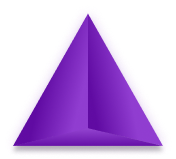
Two Special Triangles : Equilateral and Isosceles
In an equilateral triangle:
(i) all sides have
(ii) each angle has measure
Activity:
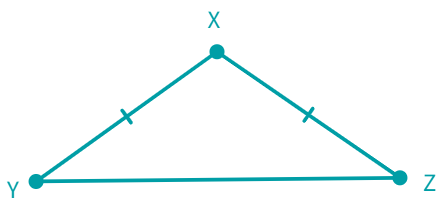
Using paper, cut out an isosceles triangle, say XYZ such that XY = XZ. Now fold it so that the Z vertex lies on the Y vertex. The line, say XM through X, is called the axis of symmetry. And we also find that ∠Y and ∠Z fit on each other
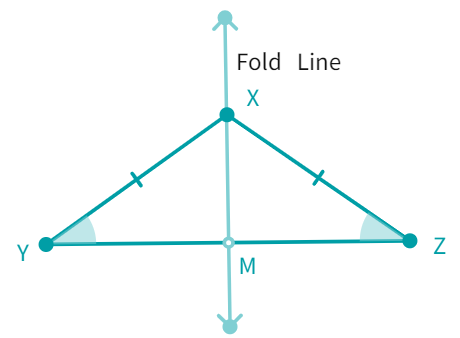
Thus, in an isosceles triangle:
(i) two sides have same length (i.e. XY and XZ are called
(ii) base angles opposite to the equal sides are
Therefore,
A triangle in which all the three sides are of equal lengths is called an
A triangle in which two sides are of equal lengths is called an
1. Find angle x in each figure:
a
Figure (i)
Solution:
Given angles:
Since the two base angles are
Thus, x = 40°.
b
Figure (ii)
Solution:
Given: One angle is 45° and the triangle is
The other base angle is also
x + 45° + 45° = 180°
x +
x = 180° - 90° =
Therefore, x = 90°
c
Figure (iii)
Solution:
Given: One angle is 50° and the triangle is
The other base angle is also
x + 50° + 50° = 180°
x +
x =
Therefore, x = 80°
d
Figure (iv)
Solution:
Given: Angles 100° , ∠x and the other ∠x.
Since the two angles are equal-
x + x + 100° = 180°
2x =
x =
Therefore, x = 40°
e
Figure (v)
Solution:
Given: Right angle 90°, ∠x and the other ∠x.
The sum of the angles in a triangle is
90° + x + x = 180°
90° +
2x =
x =
Therefore, x = 45°
f
Figure (vi)
Solution:
Given: Angle 40° and the other two angles x and x as the triangle is
The sum of the angles in a triangle is
x + x +
2x =
x =
Therefore, x = 70°
g
Figure (vii)
Solution:
Given: Angle 120° and the other two angles x and x (isosceles triangle).
The sum of the angles in a triangle is 180°
x + x +
2x =
x =
Therefore, x = 30°
h
Figure (viii)
Solution:
Given: Angle 110° and the other two angles x and x (isosceles triangle).
The sum of the angles in a triangle is 180°
x + x +
2x =
x =
Therefore, x = 35°
i
Figure (ix)
Solution:
Given: One exterior angle 30° which is equal to the sum of the two opposite interior angles.
The interior angles are x and x (isosceles triangle).
The sum of the angles in a triangle is 180°
x + x + (
2x +
2x =
x =
Therefore, x = 15°