

Exercise 13.1
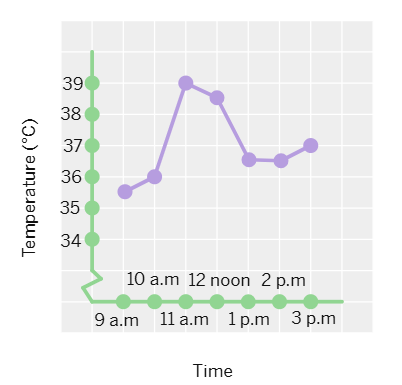
1. The following graph shows the temperature of a patient in a hospital, recorded every hour.
2. The following line graph shows the yearly sales figures for a manufacturing company.
(a) What were the sales in (i) 2002 (ii) 2006?
(i) 2002:
(b) What were the sales in (i) 2003 (ii) 2005?
(i) 2003:
(c) Compute the difference between the sales in 2002 and 2006.
The difference in the sales of 2002 and 2006 is
(d) In which year was there the greatest difference between the sales as compared to its previous year?
Solution:
(a) From the above graph we can conclude that:
Sales in 2002 = 4 crores
Sales in 2006 = 8 crores
Sales in 2003 = 7 crores
Sales in 2005 = 10 crores
(b) From the graph we can see that:
Sales in 2002 = 4 crores and
Sales in 2006 = 8 crores
Therefore,
Difference of sales = 8 - 4 = Rs. 4 crores
(c) We can observe that the year 2005 has the greatest difference in sales compared to its previous year (2004) with the difference being Rs. 10 crores – Rs. 6 crores = Rs. 4 crores
3. For an experiment in Botany, two different plants, plant A and plant B were grown under similar laboratory conditions. Their heights were measured at the end of each week for 3 weeks. The results are shown by the following graph.
(a) How high was Plant A after:
(i) 2 weeks
(ii) 3 weeks ?
(b) How high was Plant B after:
(i) 2 weeks
(ii) 3 weeks?
(c) How much did Plant A grow during the 3rd week?
(d) How much did Plant B grow from the end of the 2nd week to the end of the 3rd week?
(e) During which week did Plant A grow most?
(f) During which week did Plant B grow least?
(g) Were the two plants of the same height during any week shown here? Specify
Solution:
(a) From the above graph we can conclude:
(i) Plant A is 7 cm long after 2 weeks.
(ii) Plant A is 9 cm long after 3 weeks.
(b)
(i) Plant B is 7 cm long after 2 weeks.
(ii) Plant B is 10 cm long after 3 weeks.
(c) Plant A grew by 2 cm during 3rd week as 9 cm (3rd week end) – 7 cm (2nd week end) = 2
(d) Plant B grew by 10 cm (3rd week end ) – 7 cm (2nd week end) = 3 cm
(e) Plant A grew the most during the second week (difference of 5 cm).
(f) Plant B grew the least during first week (only 1 cm height gain).
(g) We can see that at the end of the second week, plants A and B were of the same height, that is 7 cm.
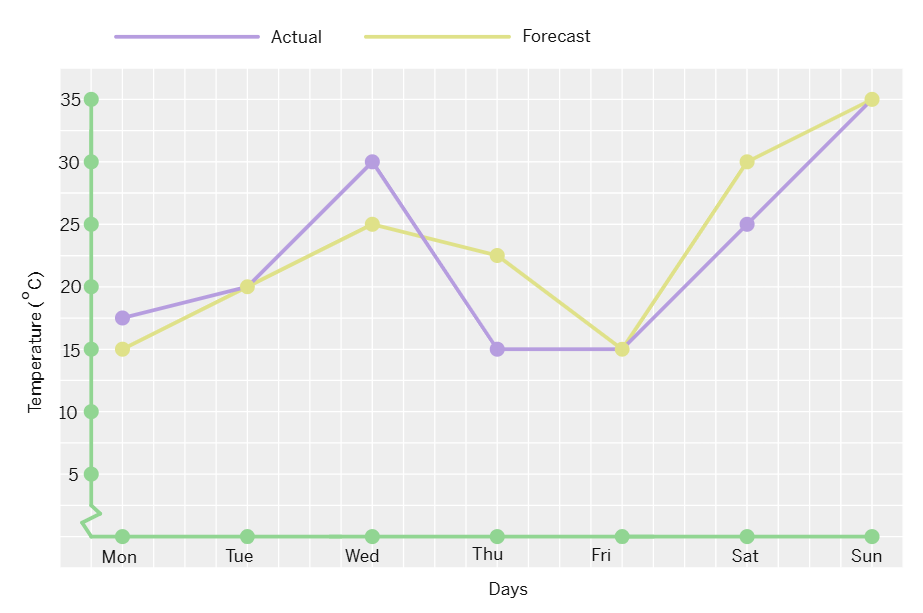
4. The following graph shows the temperature forecast and the actual temperature for each day of a week.
5. Use the tables below to draw linear graphs.
(a) The number of days a hill side city received snow in different years
| Year | Days |
|---|---|
| 2003 | 8 |
| 2004 | 10 |
| 2005 | 5 |
| 2006 | 12 |
Join the coloured data points with straight lines.
(b) Population (in thousands) of men and women in a village in different years.
| Year | Number of Men | Number of Women |
|---|---|---|
| 2003 | 12 | 11.3 |
| 2004 | 12.5 | 11.9 |
| 2005 | 13 | 13 |
| 2006 | 13.2 | 13.6 |
| 2007 | 13.5 | 12.8 |
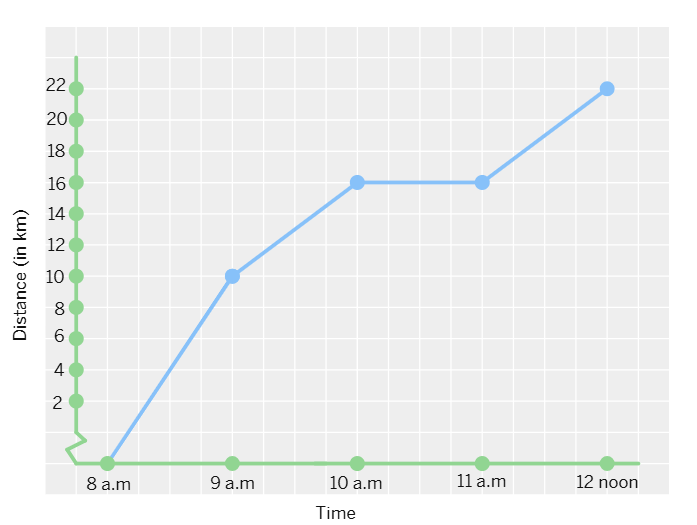
6. A courier-person cycles from a town to a neighbouring suburban area to deliver a parcel to a merchant. His distance from the town at different times is shown by the following graph.
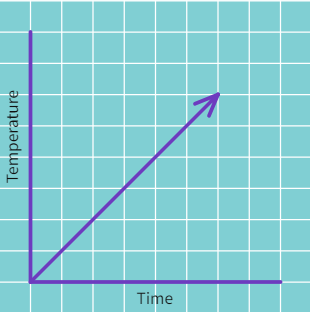
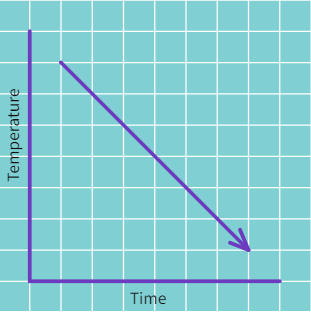
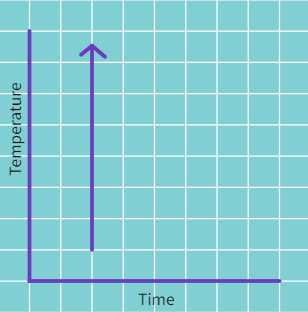
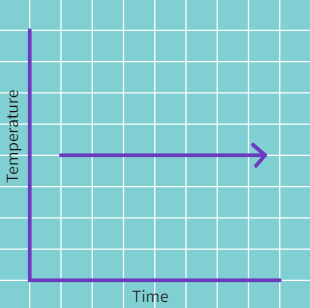
7. Can there be a time-temperature graph as follows? Justify your answer
(a)
(b)
(c)
(d)
Solution:
(i) Yes, as it is showing the increase in temperature as time increases.
(ii) Yes, as it is showing the decrease in temperature as time increases.
(iii) No, as it is showing a very rapid instanteneous rise in temperature which isn't possible.
(iv) Yes, as it is showing a constant temperature being maintained at all recorded times.