
Innings2
Powered by Innings 2

Glossary

Select one of the keywords on the left…

Chapter 3: Number Play > Introduction

Introduction

Numbers are used in different contexts and in many different ways to organise our lives. We have used numbers to count, and have applied the basic operations of addition(+), subtraction(-), multiplication(×) and division(÷) on them, to solve problems related to our daily lives.

In this chapter, we will continue this journey, by playing with numbers, seeing numbers around us, noticing patterns, and learning to use numbers and operations in new ways.

  • Think about various situations where we use numbers.

List five different situations in which numbers are used.

See what your classmates have listed, share, and discuss in below?

What are these numbers telling us?

Some children are standing in a line. Each one says a number.
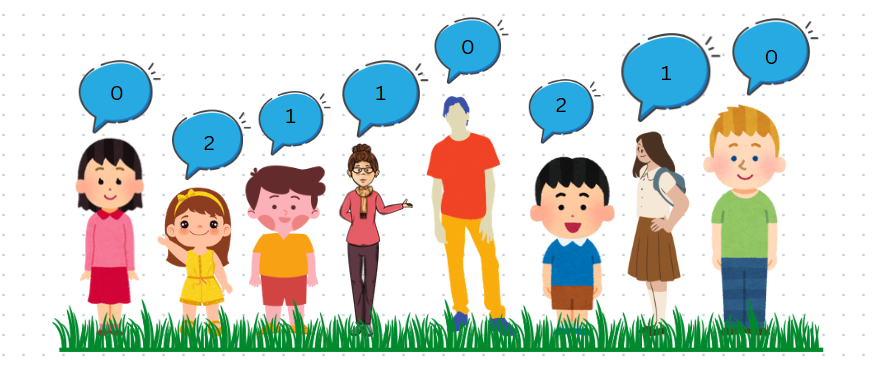
What do you think these numbers mean?

The children now rearrange themselves, and again each one says a number based on the arrangement.
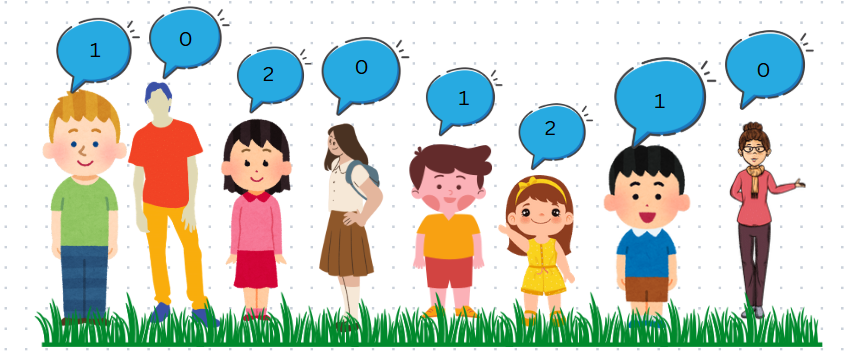
Did you figure out what these numbers represent?

Hint : Their heights be playing a role

A child says ‘1’ if there is only one taller child standing next to them.

A child says ‘2’ if both the children standing next to them are taller.

A child says ‘0’, if neither of the children standing next to them are taller.

That is each person says the number of neighbours they have.

Try answering the questions below and share your reasoning.

Instruction

1. Can the children rearrange themselves so that the children standing at the ends say ‘2’?
Ans: , the children can rearrange themselves so that the children standing at the ends say ‘2’.
As long as two children are assigned the number ‘2’, they can be positioned at the of the line.
2. Can we arrange the children in a line so that all would say only 0s?
Ans: , the children cannot all say ‘0s’ unless all of them are assigned the number .
Based on the image, it appears the numbers are predetermined as 0, 1, and 2, so it is to have all of them saying only 0.
3. Can two children standing next to each other say the same number?
Ans: , two children standing next to each other can say the same number, as long as they are assigned the same number in the sequence.
There is no restriction against adjacent children saying the number.
4. There are 5 children in a group, all of different heights. Can they stand such that four of them say ‘1’ and the last one says ‘0’? Why or why not?
Ans: , it is not possible for four children to say ‘1’ and the last one to say ‘0’, as the pattern in the image includes more than just 1s and 0s (it includes 2s as well).
Based on the existing set of numbers (0, 1, 2), you cannot assign ‘1’ to four children while leaving child with ‘0’.
5. For this group of 5 children, is the sequence 1, 1, 1, 1, 1 possible?
Ans: , the sequence 1, 1, 1, 1, 1 is not possible, as the pattern involves a variety of numbers (0, 1, and 2), and all the children cannot be assigned the same number, in this case, all 1s.
6. Is the sequence 0, 1, 2, 1, 0 possible? Why or why not?
Ans: , the sequence 0, 1, 2, 1, 0 is possible. This sequence follows a valid pattern where each child can be assigned one of the numbers 0, 1, or 2. The pattern repeats but still includes the available numbers.
7. How would you rearrange the five children so that the maximum number of children says ‘2’?
Ans: To maximise the number of children saying ‘2’, you would arrange the children so that as many as possible are assigned the number .
If there are no restrictions, and based on how the numbers are assigned, you could potentially arrange the children so that 3 out of say ‘2’, while the remaining two children could be assigned or .