
Innings2
Powered by Innings 2

Glossary

Select one of the keywords on the left…

Chapter 3: Number Play > Super Cells

Super Cells

Observe the numbers written in the table below.

Why are some numbers coloured? Discuss.
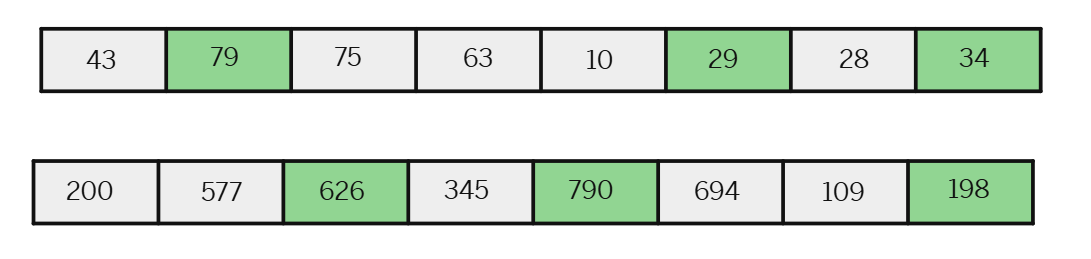
A cell is coloured if the number in it is larger than its adjacent cells. The number 626 is coloured as it is larger than and , whereas 200 is not coloured as it is smaller than .

The number 198 is coloured as it has only one adjacent cell with in it, and 198 is larger than .

1. Find the supercells in the table below.

Supercells : , ,

2. Fill the table below with only 4-digit numbers such that the supercells are exactly the 🔵 coloured cells.

5346🔵 🔵 12589635🔵

3. Fill the table below such that we get as many supercells as possible. Use numbers between 100 and 1000 without repetitions.

4. Out of the 9 numbers, how many supercells are there in the table above?

Out of 9 numbers, there are supercells in the above table

5. Find out how many supercells are possible for different numbers of cells.
Do you notice any pattern? What is the method to fill a given table to get the maximum number of supercells? Explore and share your strategy.
If there are n odd cells then number of supercells = n+12
If there are n even cells then number of supercells = n2
, there is a pattern. Alternate cells can be supercells.
Method to fill a given table to get the maximum number of supercells.
Make first cell as supercell. After that each alternate cell is to be made supercell.
No consecutive cells can be supercell except in case of cells because then first and fourth cell can be supercell.
6. Can you fill a supercell table without repeating numbers such that there are no supercells? Why or why not?
, it is not possible to fill a supercell table without repeating numbers such that there are no supercells.
As there are two cases: Case I: If we fill the cells in descending order then the first cell be .
Case II: If we fill the cells in order then the last cell will be supercell.
If we don’t follow any order, then there will atleast one supercell.
7. Will the cell having the largest number in a table always be a supercell? Can the cell having the smallest number in a table be a supercell? Why or why not?
, the cell having the largest number in a table always be a supercell because if it is comer cell, then the number adjacent to it will be smaller than it. If it is in between then both its adjacent numbers would be smaller than it.
, the cell having a smallest number in a table can not be a supercell because the number adjacent to it will always be larger/greater than it.

8. Identify the cell having the second largest number is not a supercell.

Here is the second largest number but it is not a supercell as is the supercell.

9. Fill a table such that the cell having the second largest number is not a supercell but the second smallest number is a supercell. Is it possible?

Here 1870 is the second largest number but the cell having 1870 is not a supercell because number (adjacent to it) is greater than it.

489 is the second smallest number but the cell having 489 is a supercell because adjacent number is smaller to it.

10. Make other variations of this puzzle and challenge your classmates.

Let’s do the supercells activity with more rows.

Here the neighbouring cells are those that are immediately to the left, right, top and bottom.
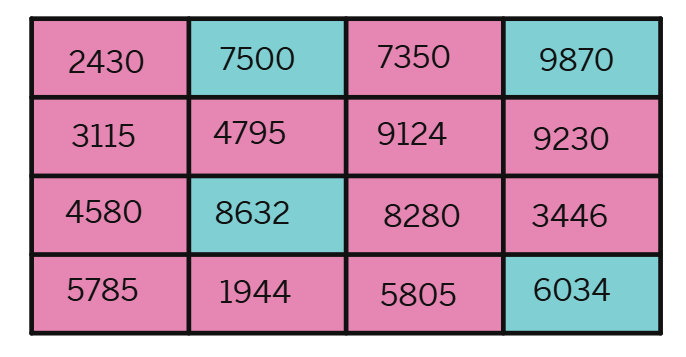
The rule remains the same: A cell becomes a supercell if the number in it is than all the numbers in its neighbouring cells.

In Table is greater than all its neighbours 4580, 8280, 4795 and 1944.

Complete Table with 5-digit numbers whose digits are ‘1’, ‘0’, ‘6’, ‘3’, and ‘9’ in some order. Only a 🟨 coloured cell should have a number greater than all its neighbours.

🟨96,30136,109🟨
13,609🟨60,31919,306
60,193
🟨10,963🟨

The biggest number in the table is .

The smallest even number in the table is .

The smallest number greater than 50,000 in the table is .

Once you have filled the table above, put commas appropriately after the thousands digit.