

Relations among Number Sequences
Sometimes, number sequences can be related to each other in surprising ways.
Example: What happens when we start adding up odd numbers?
1 =
1 +
1 +
1 +
1 +
1 +
This is a really beautiful pattern!
Can you see the pattern? Sum of 1 odd number is 1. Sum of 2 odd numbers is
Why does this happen? Do you think it will happen forever?
The answer is that the pattern does happen forever. But why?
As mentioned earlier, the reason why the pattern happens is just as important and exciting as the pattern itself.
A picture can explain it. Visualising with a picture can help explain the phenomenon. Recall that square numbers are made by counting the number of dots in a square grid.
How can we partition the dots in a square grid into odd numbers of dots: 1, 3, 5, 7,... ?
Think about it for a moment before reading further!
Here is how it can be done:
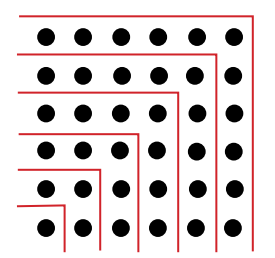
This picture now makes it evident that
1 + 3 + 5 + 7 + 9 + 11 =
Because such a picture can be made for a square of any size, this explains why adding up odd numbers gives square numbers.
By drawing a similar picture, can you say what is the sum of the first 10 odd numbers?
Now by imagining a similar picture, or by drawing it partially, as needed, can you say what is the sum of the first 100 odd numbers?
Another example of such a relation between sequences:
Adding up and down
Let us look at the following pattern:
1 = 1
1 + 2 + 1 =
1 + 2 +
1 + 2 + 3 +
1 + 2 + 3 + 4 +
1 + 2 + 3 + 4 + 5 +
This seems to be giving yet another way of getting the square numbers— by adding the counting numbers up and then down!
Can you find a similar pictorial explanation?
Counting numbers up and down
(2) By imagining a large version of your picture, or drawing it partially, as needed, can you see what will be the value of 1 + 2 + 3 + ... + 99 + 100 + 99 + ... + 3 + 2 + 1?
(3) Which sequence do you get when you start to add the All 1’s sequence up? What sequence do you get when you add the All 1’s sequence up and down?
(4) Which sequence do you get when you start to add the counting numbers up? Can you give a smaller pictorial explanation?
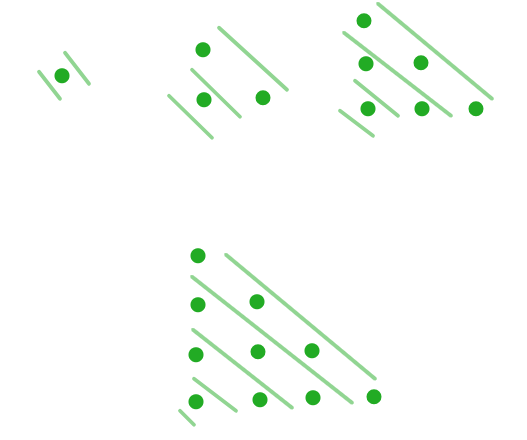
(5) What happens when you add up pairs of consecutive triangular numbers? That is, take 1 + 3, 3 + 6, 6 + 10, 10 + 15, … Which sequence do you get? Why? Can you explain it with a picture?
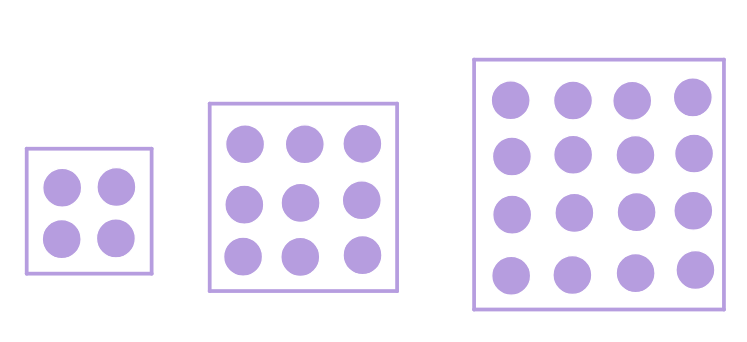
(6) What happens when you start to add up powers of 2 starting with 1, i.e., take 1, 1 + 2, 1 + 2 + 4, 1 + 2 + 4 + 8, … ? Now add 1 to each of these numbers — what numbers do you get? Why does this happen?
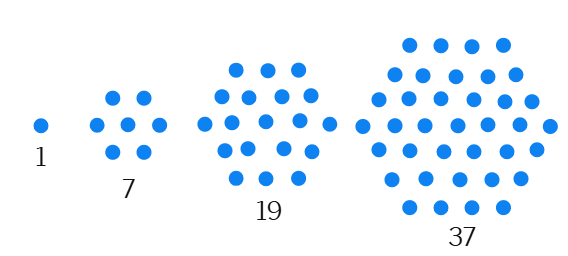
(7) What happens when you multiply the triangular numbers by 6 and add 1? Which sequence do you get? Can you explain it with a picture?
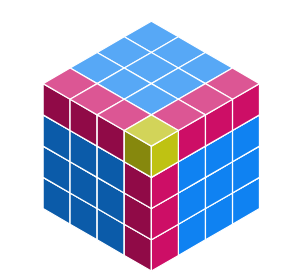
(8) What happens when you start to add up hexagonal numbers, i.e., take 1, 1 + 7, 1 + 7 + 19, 1 + 7 + 19 + 37, … ? Which sequence do you get? Can you explain it using a picture of a cube?

(9) Find your own patterns or relations in and among the sequences in Table 1. Can you explain why they happen with a picture or otherwise?