
Visualising Number Sequences
Many number sequences can be visualised using pictures. Visualising mathematical objects through pictures or diagrams can be a very fruitful way to understand mathematical patterns and concepts. Let us represent the first seven sequences in Table 1 using the following pictures.
| n1 | n2 | n3 | n4 | n5 | Sequence Type |
|---|---|---|---|---|---|
 | | | | | All 1’s |
 |  |  |  |  | Counting numbers |
 |  |  |  |  | Odd numbers |
 |  |  |  |  | Even numbers |
 |  |  |  |  | Triangular numbers |
 |  |  |  |  | Squares |
 | 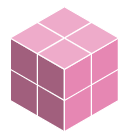 | 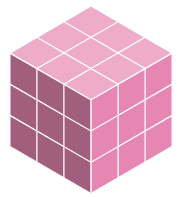 | 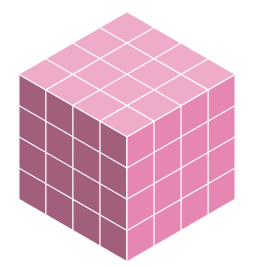 | 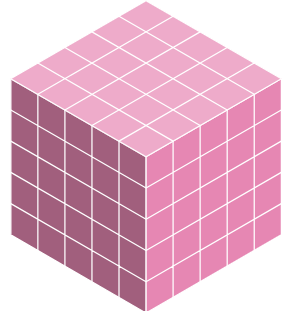 | Cubes |
🎯 Sequence Master 🎯
Welcome to Sequence Master!
Select a sequence type above to see how it works. Watch the patterns appear with animation and learn visually!
🔺 Triangle Arrangement Challenge
Figure it Out
(1) Place the picture for each sequence in the correct box.
Visualising Square Numbers
Visualising Triangular Numbers
1
3
6
10
15
21
If we use polygons with 6 sides, we get the sequence of Hexagonal numbers.
(2) Why are 1, 3, 6, 10, 15, … called triangular numbers? Why are 1, 4, 9, 16, 25, … called square numbers or squares? Why are 1, 8, 27, 64, 125, … called cubes?
(3) You will have noticed that 36 is both a triangular number and a square number! That is, 36 dots can be arranged perfectly both in a triangle and in a square. Make pictures in your notebook illustrating this!
This shows that the same number can be represented differently, and play different roles, depending on the context. Try representing some other numbers pictorially in different ways!
(4) What would you call the following sequence of numbers?
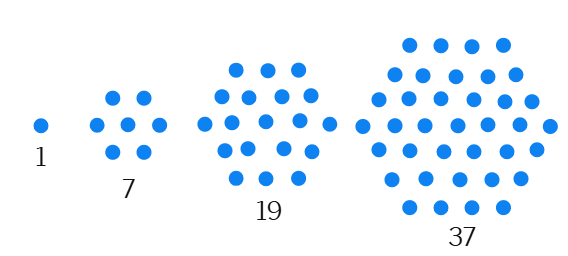
That’s right, they are called hexagonal numbers! Draw these in your notebook. What is the next number in the sequence?
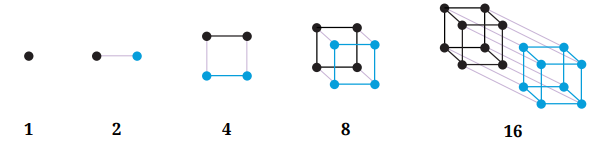
(5) Can you think of pictorial ways to visualise the sequence of Powers of 2? Powers of 3?
Here is one possible way of thinking about Powers of 2: