
Introduction
In the previous chapter, we have studied about trigonometric ratios. In this chapter, we will be looking at some ways in which trigonometry is used in the life around you.

Looking at a tower
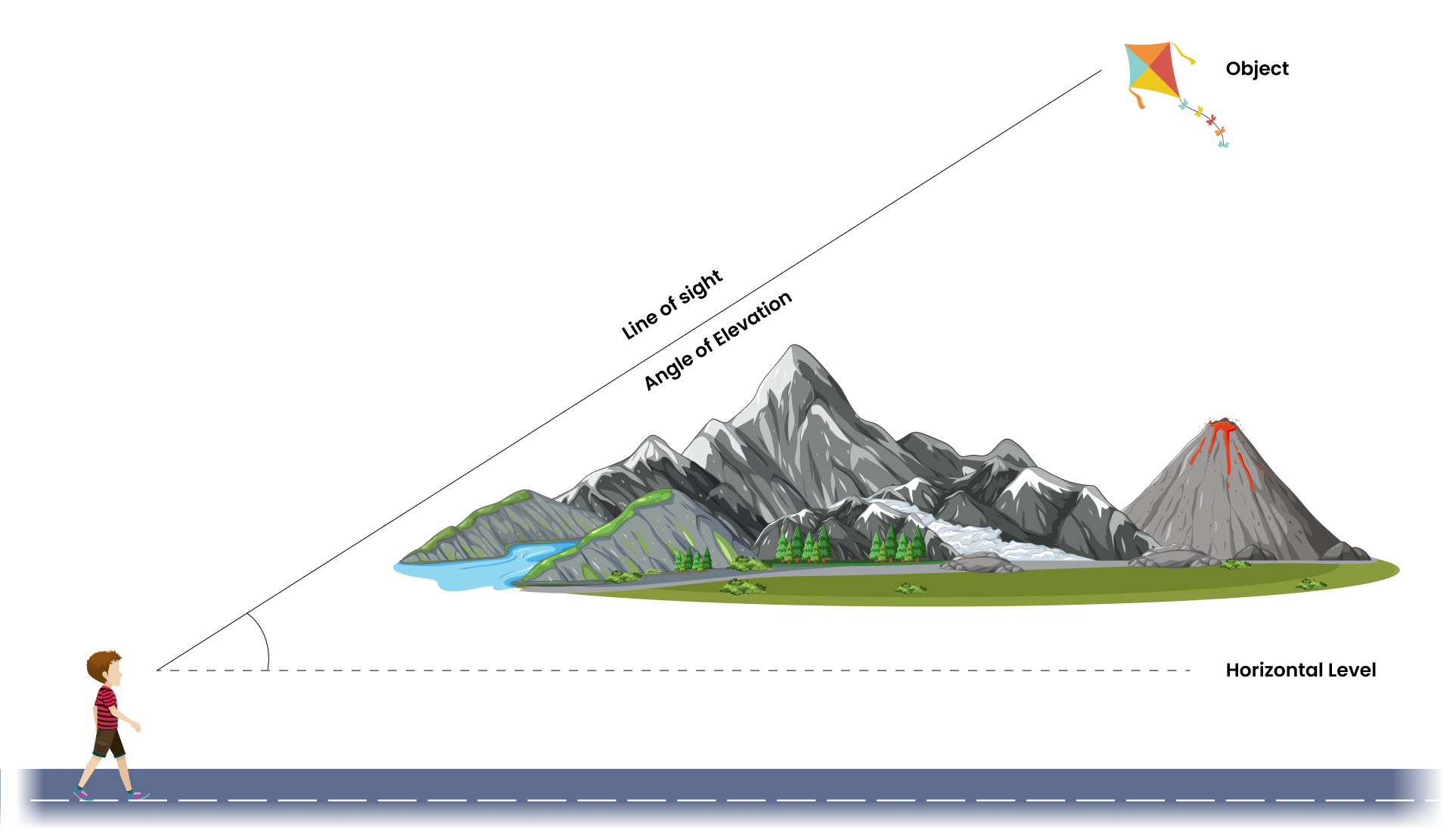
Say we are looking at the top of a tower. From our eye level a line can be drawn to the top of the tower which is called the line of sight. This line of sight makes an angle with the horizontal, which is called the angle of elevation of the top of the tower from the eye of the observer i.e. when we raise our head to look at the object.
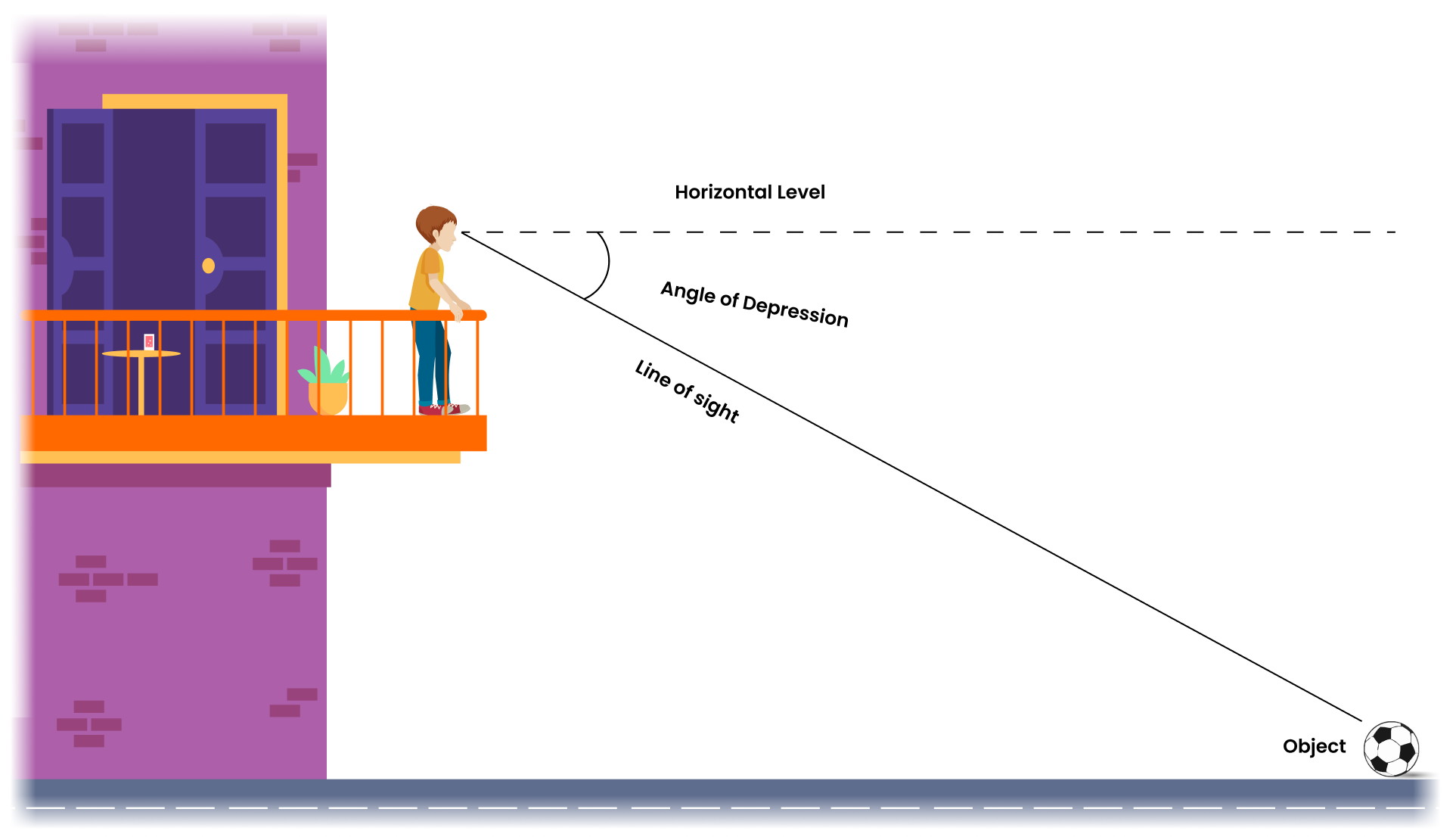
Now, look at the reverse case. Say, somebody is looking at us from the top of the tower In this case, the line of
sight (drawn from the eye of the observer) is below the reference
The angle so formed by the line of sight with the horizontal is called the angle of depression.
Thus, the angle of depression of a point on the object being viewed is the angle formed by the line of sight with the horizontal when the point is below the horizontal level, i.e., the case when the observer lowers their head to look at the point being viewed.
Now, let's look at the figure given below.
A person is looking at the top of the hill from the ground level and another person is watching the ground from the top of the hill.
Can you identify the lines of sight, and the angles so formed in the figure?
What are the angles of elevation (or) angles of depression?
Angle of elevation :
In this figure, the line AB drawn from the eye of A to the top of the mountain is called the line of sight. A is looking at the top of the mountain. ∠CAB is called the
Now, consider the situation of B. B is standing on the moutain and looking down at A. In this case, the line of sight is
If we want to find the height of the mountain i.e. line BC without actually measuring it, what information do we need? We would need to know the following:
(i) the distance AC at which the ground observer is standing from the foot of the mountain
(ii) the angle of elevation: ∠ CAB of the top of the mountain
(iii) the height of the ground observer (AE).
We need the height of observer because we need to add that as the triangle is formed only till the horizontal level.
Assuming that the above three conditions are known, can we determine the height of the mountain?
Given that we know the distance AC and the angle: the trigonometric ratio that can be used to find the height is
So, the height of the mountain is :