
Centroid Triangle
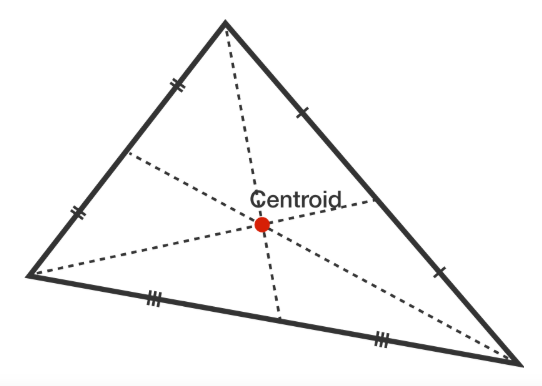
Here you can see a triangle as well as the
What happens as you move the vertices of the triangle?
It seems like the medians always
This point is called the centroid.
We know:
The
A
The centroid divides each median in the ratio
Keeping this in mind, we get:
If a triangle has vertices at A(
G = (
How do we get this?
Given: Let triangle ABC have vertices at: A(
Step 1: Find the Midpoint of Side BC
The median from vertex
Let's call this midpoint D. Using the midpoint formula: D = (
Step 2: Apply the Key Property of Centroids
The centroid G
This means: AG : GD = 2 : 1
In other words, G divides the line segment joining A and D in the ratio 2:1.
Step 3: Apply the Section Formula
When a point divides a line segment joining two points internally in a given ratio, we use the section formula.
For a point dividing the line joining A(
G = (
where m =
Step 4: Calculate the x-coordinate of G
x-coordinate of G =
Step 5: Calculate the y-coordinate of G
y-coordinate of G =
Therefore, the centroid of a triangle with vertices A(
G = (
Example 1: Find the centroid of a triangle with vertices at A(1, 4), B(5, -2), and C(-3, 8).
Solution: Using the centroid formula:
x-coordinate:
y-coordinate:
Therefore, the centroid is at G(1,
Example 2: Find the ratio in which the point (2, 1) divides the line segment joining A(-1, 3) and B(8, -3).
Solution:
Let the ratio be m:n. Using the section formula:
For x-coordinate: 2 =
2m + 2n = 8m - n
Therefore m:n = 1:2
Verification with y-coordinate: 1 =
With m = 1, n = 2:
The ratio is 1:2. So, we have verified the result!
Example 3: Find the ratio in which the x-axis divides the line segment joining points A(3, 8) and B(-5, -4). Also find the point of intersection.
Solution:
Let the ratio be k:1. The point on the x-axis has y-coordinate =
Using section formula for y-coordinate:
So the ratio is 2:1.
Finding the intersection point using x-coordinate: x =
The point of intersection is (
Example 4: Show that the points P(2, 1), Q(5, 4), R(8, 3), and S(5, 0) form a parallelogram.
Solution: For a parallelogram, the midpoints of diagonals PR and QS must be
Midpoint of PR = (
Midpoint of QS = (
Since both midpoints are equal, PQRS is a parallelogram.
Example 5: If A(4, 2), B(7, 5), C(10, 6), and D(q, r) are vertices of a parallelogram, find the values of q and r.
Solution: The midpoint of AC will be the same as the midpoint of
Midpoint of AC = (
Midpoint of BD = (
Equating:
Therefore, D(7, 3).