
Measuring of an Angles
In the previous section, we made a tester to help classify angles into the different categories. But as always, apart from the general classification, values are required when dealing with these basic concepts in the real-life scenario.
In order to be more precise in comparison, we need to ‘measure’ the angles and that can be done with the help of a ‘protractor’.
An unit of angle is a degree. A degree, symbolized as "°", is a unit of measurement for angles. One degree represents
Think discuss and write
How many degrees are there in full a revolution? A full rotation is
Let's continue to measuring angles.
Paper Tester for Measuring Angles
Similar to what we did in the previous section to classify angles using the "right-angle-tester" , we will do something similar to narrow down the range in which a said angle's value may lie.
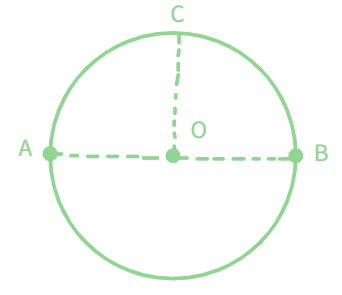
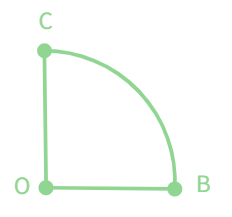
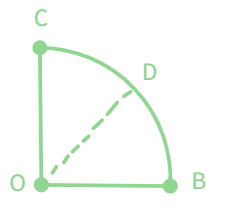
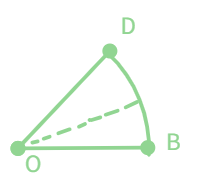
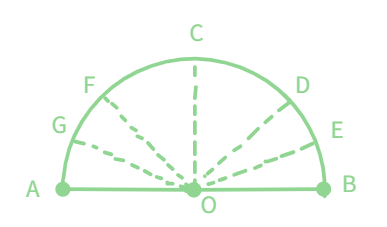
Now, we have a do-it-yourself protractor which will help us get a rough idea about the range of the angle being measured.
Protractor
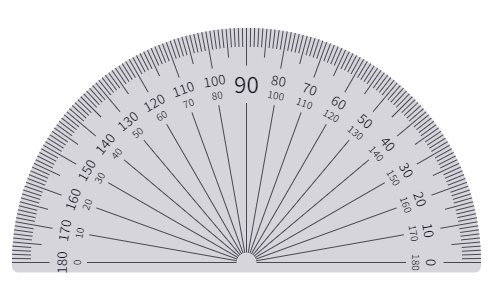
The curved edge of a protractor is divided into 180 equal parts. Each part is equal to a ‘degree’. The markings start from 0° on the right side and ends with 180° on the left side, and vice-versa.
Now, take an angle AOB, as shown below
Angle AOB
In order to measure a given angle:
Place the protractor so that the mid point of its straight edge lies on the vertex O of the angle.
Adjust the protractor so that OA is along the straight-edge of the protractor.
There are two ‘scales’ on the protractor : read that scale which has the 0° mark coinciding with the straight-edge i.e. OA.
The mark on the curved edge gives the degree measure of the angle at the point where the angle arm OB coincides with the corresponding marking.
How many degrees are there in half a revolution?
In one right angle?
In one straight angle?
How many right angles make 180° and 360° respectively?
Let's Solve
1. Draw the angle for the given measure angles by using protractor like in the below figure:
(i) Draw an angle named ∠AOB with the angle measure = 90°
(ii) Draw an angle named ∠AOC with the angle measure = 135°
(iii) Draw an angle named ∠DOB with the angle measure = 180°
Instructions: Use the "Draw Line" option given on the top panel to draw the "arms of the angles" and use the rotation button to align the lines accordingly. Under the "Utensils" dropwdown (given in the side panel), drag the protractor to use it for angle measurment. Make the angles according to the measurements given above. You can use the "Paint" option for the angle naming.