

Symmetry
An object is symmetric if it looks the same, even after applying a certain transformation.

We can reflect this butterfly, and it looks the same afterwards. We say that it has reflectional symmetry.
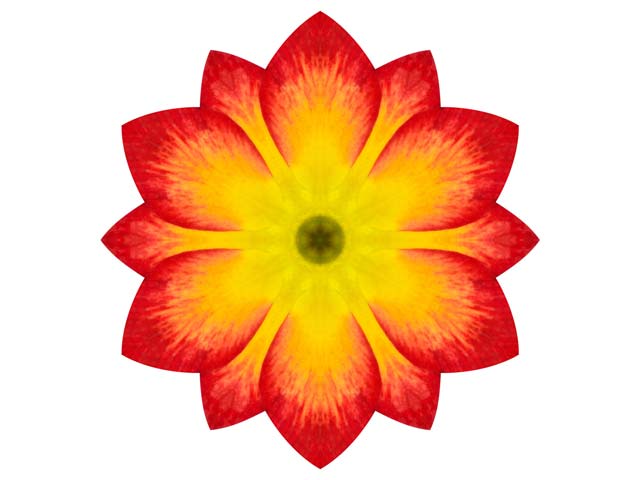
We can rotate this flower, and it looks the same afterwards. We say that it has rotational symmetry.
Line Symmetry
You know that a polygon is a closed figure made of several
The
A polygon is said to be regular if all its sides are of
Thus, an
Can you name the regular polygon of four sides?
An equilateral triangle is regular because each of its sides has same length and each of its angles measures
A
If a
A regular hexagon has all its sides equal and each of its angles measures
The regular polygons are symmetrical figures and hence their lines of symmetry are quite interesting,
Each regular polygon has as many lines of symmetry as it has sides. We say, they have
In the below given regular polygons, draw their respective axes of symmetry and add in the number of axes possible in the provided blanks
Equilateral triangle has
A square has
A regular pentagon has
A regular hexagon has
Rotational Symmetry
What do you say when the hands of a clock go round?
You say that they rotate. The hands of a clock rotate in only
Rotation, like movement of the hands of a clock, is called a clockwise rotation; otherwise it is said to be anticlockwise.
What can you say about the rotation of the blades of a ceiling fan? It rotates in a
If you spin the wheel of a bicycle, it rotates. It can rotate in either way: both clockwise and anticlockwise.
When an object rotates, its shape and size do not change. The rotation turns an object about a fixed point. This fixed point is the centre of rotation.
The angle of turning during rotation is called the angle of rotation. A full turn, you know, means a rotation of 360°.
A half-turn means rotation by

We can rotate this paper wind mill, and it looks the same afterwards. We say that it has rotational symmetry.
Have you ever made a paper windmill? The Paper windmill in the picture looks symmetrical but you do not find any line of symmetry. No folding can help you to have coincident halves. However if you rotate it by 90° about the fixed point, the windmill will look exactly the same. We say the windmill has a
In a full turn, there are precisely four positions (on rotation through the angles 90°, 180°, 270° and 360°) when the windmill looks exactly the same. Because of this, we say it has a rotational symmetry of order 4. Here is one more example for rotational symmetry.
Consider a square with A,B,C,D as of its corners.
Let us perform quarter-turns about the centre of the square marked x.
Thus a square has a rotational symmetry of order 4 about its centre. Observe that in this case,
(i) The centre of rotation is the
(ii) The angle of rotation is
(iii) The direction of rotation is
(iv) The order of rotational symmetry is
The point where we have the pin is the centre of rotation. It is the intersecting point of the diagonals in this case.
Every object has a rotational symmetry of order
You have around you many shapes, which possess rotational symmetry
For example, when you slice certain fruits, the cross-sections are shapes with rotational symmetry. This might surprise you when you notice them
Patterns
In the previous sections, we saw two different kinds of symmetry corresponding to two different transformations: rotations and reflections. But there is also a symmetry for the third kind of rigid transformation: translations.
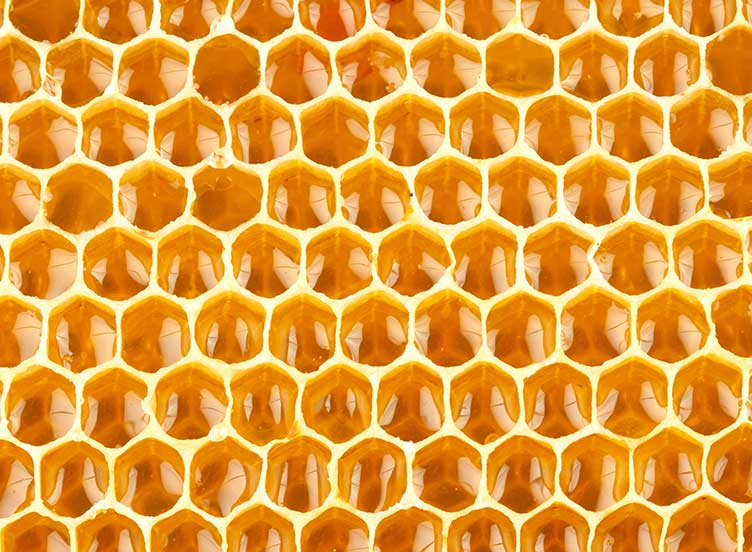
Hexagonal honyecomb
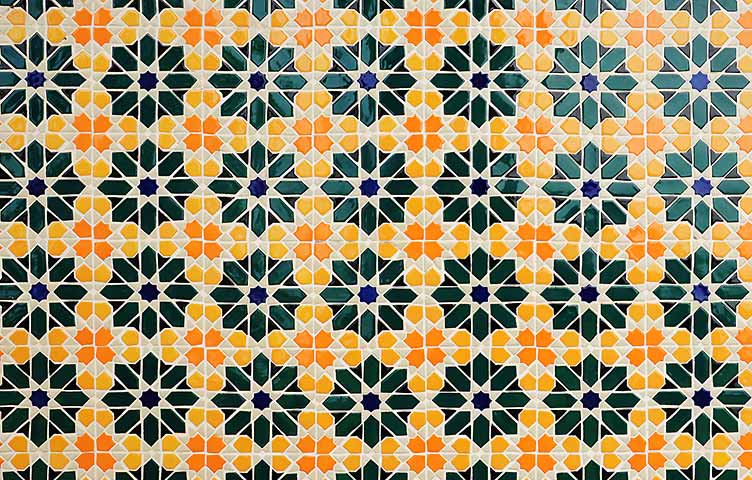
Ceramic wall tiling
In addition to reflectional, rotational and translational symmetry, there even is a fourth kind: glide reflections. This is a combination of a reflection and a translation in the same direction as the axis of reflection.
