

Cube
In the case of cuboid, the length, breadth and height is assumed to be of unequal numerical values. But if
length(l) = breadth(b) = height (h) for a cuboid
We get a cube. Just like a cuboid, a cube also has a total number of 6 faces but each face is a square, instead of a rectangle. We already know that the area of a square with side length 'a' is:
Thus,
Total surface area of cube =
The total surface area of a cube = 6a2 where, a is the length of a side.
Find the surface area of cube A and lateral surface area of cube B.
How will you arrange 12 cubes of equal length to form a cuboid of smallest surface area?
- The possible arrangements include:
12 × 1 × 1 ,2 × 3 × 2 and6 × 2 × 1 - Calculating the surface area for each:
- For:
12 × 1 × 1 =cm 2 2 × 3 × 2 =cm 2 6 × 2 × 1 =cm 2 - Thus, we have found the arrangement with the smallest surface area i.e.
Two cubes each with side b are joined to form a cuboid.
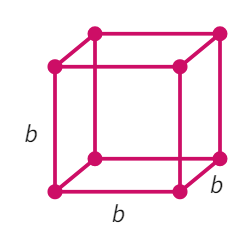
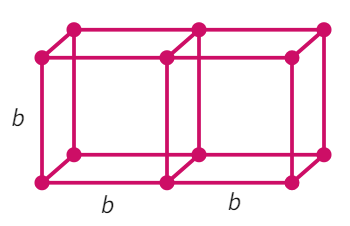
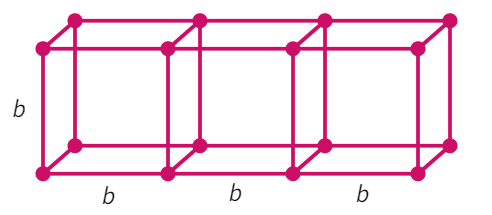
- When two cubes are together: l =
, b = and h = - Thus, surface area of this cuboid:
- When three cubes are put together: l =
, b = and h = - Thus, surface area of the second cuboid:
- We have found the desired answers.
Lateral surface area (cuboid) = Base Perimeter × h
In general,
The formulae of Lateral Surface Area for cube, cuboid and cylinder is base perimeter multiplied into height.
Find the surface area and the lateral surface area of a cube of side equal to 5 units.
- We know that, total surface area of cube:
unit 2 - And the lateral surface area of cube:
unit 2 - Substituting the value we get
- Total surface area of cube:
unit 2 - Lateral surface area of cube:
unit 2 - We got the respective results.
If the cube in the previous question is elongated to a height of 10 units, it becomes a
- We know that, total surface area of cuboid of length(l), breadth(b) and height(h):
unit 2 - And the lateral surface area of cuboid:
unit 2 - Substituting the values we get
- Total surface area of cuboid:
unit 2 - Lateral surface area of cuboid:
unit 2 - We have found the respective results.