

Polynomials in One Variable
Let us begin by recalling that a variable is denoted by a symbol that can take any real value. We use the letters x, y, z, etc. to denote variables. Notice that 2x, 3x, – x, -
All these expressions are of the form (a constant) ×
Now suppose we want to write an expression which is (a constant) × (a variable) and we do not know what the constant is. In such cases, we write the constant as a, b, c, etc. So the expression will be ax, say.
However, there is a difference between a letter denoting a constant and a letter denoting a variable. The values of the constants
Now, consider a square of side 3 units. What is its perimeter? You know that the perimeter of a square is the sum of the lengths of its
Here, each side is 3 units. So, its perimeter is 4 × 3, i.e.,
What will be the perimeter if each side of the square is 10 units?
The perimeter is 4 × 10, i.e., 40 units.
In case the length of each side is x units (see Fig. 2.2), the perimeter is given by 4x units. So, as the length of the side varies, the perimeter varies.
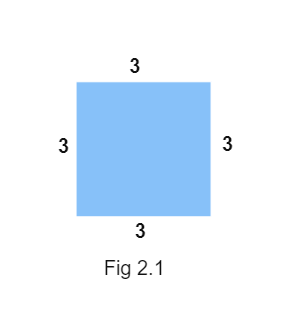
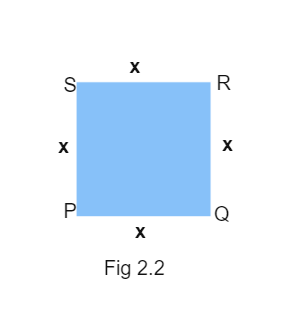
Can you find the area of the square PQRS? It is x × x =
In the examples above, the variable is x. For instance,
In the polynomial
Similarly, the polynomial
Can you write the terms of the polynomial
Each term of a polynomial has a coefficient. So, in
Let us consider these examples:
In fact, -2, 7 are examples of constant polynomials.
If a constant of a polynomial is 0 then the polynomial is called the zero polynomial. This plays a very important role in the collection of all polynomials, as you will see in the higher classes.
Example :
Drop the zero and nonzero polynomials into the concerned boxes.
Now, consider algebraic expressions such as x +
A polynomial can have any (finite) number of terms. For instance,
Consider the polynomials:
Do you see that each of these polynomials has only one term ? Polynomials having only one term are called monomials (‘mono' means 'one').
Now observe each of the following polynomials:
p(x) =
q(x) =
r(y) =
t(u) =
How many terms are there in each of these? Each of these polynomials has only
Similarly, polynomials having only
p(x) = x +
q(x) =
r(u) =
t(y) =
Drop the monomials,binomials and trinomials into the concerned boxes.