

Enhanced Curriculum Support
This is a comprehensive educational resource designed to provide students with the tools and guidance necessary to excel. This support system is structured to cater to various aspects of learning, ensuring that students are well-prepared for academic challenges and practical applications of mathematical concepts. Some are the key benefits are mentioned below:
Comprehensive Learning: This holistic approach helps students gain a thorough understanding of the subject. Practical Application: The resources encourage students to apply mathematical concepts to real-life scenarios, enhancing their practical understanding and problem-solving skills.
Critical Thinking and Reasoning: Value-Based and HOTS questions promote critical thinking and reasoning abilities. These skills are crucial for students to tackle complex problems and make informed decisions.
Exam Preparedness: Sample Question Papers and NCERT Exemplar Solutions provide ample practice for exams. They help students familiarize themselves with the exam format and types of questions, reducing exam anxiety.
Ethical and Moral Development: Value-Based Questions integrate ethical and moral lessons into the learning process, helping in the overall development of students' character and social responsibility. By incorporating these diverse elements, Enhanced Curriculum Support aims to provide a robust and well-rounded knowledge, preparing students for both academic success and real-world challenges.
Sec A
1. The value of
(a)
2. If
(a) 1 (b) -2 (c) 7 (d) 3
3. Simplify:
(a) 4 (b) 27 (c) 25 (d) 8
4. The value of
(a)
5. The value of
(a) 13 (b) 11 (c) 15 (d) 12
6. The standard form for 234000000 is:
(a)
7. The value of
(a)
8. If
(a) 1 (b)-2 (c) 2 (d)
9.
(a)
Sec B
1. Find the value of x, so that
(OR)
Simplify and write in exponential form:
2. Find the value of x in the expression
3. Express 0.000045 in scientific notation.
4. Express 1.25 ×
5. Write
Sec C
1. Add
2. Find the value of :
3. Express in standard form: 2years in seconds
(OR)
The diameter of the Sun is
4. A light-year is a distance that light can travel in one year. 1 light year = 9,460,000,000,000 km. a. Express one light-year in scientific notation. b. The average distance between Earth and Sun is
5. Find the volume of rectangular box with sides are
(OR)
Find the sum of
6. If a =
Sec D
1. Find the product of
2. Suppose 2 kg of sugar contains
3. Simplify:
(OR)
Simplify:
4. Solve
5. Convert 2.34 ×
Problem 1
The population of a city is
Problem 2
In a hypothetical scenario, a contagious disease spreads at an exponential rate, with each infected person spreading the disease to 3 others every day. If there are initially 5 infected individuals, how many people will be infected after 5 days? Discuss how vaccination and following safety measures can prevent exponential disease spread and protect public health.
Problem 3
The energy consumption of a household over a year is approximately
Q1
Prove that
Q2
Which is larger,
Q3
A population of bacteria doubles every 4 hours. If the initial population is 500, express the population P(t) after t hours as a function of t using exponents. How many bacteria will there be after 24 hours?
Q4
If
Questions
1. Multiplicative inverse of
(a)
2. True/False: Very small numbers can be expressed in standard form using positive exponents.
3. True/False: (–10) × (–10) × (–10) × (–10) =
4. The distance between earth and sun is 150 million kilometres which can be written in exponential form as ?
5.
6. Find x so that
7. Simplify:
8. For a fixed base, if the exponent decreases by 1, the number becomes:
(a) One-tenth of the previous number.
(b) Ten times of the previous number.
(c) Hundredth of the previous number.
(d) Hundred times of the previous number.
9. A new born bear weighs 4 kg. How many kilograms might a five year old bear weigh if its weight increases by the power of 2 in 5 years?
10. In
(a) Base (b) Constant (c) x (d) Variable
11. The value of
(a)
12. If x be any integer different from zero and m be any positive integer, then
(a)
13. An insect is on the 0 point of a number line, hopping towards 1. She covers half the distance from her current location to 1 with each hop. So, she will be at
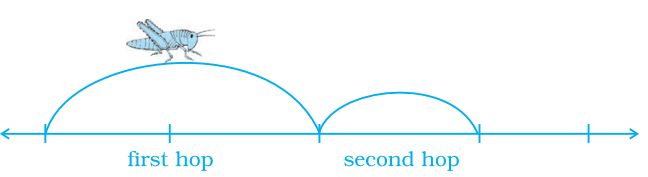
(a) Make a table showing the insect’s location for the first 10 hops.
(b) Where will the insect be after n hops?
(c) Will the insect ever get to 1? Explain.
14. By what number should
15. Some migratory birds travel as much as 15,000 km to escape the extreme climatic conditions at home. Write the distance in metres using scientific notation.
16. Express each of the following in standard form:
(a) The mass of a proton in gram is
(b) A Helium atom has a diameter of 0.000000022 cm.
(c) Mass of a molecule of hydrogen gas is about 0.00000000000000000000334 tons.
(d) Human body has 1 trillon of cells which vary in shapes and sizes.
(e) Express 56 km in m.
(f) Express 5 tons in g.
(g) Express 2 years in seconds.
(h) Express 5 hectares in cm^2 (1 hectare = 10000
17. Express
18. Express the product of
19. Find the multiplicative inverse of
20. By what number should we multiply
21. Express
22. The value of [
Q1
Prefixes which are used to represent large or very small numbers
| Positive Exponents of 10 | Prefix | Negative Exponents of 10 | Prefix |
|---|---|---|---|
| kilo | milli | ||
| mega | micro | ||
| giga | nano | ||
| tera | pico | ||
| peta | femto |
Distance between different places and objects
| Places/Objects | Distance (m) |
|---|---|
| Bengaluru and Delhi | 2,175,000 |
| Delhi and Washington, D.C | 12,025,000 |
| Earth and Moon | |
| Sun and Earth |
(1) (i) Usually, the prefix used with metre to represent the distance between two cities is 'kilo'. If you have to choose another prefix for metre to represent the distance between Delhi and Washington, D. C., which of the following prefixes are most suitable? Choose any two.
(a) Tera (b) Mega (c) Micro (d) Giga
(ii) Distance between the Sun and Earth is how many gigametres?
(2) If you have to choose a prefix for metre to represent the distances given in i and ii below, such that the number representing the distance satisfies the following conditions, which prefixes will you choose?
Condition:
If the number is greater than one (>1) then there can be either two or only one digit to the left of the decimal point, e.g.: 2.75, 45.58, but not 134.84. If the number is less than one (<1) then the digit at the immediate right of the decimal point should not be zero, e.g.: 0.125, 0.5, but not 0.015.
E.g., the distance between the Sun and the Earth is given as
(i) Distance between Bengaluru and Delhi.
(ii) Distance between the Earth and Moon
(3) The diameter of the human hair varies from 0.000017 metres to 0.00018 metres. Express these numbers using a suitable unit with a prefix satisfying the condition given in Question 2.
Sol 1
Solution:
(1) (i) Option (b) and (d)
(ii) The distance between the Sun and Earth is 151.18 gigametres.
(2) (i) The appropriate prefix is Mega (Mm).
(ii) The appropriate prefix is Giga (Gm).
(3) The diameter of human hair varies from 17 micrometres (µm) to 180 micrometres (µm).
Q2
Have you ever wondered which is the smallest object around you? If you zoom in on any object around, you can see them in greater detail, with smaller and smaller features being visible. But you can’t zoom in beyond a certain point because of our eyes/camera limitations. If we use the most advanced devices we see that the smallest unit from which all the objects are made is an atom. We can imagine an atom to have a spherical shape with a diameter in the range of
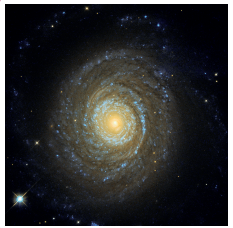
Similarly, if you ask which is the single largest distinct object in the universe, the answer is a galaxy. The galaxy typically contains many stars. Our planet exists in a galaxy called the Milky Way, whose shape is a spiral, as shown in the figure, with a diameter of
(1) (i)
(ii) If you place atoms side by side to form a long line, how many atoms will you need to cover the entire diameter of the Milky Way galaxy? Assume that the atoms have the size mentioned in above.
(2) (i) Planet Earth is also spherical in shape with a diameter of 12,742,000 metres. We can say that the diameter of an atom is ? times smaller than the diameter of the Earth. Choose the closest answer.
(a) 1.3 x
(c) 1.2 x
(ii) The diameter of the Milky Way galaxy is how many times larger than the diameter of the Earth? Choose the closest answer.
(a)
(c)
Sol 2
Solution:
(1) (i) 1 kilometre =
(ii)
(2) (i) Option (a)
(ii) Option (b)