

A Pinch of History
Do you know what a fraction was called in ancient India?
It was called bhinna in Sanskrit, which means ‘broken’.
It was also called bhaga or ansha meaning ‘part’ or ‘piece’.
The way we write fractions today, globally, originated in India.
In ancient Indian mathematical texts, such as the Bakshali manuscript (from around the year 300 CE), when they wanted to write
The line segment between the numerator and denominator in
Over the next few centuries the notation then spread to Europe and around the world.
Fractions had also been used in other cultures such as the ancient Egyptian and Babylonian civilisations, but they primarily used only fractional units, that is, fractions with a
More general fractions were expressed as sums of fractional units, now called ‘Egyptian fractions’. Writing numbers as the sum of fractional units, e.g.,
We will consider one such puzzle below.
General fractions (where the numerator is not necessarily 1) were first introduced in India, along with their rules of arithmetic operations like addition, subtraction, multiplication, and even division of fractions.
The ancient Indian treatises called the ‘Sulbasutras’ shows that even during Vedic times, Indians had discovered the rules for operations with fractions.
General rules and procedures for working with and computing with fractions were first codified formally and in a modern form by Brahmagupta.
Brahmagupta’s methods for working with and computing with fractions are still what we use today.
For example, Brahmagupta described how to add and subtract fractions as follows:
“By the multiplication of the numerator and the denominator of each of the fractions by the other denominators, the fractions are reduced to a common
Then, in case of addition, the numerators (obtained after the above reduction) are added.
In case of subtraction, their difference is taken.’’
(Brahmagupta,Brahmasphuṭasiddhānta, Verse 12.2, 628 CE)
The Indian concepts and methods involving fractions were transmitted to Europe via the Arabs over the next few centuries and they came into general use in Europe in around the 17th century and then spread worldwide.
It is easy to add up fractional units to obtain the sum 1, if one uses the same fractional unit, for example,
However, can you think of a way to add fractional units that are all different to get 1?
It is not possible to add two different fractional units to get
The reason is that
To get different fractional units, we would have to replace at least one of the
Therefore, it is not possible for two different fractional units to add up to 1.
We can try to look instead for a way to write 1 as the sum of
1. Can you find three different fractional units that add up to 1?
It turns out there is only one solution to this problem (up to changing the order of the 3 fractions)! Can you find it? Try to find it before reading further.
Here is a systematic way to find the solution. We know that
To get the fractional units to be different, we will have to increase at least one of the
So
Now
So two of the fractions must be
This explains why there is only one solution to the above problem.
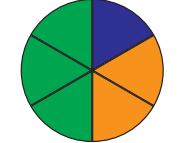
What if we look for four different fractional units that add up to 1?
2. Can you find four different fractional units that add up to 1?
It turns out that this problem has six solutions! Can you find at least one of them? Can you find them all?
You can try using similar reasoning as in the cases of two and three fractional units—or find your own method!
Once you find one solution, try to divide a circle into parts like in the figure above to visualise it!