

Equivalent Fractions
Using a fraction wall to find equal fractional lengths!
In the previous section, you used paper folding to represent various fractions using fractional units. Let us do some more activities with the same paper strips.
What do you observe?
Are the lengths
Are the lengths
We can say that
These are ‘equivalent fractions’ that denote the same length, but they are expressed in terms of different fractional units.
Now, check whether
Answer the following questions after looking at the fraction wall:
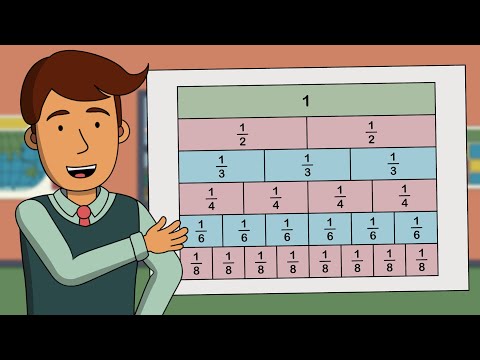
1
Are the lengths
Both represent the same portion of a whole, making them
2
Are
Both fractions represent the same part of a whole, ensuring equivalence.
3
How many pieces of length
Multiplying 3 by
This demonstrates how smaller fractions combine to form larger ones.
4
How many pieces of length
This demonstrates the additive nature of smaller fractional parts.
We can extend this idea to make a fraction wall up to the fractional unit
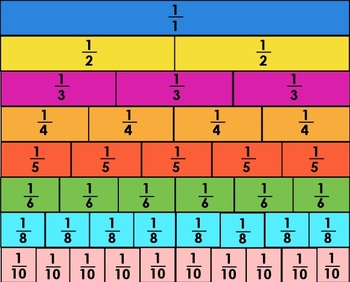
1
Are the
Each simplifies to
2
Write two equivalent fractions for
One roti was shared equally by four children.
What fraction of the whole did each child get?
The adjoining picture shows the division of a roti among four children.
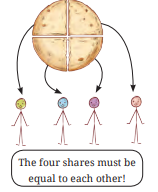
Fraction of roti each child got is
You can also express this event through division facts, addition facts, and multiplication facts.
The division fact is 1 ÷ 4 =
The addition fact is 1 =
The multiplication fact is 1 =
1
1. Three rotis are shared equally by four children. Show the division in the picture and write a fraction for how much each child gets. Also, write the corresponding division facts, addition facts, and, multiplication facts. Fraction of roti each child gets is.
Division fact: Addition fact: Multiplication fact: Compare your picture and answers with your classmates!
Each child gets
Division fact: 3 ÷ 4 =
Addition fact:
Multiplication fact: 4 ×
Equal sharing ensures fairness.
2
2. Anil was in a group where 2 cakes were divided equally among 5 children. How much cake would Anil get?
Anil would get
This division represents fair sharing, where each fraction corresponds to equal portions of the whole cakes.
1.Are
Expressing a fraction in lowest terms (or in its simplest form)
In any fraction, if its numerator and denominator have no common factor except 1, then the fraction is said to be in lowest terms or in its simplest form. In other words, a fraction is said to be in lowest terms if its numerator and denominator are as small as possible.
Any fraction can be expressed in lowest terms by finding an equivalent fraction whose numerator and denominator are as small as possible.
Let’s see how to express fractions in lowest terms.
Is the fraction
No,