

Division of Fractions
What is 12 ÷ 4? You know this already. But can this problem be restated as a multiplication problem? What should be multiplied by 4 to get 12? That is,
4 ×
We can use this technique of converting division into multiplication problems to divide fractions. What is 1 ÷
Let us rewrite this as a multiplication problem
What should be multiplied by
So, 1 ÷
Let us try another problem: 3 ÷
This is the same as:
Can you find the answer?
We know what to multiply
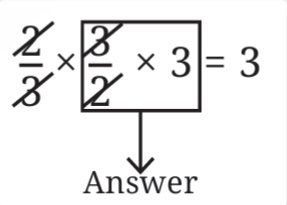
So, 3 ÷
What is
Rewriting it as a multiplication problem, we have:
How do we solve this?
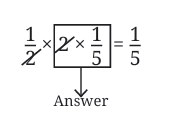
So,
What is
Rewriting this as multiplication, we have:
How will we solve this?
So,
Discussion
In each of the division problems above, observe how we found the answer. Can we frame a rule that tells us how to divide two fractions? Let us consider the previous problem.
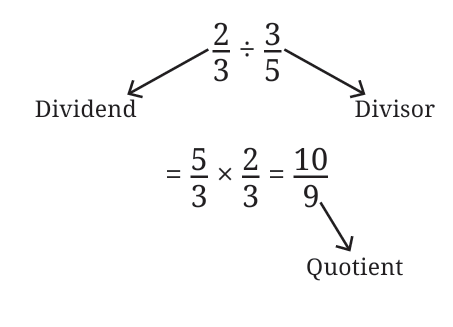
In every division problem we have a
The technique we have been using to get the quotient is:
- First, find the number which gives 1 when multiplied by the divisor.
We see that the resulting number is a fraction whose numerator is the divisor’s denominator and denominator is the divisor’s numerator.
For the divisor
We call
When we multiply a fraction by its reciprocal, we get
So, the first step in our technique is to find the divisor’s reciprocal.
2. We then multiply the dividend with this reciprocal to get the quotient.
Summarising, to divide two fractions:
• Find the reciprocal of the divisor • Multiply this by the dividend to get the quotient.
So,
This can be rewritten as:
As with methods and formulas for addition, subtraction, and multiplication of fractions that you learnt earlier, this method and formula for division of fractions, in this general form, was first explicitly stated by Brahmagupta in his Brāhmasphuṭasiddhānta (628 CE).
So, to evaluate, for example,
2/3 ÷ 3/5 =
Dividend, Divisor and the Quotient
When we divide two whole numbers, say 6 ÷ 3, we get the quotient
Here the quotient is
But what happens when we divide 6 by
Here the quotient is greater than the dividend!
What happens when we divide
Here too the quotient is greater than the dividend!
When do you think the quotient is less than the dividend and when is it greater than the dividend?
Is there a similar relationship between the divisor and the quotient?
Use your understanding of such relationships in multiplication to answer the questions above.