
Fractional Relations
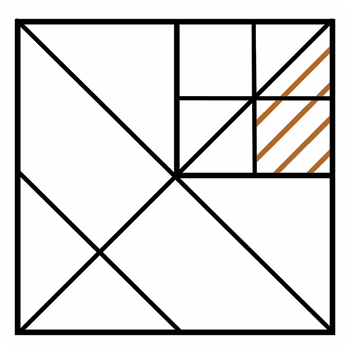
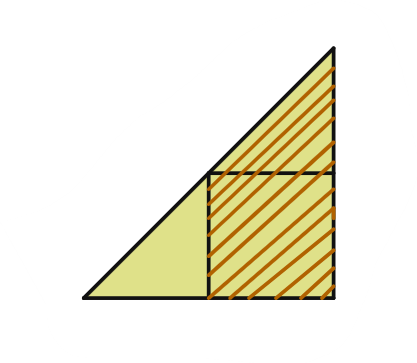
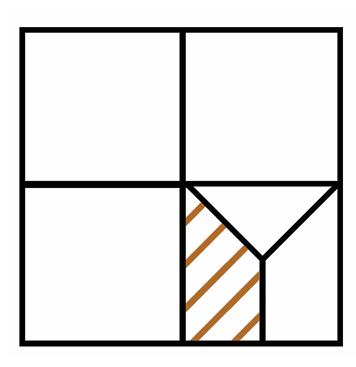
Here is a square with some lines drawn inside.
What fraction of area of the whole square does the shaded region occupy?
There are different ways to solve this problem. Here is one of them: Let the area of the whole square be 1 square unit. We can see that the top right square (in figure below), occupies 1 4 of the area of the whole square.
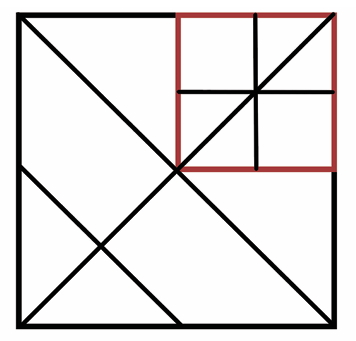
Area of red square =
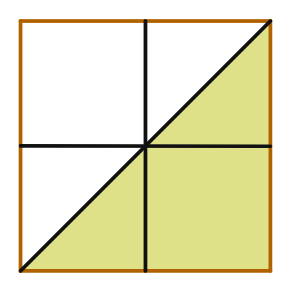
Let us look at this red square. The area of the triangle inside it (coloured yellow) is half the area of the red square. So,
the area of the yellow triangle =
What fraction of this yellow triangle is shaded?
The shaded region occupies
The area of shaded part =
Thus, the shaded region occupies
In each of the figures given below, find the fraction of the big square that the shaded region occupies.
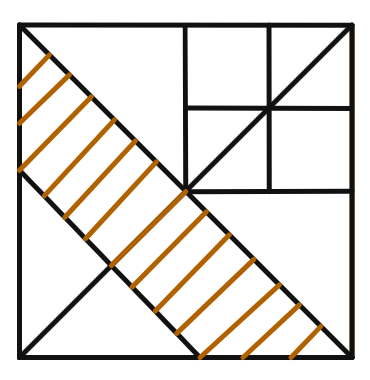
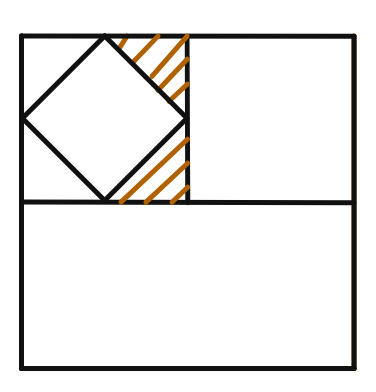
We will solve more interesting problems of this kind in a later chapter.
A Dramma-tic Donation
The following problem is translated from Bhāskarāchārya’s
(Bhāskara II’s) book, Līlāvatī, written in 1150 CE.
“O wise one! A miser gave to a beggar
Dramma refers to a silver coin used in those times. The tale says that 1 dramma was equivalent to 1280 cowrie shells. Let’s see what fraction of a dramma the person gave:
(
Evaluating it gives
Upon simplifying to its lowest form, we get
So, one cowrie shell was given to the beggar. You can see in the answer Bhāskarāchārya’s humour! The miser had given the beggar only one coin of the least value (cowrie).
Around the 12th century, several types of coins were in use in different kingdoms of the Indian subcontinent. Most commonly used were gold coins (called dinars/gadyanas and hunas), silver coins (called drammas/tankas), copper coins (called kasus/panas and mashakas), and cowrie shells. The exact conversion rates between these coins varied depending on the region, time period, economic conditions, weights of coins and their purity.
Gold coins had high-value and were used in large transactions and to store wealth. Silver coins were more commonly used in everyday transactions. Copper coins had low-value and were used in smaller transactions. Cowrie shells were the lowest denomination and were used in very small transactions and as change.
If we assume 1 gold dinar = 12 silver drammas, 1 silver dramma = 4 copper panas, 1 copper pana = 6 mashakas, and 1 pana = 30 cowrie shells,
1 copper pana =
1 cowrie shell =
1 cowrie shell =
A Pinch of History
As you have seen, fractions are an important type of number, playing a critical role in a variety of everyday problems that involve sharing and dividing quantities equally. The general notion of non-unit fractions as we use them today — equipped with the arithmetic operations of addition, subtraction, multiplication, and division — developed largely in India. The ancient Indian geometry texts called the Śhulbasūtra — which go back as far as 800 BCE, and were concerned with the construction of fire altars for rituals — used general non-unit fractions extensively, including performing division of such fractions as we saw in Example 3.
Fractions even became commonplace in the popular culture of India as far back as 150 BCE, as evidenced by an offhand reference to the reduction of fractions to lowest terms in the philosophical work of the revered Jain scholar Umasvati.
General rules for performing arithmetic operations on fractions — in essentially the modern form in which we carry them out today — were first codified by Brahmagupta in his Brāhmasphuṭasiddhānta in 628 CE. We have already seen his methods for adding and subtracting general fractions. For multiplying general fractions, Brahmagupta wrote:
“Multiplication of two or more fractions is obtained by taking the product of the numerators divided by the product of the denominators.” (Brāhmasphuṭasiddhānta, Verse 12.1.3)
That is,
For division of general fractions, Brahmagupta wrote: “The division of fractions is performed by interchanging the numerator and denominator of the divisor; the numerator of the dividend is then multiplied by the (new) numerator, and the denominator by the (new) denominator.”
Bhāskara II in his book Līlāvatī in 1150 CE clarifies Brahmagupta‘s statement further in terms of the notion of reciprocal: “Division of one fraction by another is equivalent to multiplication of the first fraction by the reciprocal of the second.” (Līlāvatī, Verse 2.3.40) Both of these verses are equivalent to the formula:
Bhāskara I, in his 629 CE commentary Āryabhaṭīyabhāṣhya on Aryabhata’s 499 CE work, described the geometric interpretation of multiplication of fractions (that we saw earlier) in terms of the division of a square into rectangles via equal divisions along the length and breadth.
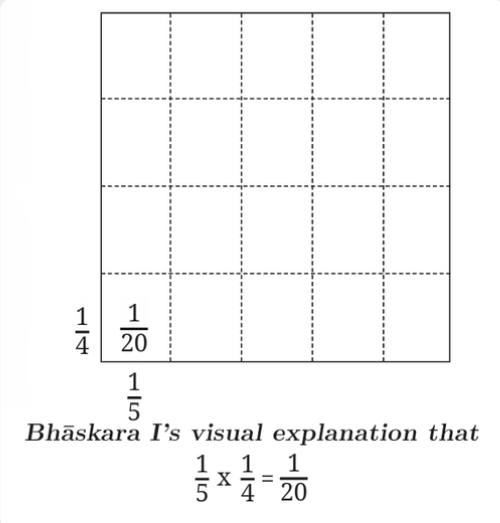
Many other Indian mathematicians, such as Śhrīdharāchārya (c. 750 CE), Mahāvīrāchārya (c. 850 CE), Caturveda Pṛithūdakasvāmī (c. 860 CE), and Bhāskara II (c. 1150 CE) developed the usage of arithmetic of fractions significantly further.
The Indian theory of fractions and arithmetic operations on them was transmitted to, and its usage developed further, by Arab and African mathematicians such as al-Hassâr (c. 1192 CE) of Morocco. The theory was then transmitted to Europe via the Arabs over the next few centuries, and came into general use in Europe in only around the 17th century, after which it spread worldwide. The theory is indeed indispensable today in modern mathematics.
Figure It Out
1. Evaluate the following:
2. For each of the questions below, choose the expression that describes the solution. Then simplify it.
3. If
4. Pāṭīgaṇita, a book written by Sridharacharya in the 9th century CE, mentions this problem: “Friend, after thinking, what sum will be obtained by adding together 1 ÷
5. Mira is reading a novel that has 400 pages. She read
6. A car runs 16 km using 1 litre of petrol. How far will it go using 2
7. Amritpal decides on a destination for his vacation. If he takes a train, it will take him 5
8. Mariam’s grandmother baked a cake. Mariam and her cousins finished
9. Choose the option(s) describing the product of (
(a) >
(b) <
(c) >
(d) <
(e) > 1
(f) < 1
10. What fraction of the whole square is shaded?
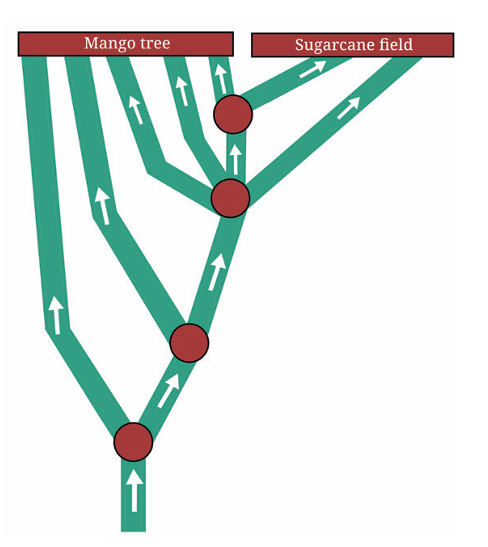
11. A colony of ants set out in search of food. As they search, they keep splitting equally at each point (as shown) and reach two food sources, one near a mango tree and another near a sugarcane field. What fraction of the original group reached each food source?