

Multiplication of Fractions
Aaron walks 3 kilometres in 1 hour. How far can he walk in 5 hours? This is a simple question.
We know that to find the
Distance covered in 1 hour =
Therefore, Distance covered in 5 hours = 5 × 3 km = 3 + 3 + 3 + 3 + 3 km =
Aaron’s pet tortoise walks at a much slower pace. It can walk only 1 4 kilometre in 1 hour. How far can it walk in 3 hours?
Here, the distance covered in an hour is a
This does not matter. The total distance covered is calculated in the same way, as multiplication.
Distance covered in 1 hour =
Therefore, distance covered in 3 hours =
The tortoise can walk 3/4 km in 3 hours.
Let us consider a case where the time spent walking is a fraction of an hour.
We saw that Aaron can walk 3 kilometres in 1 hour. How far can he walk in 1/5 hours?
We continue to calculate the total distance covered through multiplication.
Distance covered in 1/5 hours = 1/5 × 3 km.
Finding the product: Distance covered in 1 hour = 3 km.
In 1/5 hours, distance covered is equal to the
This tells us that 1/5 × 3 = 3/5
How far can Aaron walk in
Once again, we have - Distance covered =
Finding the product:
We can first find the distance covered in
1 5 Since, the duration
2 5 1 5
Here is the calculation:
Distance covered in 1 hour = 3 km.
Distance covered in
1 5
= 3/5 km.Multiplying this distance by 2, we get: 2 × 3/5 = 6/5 km. From this we can see that: 2/5 × 3 = 6/5.
Discussion
We did this multiplication as follows:
First, we divided the multiplicand, 3 , by the denominator of the multiplier, 5, to get
We then multiplied the result by the numerator of the multiplier, 2, to get
Thus, whenever we need to multiply a fraction and a whole number, we follow the steps above.
Example 1: A farmer had 5 grandchildren. She distributed
Total land given = No. of grandchildren × land given to each =
Example 2: 1 hour of internet time costs ₹8. How much will 1
Simplifying: 1
Cost of 5/4 hour of internet time = 5/4 ×
It costs ₹ 10 for 1
Figure it Out
1. Tenzin drinks
2. A team of workers can make 1 km of a water canal in 8 days. So, in one day, the team can make ? km of the water canal. If they work 5 days a week, they can make ? km of the water canal in a week.
3. Manju and two of her neighbours buy 5 litres of oil every week and share it equally among the 3 families. How much oil does each family get in a week? How much oil will one family get in 4 weeks?
4. Safia saw the Moon setting on Monday at 10 pm. Her mother, who is a scientist, told her that every day the Moon sets
5. Multiply and then convert it into a mixed fraction:
So far, we have learnt multiplication of a whole number with a fraction, and a fraction with a whole number. What happens when both numbers in the multiplication are fractions?
Multiplying Two Fractions
We know, that Aaron’s pet tortoise can walk only
Following our approach of using multiplication to solve such problems, we have,
Distance covered in 1/2 hour =
Finding the product: Distance covered in 1 hour = 1/4 km.
Therefore, the distance covered in
To find this, it is useful to represent fractions using the unit square to stand for a “whole”.
Now we divide this
Since the whole is divided into
So, the distance covered by the tortoise in half an hour is
This tells us that
If the tortoise walks faster and it can cover
Distance covered =
Finding the product:
(i) First find the distance covered in
(ii) Multiply the result by 3, to get the distance covered in
(iii) Distance in km covered in
Taking the unit square as the whole, the shaded part is a region we get when we divide
How much of the whole is it?
The whole is divided into
Number of these parts shaded =
So, the distance covered in
(ii) Now, we need to multiply
Distance covered in 3/4 of an hour = 3 ×
So, 3/4 × 2/5 = 6/20 =
Discussion
In the case of a fraction multiplied by another fraction, we follow a method similar to the one we used, when we multiplied a fraction by a whole number. We multiplied as follows:
Using this understanding, multiply
First, let us represent
Following the steps of multiplication, we need to first divide this fraction
We see that the whole is divided into —
Number of parts shaded =
So the yellow shaded part =
Now, the next step is multiplying this result by 5. This gives the product of
Connection between the Area of a Rectangle and Fraction Multiplication
In the Fig. 8.3, what is the length and breadth of the shaded rectangle?
Since we started with a unit square (of side 1 unit), the length and breadth are
What is the area of this rectangle? We see that
Do you see any relation between the area and the product of length and breadth?
The area of a rectangle of fractional sides equals the
of its
In general, if we want to find the product of two fractions, we can find the area of the rectangle formed with the two fractions as its sides.
Figure it Out
1. Find the following products. Use a unit square as a whole for representing the fractions:
(a)
(b)
(c)
(d)
Now find
Doing this by representing the fractions using a unit square is cumbersome. Let us find the product by observing what we did in the above cases.
In each case, the whole is divided into rows and columns.
The number of rows is the
The number of columns is the
Thus, the whole is divided into 18 × 12 =
So,
Thus, when two fractional units are multiplied, their product is:
We express this as:
2. Find the following products. Use a unit square as a whole for representing the fractions and carrying out the operations.
(a)
(c)
Multiplying Numerators and Denominators
Now, find
Like the previous case, let us find the product by performing the multiplication, step by step.
First, the whole is divided into 18 rows and 12 columns creating 12 × 18 equal parts.
The value we get by dividing
Then, we multiply this result by 5 to get the product. This is
So,
From this we can see that, in general,
This formula was first stated in this general form by Brahmagupta in his Brāhmasphuṭasiddhānta in 628 CE.
The formula above works even when the multiplier or multiplicand is a whole number. We can simply rewrite the whole number as a fraction with denominator 1. For example,
3 ×
=
And,
Multiplication of Fractions — Simplifying to Lowest Form
Multiply the following fractions and express the product in its lowest form:
Instead of multiplying the numerators (12 and 5) and denominators (7 and 24) first and then simplifying, we could do the following:
We see that both the []-enclosed numbers have a common factor of 12. We know that a fraction remains the same when the numerator and denominator are divided by the common
Let us use the same technique to do one more multiplication.
When multiplying fractions, we can first divide the numerator and denominator by their common factors before multiplying the numerators and denominators. This is called cancelling the common factors.
A Pinch of History
In India, the process of reducing a fraction to its lowest terms — known as apavartana — is so well known that it finds mention even in a
non-mathematical work. A Jaina scholar Umasvati (c. 150 CE) used it as a simile in a philosophical work.
Figure it Out
1. A water tank is filled from a tap. If the tap is open for 1 hour,
(a)
(b)
(c)
(d)
(e) For the tank to be full, how long should the tap be running?
2. The government has taken
3. Find the area of a rectangle of sides 3
4. Tsewang plants four saplings in a row in his garden. The distance between two saplings is
[Hint: Draw a rough diagram with four saplings with distance between two saplings as
5. Which is heavier:
Is the Product Always Greater than the Numbers Multiplied?
Since, we know that when a number is multiplied by 1, the product
When we multiply two counting numbers greater than 1, say 3 and 5, the product is
3 × 5 =
The product, 15, is
But what happens when we multiply
In the above multiplication the product, 2, is
What happens when we multiply
Let us compare this product
From this we can see that the product is less than both the numbers.
When do you think the product is greater than both the numbers multiplied, when is it in between the two numbers, and when is it smaller than both?
[Hint: The relationship between the product and the numbers multiplied depends on whether they are between 0 and 1 or they are greater than 1.]
Take different pairs of numbers and observe their product. For each multiplication, consider the following questions.
| Situation | Multiplication | Relationship |
|---|---|---|
| Situation 1 | Both numbers are greater than 1: | The product |
| Situation 2 | Both numbers are between 0 and 1: | The product |
| Situation 3 | One number is between 0 and 1, and one number is greater than 1: | The product |
Create more such examples for each situation and observe the relationship between the product and the numbers being multiplied.
What can you conclude about the relationship between the numbers multiplied and the product?
Fill in the blanks:
When one of the numbers being multiplied is between 0 and 1, the product is
When one of the numbers being multiplied is greater than 1, the product is
Order of Multiplication
We know that
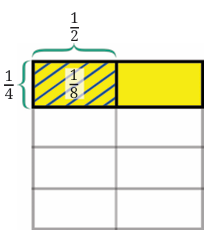
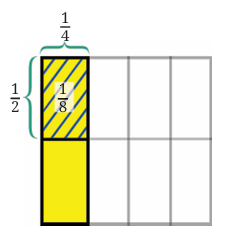
Now, what is
In general, note that the area of a rectangle
The order of multiplication
Thus,
This can also be seen from Brahmagupta’s formula for multiplying fractions.