

Number of Faces, Edges and Vertices of Polyhedron

Euler's Relation is a fascinating mathematical formula that establishes a relationship between the number of vertices (V), edges (E), and faces (F) in any convex polyhedron. The formula states:
V - E + F = 2
For a cube:
Vertices (V) =
Edges (E) =
Faces (F) =
Substituting we get: V - E + F = 8 - 12 + 6 =
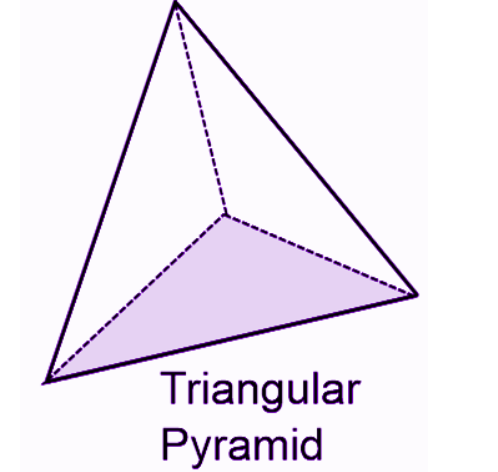
For a triangular pyramid (tetrahedron):
Vertices (V) =
Edges (E) =
Faces (F) =
Substituting we get: V - E + F = 4 - 6 + 4 =
It works for all convex polyhedra (shapes with no indentations or holes). The formula remains true regardless of the polyhedron's size or shape. It doesn't apply to shapes with holes (like a donut shape) or non-convex polyhedra.
This relationship helps us understand the fundamental structure of three-dimensional shapes and is particularly useful in:
Computer graphics and 3D modeling
Architectural design
Understanding molecular structures in chemistry
Solving geometric problems