

Angle
An angle is formed by two rays having a common starting point. Here is an angle formed by rays BD and BE where
Angle DBE
The point B is called the vertex of the angle, and the rays BD and BE are called the arms of the angle.
How can we name this angle? We can simply use the vertex and say that it is the Angle B.
To be clearer, we use a point on each of the arms together with the vertex to name the angle. In this case, we name the angle as Angle DBE or Angle EBD. The word angle can be replaced by the symbol ‘∠’, i.e., ∠DBE or ∠EBD. Note that in specifying the angle, the vertex is always written as the
To indicate an angle, we use a small curve at the vertex
Vidya has just opened her book. Let us observe her opening the cover of the book in different scenarios.
Do you see angles being made in each of these cases? Can you mark their arms and vertex?
Which angle is greater—the angle in Case 1 or the angle in Case 2?
Just as we talk about the size of a line based on its length, we also talk about the size of an angle based on its amount of rotation.
So, the angle in Case 2 is
Similarly, the angle in Case 3 is even larger than that of Case 2, because there is even more rotation, and Cases 4, 5, and 6 are successively larger angles with more and more rotation.
The size of an angle is the amount of rotation or turn that is needed about the vertex to move the first ray to the second ray.
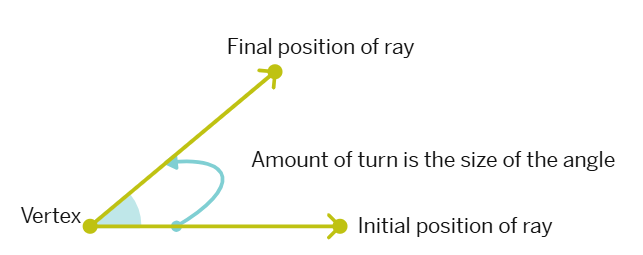
Let’s look at some other examples where angles arise in real life by rotation or turn:
• In a compass or divider, we turn the arms to form an angle. The vertex is the point where the two arms are joined. Identify the arms and vertex of the angle.
• A pair of scissors has two blades. When we open them (or ‘turn them’) to cut something, the blades form an angle. Identify the arms and the vertex of the angle.
• Look at the pictures of spectacles, wallet and other common objects. Identify the angles in them by marking out their arms and vertices
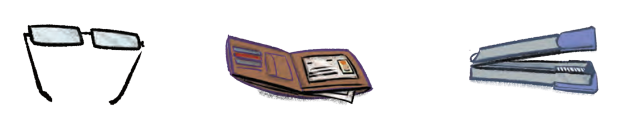
Do you see how these angles are formed by turning one arm with respect to the other?
Figure it Out
1. Can you find the angles in the given pictures? Draw the rays forming any one of the angles and name the vertex of the angle.
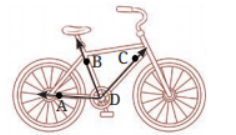
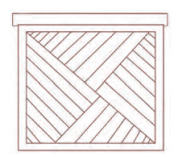
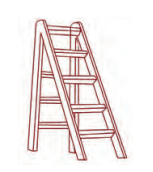
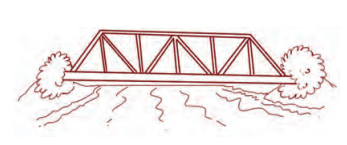
Let's start by naming the arms and vertices of the said angle.
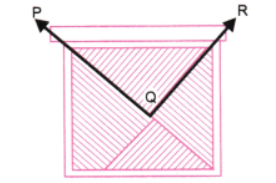
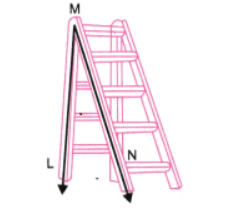
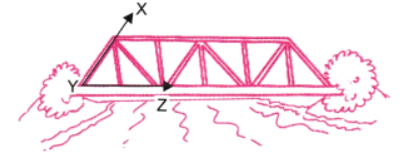
2. Draw and label an angle with arms ST and SR.
3. Explain why ∠APC cannot be labelled as ∠P.
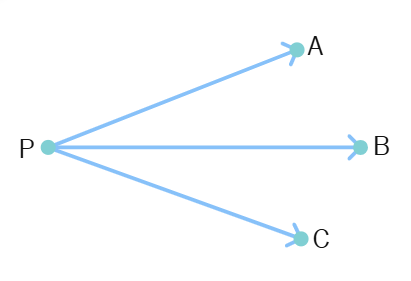
4. Name the angles marked in the given figure.
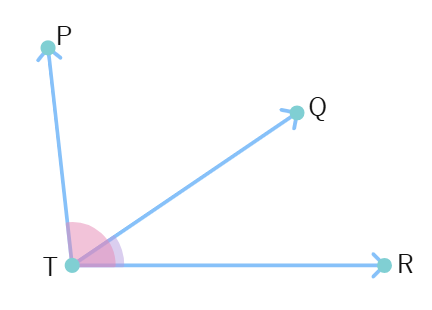
5. Mark any three points on your paper that are not on one line. Label them A, B, C. Draw all possible lines going through pairs of these points. How many lines do you get? Name them. How many angles can you name using A, B, C? Write them down, and mark each of them with a curve as in Fig. 2.9.
6. Now mark any four points on your paper so that no three of them are on one line. Label them A, B, C, D. Draw all possible lines going through pairs of these points. How many lines do you get? Name them. How many angles can you name using A, B, C, D? Write them all down, and mark each of them with a curve as in Fig. 2.9.
Interactive Geometry Explorer
Instructions: Drag the colored points A, B, C, and D to explore different geometric configurations.
Notice that no three points are positioned in a straight line (collinear), which creates interesting geometric relationships.
Step 1: Show All Possible Lines
Excellent! You can see all 6 possible lines connecting pairs of points:
- Line AB (red)
- Line AC (teal)
- Line AD (blue)
- Line BC (green)
- Line BD (yellow)
- Line CD (orange)
Try dragging the points to see how the lines change dynamically!
Step 2: Explore Angles at Each Point
Now let's examine the angles formed at each point:
At point A:
Three angles are formed at point A: ∠BAC, ∠BAD, and ∠CAD
At point B:
Three angles are formed at point B: ∠ABC, ∠ABD, and ∠CBD
At point C:
Three angles are formed at point C: ∠ACB, ∠ACD, and ∠BCD
At point D:
Three angles are formed at point D: ∠ADB, ∠ADC, and ∠BDC
Step 3: Count the Total
Total count:
- Lines:
(connecting each pair of points) - Angles:
(3 angles at each of the 4 points)
🎉 Perfect! You've discovered that with 4 points (no three collinear):
We can draw 6 unique lines
We can form 12 unique angles
### Challenge: Can you rearrange the points to create different angle sizes while keeping the same number of lines and angles?