Figure it out
Infinitely Many Lines Through One Point
**Observe:** The red point P is the **{.m-red}center point** through which all lines pass.
Notice how **every line** passes through point P, no matter what direction it takes!
Watch the **{.m-yellow}yellow line** rotate around point P. As it spins, it represents just a tiny fraction of the infinite lines possible.
**Key Concept:** Through any single point, there are **infinitely many** different lines that can be drawn. Each line has a different slope (direction), but they all pass through the same point.
**Lines drawn:** 4
**Rotation angle:** 0°
Fundamental Property of Lines: Through any two distinct points, there exists exactly one unique line.
Interactive Demonstration
Instructions: Drag the red point A and blue point B to different positions and observe what happens to the line.
Key Observations:
- No matter where you place points A and B, there is always exactly one line that passes through both points
- This line is unique - no other line can pass through the same two points
- When the points are moved, the line automatically adjusts to maintain this property
- If the points coincide (same position), infinitely many lines would pass through that single point
Try This Challenge
Move the points so they are:
- Very close together - notice the line still exists and is unique
- Far apart - the line extends infinitely in both directions
- Arranged vertically - observe how the line becomes vertical
- Arranged horizontally - see how the line becomes horizontal
Remember: In each case, there is still exactly one unique line through the two points!
Rihan marked a point on a piece of paper. How many lines can he draw that pass through the point?
Sheetal marked two points on a piece of paper. How many different lines can she draw that pass through both of the points?
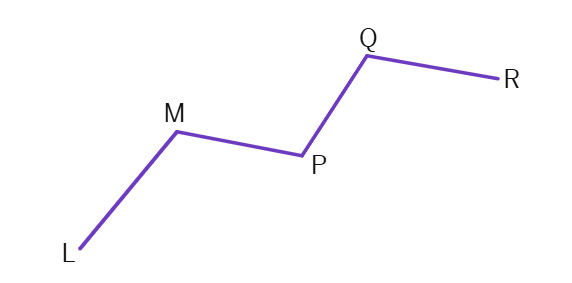
2. Name the line segments in the given below figure. Which of the five marked points are on exactly one of the line segments? Which are on two of the line segments?
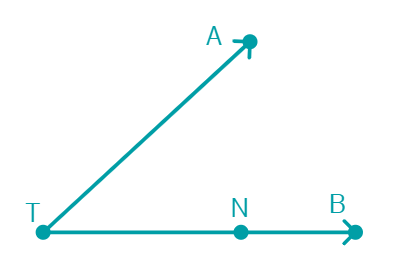
3. Name the rays shown in the figure. Is T the starting point of each of these rays?
4. Draw a rough figure and write labels appropriately to illustrate each of the following:
a. OP and OQ meet at O.
b. XY and PQ intersect at point M.
c. Line l contains points E and F but not point D.
d. Point P lies on AB.
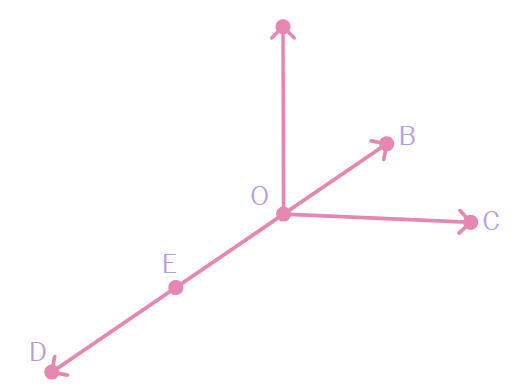
5. In the figure, name:
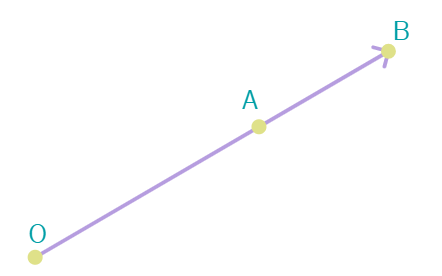
6. Here is a ray OA. It starts at O and passes through the point A. It also passes through the point B.