
Measuring Angles
We have seen how to compare two angles. But can we actually quantify how big an angle is using a number without having to compare it to another angle?
We saw how various angles can be compared using a circle. Perhaps a circle could be used to assign measures for angles?
To assign precise measures to angles, mathematicians came up with an idea. They divided the angle in the centre of the circle into 360 equal angles or parts.
The angle measure of each of these unit parts is 1 degree, which is written as
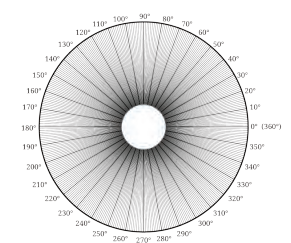
This unit part is used to assign measure to any angle: the measure of an angle is the number oof 1° unit parts it contains inside it.
For example, see this figure:
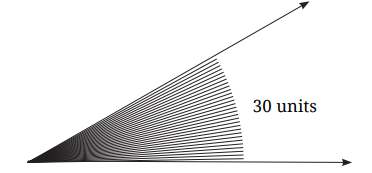
It contains 30 units of 1° angle and so we say that its angle measure is
Measures of different angles
What is the measure of a full turn in degrees?
As we have taken it to contain 360 degrees, its measure is
What is the measure of a straight angle in degrees? A straight angle is
As a full-turn is
What is the measure of a right angle in degrees?
A pinch of history
A full turn has been divided into 360°. Why 360? The reason why we use 360° today is not fully known. The division of a circle into 360 parts goes back to ancient times.
The Rigveda, one of the very oldest texts of humanity going back thousands of years, speaks of a wheel with 360 spokes (Verse 1.164.48). Many ancient calendars, also going back over 3000 years—such as calendars of India, Persia, Babylonia and Egypt—were based on having 360 days in a year.
In addition, Babylonian mathematicians frequently used divisions of 60 and 360 due to their use of sexagesimal numbers and counting by 60s. Perhaps the most important and practical answer for why mathematicians over the years have liked and continued to use 360 degrees is that 360 is the smallest number that can be evenly divided by all numbers up to 10, aside from 7.
Thus, one can break up the circle into 1, 2, 3, 4, 5, 6, 8, 9 or 10 equal parts, and still have a whole number of degrees in each part! Note that 360 is also evenly divisible by 12, the number of months in a year, and by 24, the number of hours in a day. These facts all make the number 360 very useful.
The circle has been divided into 1, 2, 3, 4, 5, 6, 8, 9 10 and 12 parts below. What are the degree measures of the resulting angles? Write the degree measures down near the indicated angles.
Degree measures of different angles
How can we measure other angles in degrees? It is for this purpose that we have a tool called a protractor that is either a circle divided into 360 equal parts as shown earlier, or a half circle divided into 180 equal parts.
Unlabelled Protractor
Here is a protractor. Do you see the straight angle at the center divided into 180 units of 1 degree? Only part of the lines dividing the straight angle are visible, though!
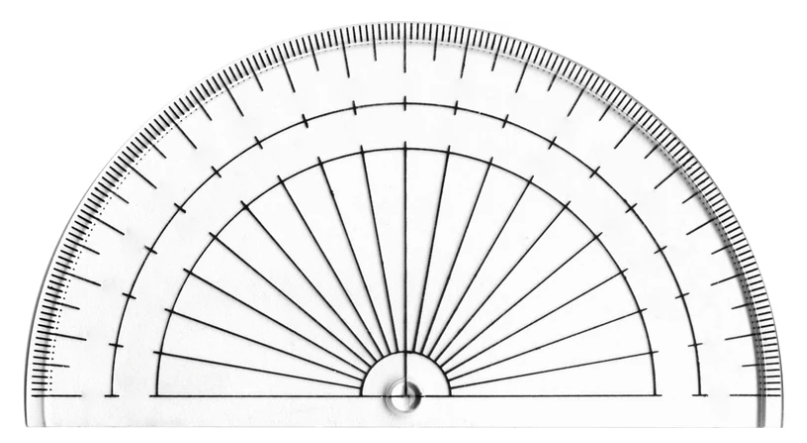
Starting from the marking on the rightmost point of the base, there is a long mark for every 10°. From every such long mark, there is a medium sized mark after 5°.
Figure it out
1. Write the measures of the following angles:
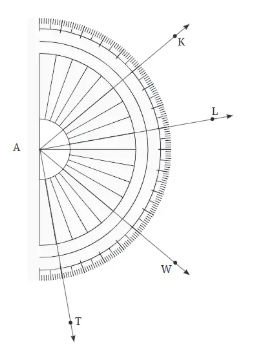
(a) ∠ KAL
Notice that the vertex of this angle coincides with the centre of the protractor. So the number of units of 1 degree angle between KA and AL gives the measure of ∠KAL.
By counting, we get—
∠KAL = 30°
Making use of the medium sized and large sized marks, is it possible to count the number of units in 5s or 10s?
Labelled protractor
This is a protractor that you find in your geometry box. It would appear similar to the protractor above except that there are numbers written on it. Will these make it easier to read the angles?
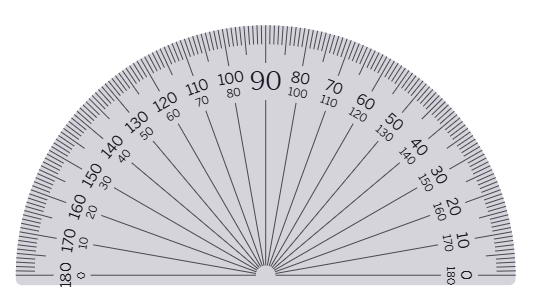
There are two sets of numbers on the protractor: one increasing from right to left and the other increasing from left to right. Why does it include two sets of numbers?
Name the different angles in the figure and write their measures.
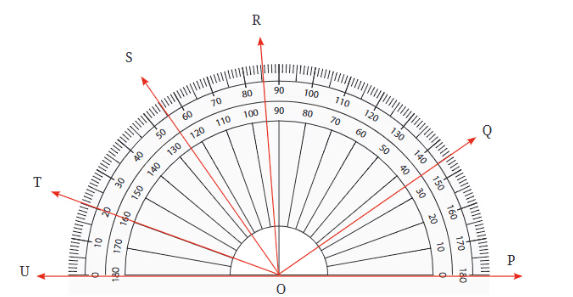
Did you include angles such as ∠TOQ?
Which set of markings did you use—inner or outer?
What is the measure of ∠TOS?
Can you use the numbers marked to find the angle without counting the number of markings?
Here, OT and OS pass through the numbers 20 and 55 on the outer scale. How many units of 1 degree are contained between these two arms?
Can subtraction be used here?
How can we measure angles directly without having to subtract?
Place the protractor so the center is on the vertex of the angle. Align the protractor so that one the arms passes through the 0º mark as in the picture below.
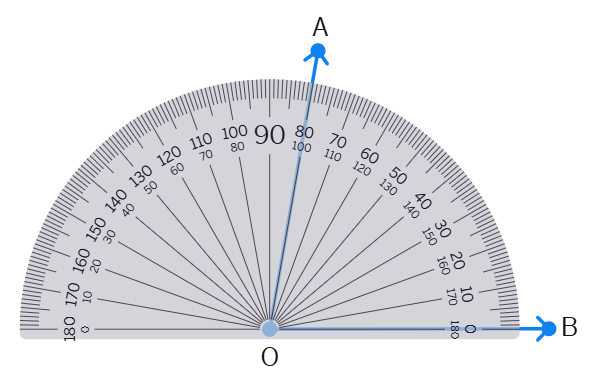
What is the degree measure of ∠AOB?
Make your own Protractor!
You may have wondered how the different equally spaced markings are made on a protractor. We will now see how we can make some of them!
(1) Draw a circle of a convenient radius on a sheet of paper. Cut out the circle. A circle or one full turn is 360°.
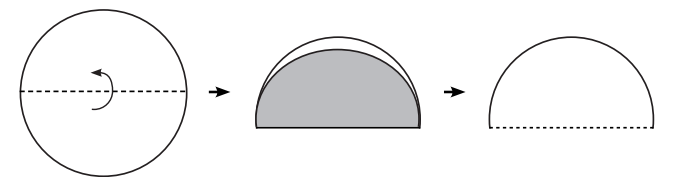
(2) Fold the circle to get two equal halves and cut it through the crease to get a semicircle. Write ‘0°’ in the bottom right corner of the semicircle.
(3) Fold the semi-circular sheet in half to form a quarter circle.
(4) Fold the sheet again as shown:
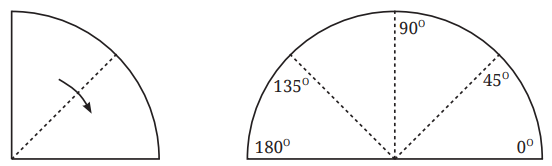
When folded, this is
The new creases formed give us measures of 45° and 180° − 45° =
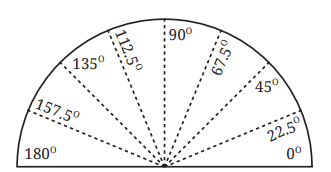
(5) Continuing with another half fold as shown in Fig. 2.18, we get an angle of measure
(6) Unfold and mark the creases as OB, OC, ..., etc., as shown.
Think!
In the figure, we have ∠AOB = ∠BOC = ∠COD = ∠DOE = ∠EOF = ∠FOG = ∠GOH = ∠HOI= ?. Why?
∠AOB = ∠BOC = ∠COD = ∠DOE = ∠EOF = ∠FOG = ∠GOH = ∠HOI =
The straight angle is divided into 8 equal parts, thus, the measure of each angles is
Angle Bisector
At each step, we folded in halves. This process of getting half of a given angle is called bisecting the angle. The line that bisects a given angle is called the angle bisector of the angle.
Identify the angle bisectors in your handmade protractor. Try to make different angles using the concept of angle bisector through paper folding.
Figure it Out
1. Find the degree measures of the following angles using your protractor.
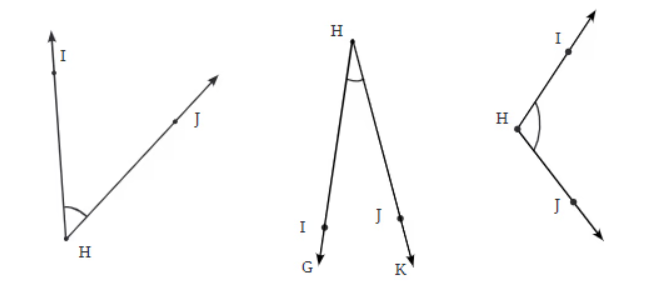
∠IHJ =
2. Find the degree measures of different angles in your classroom using your protractor.
3. Find the degree measures for the angles given below. Check if your paper protractor can be used here!
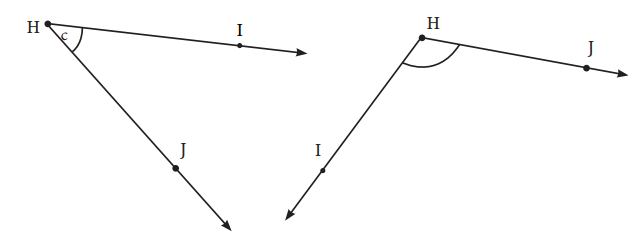
4. How can you find the degree measure of the angle given below using a protractor?
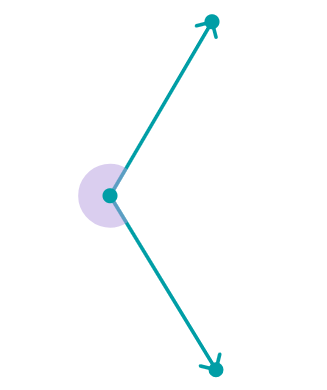
5. Measure and write the degree measures for each of the following angles:
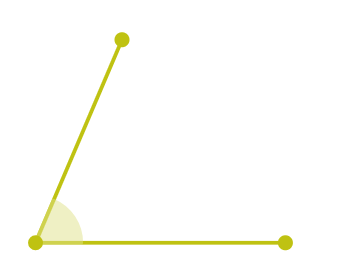
(a)
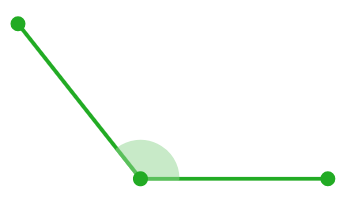
(b)

(c)
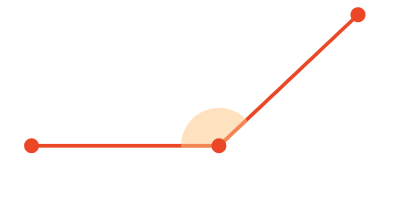
(d)
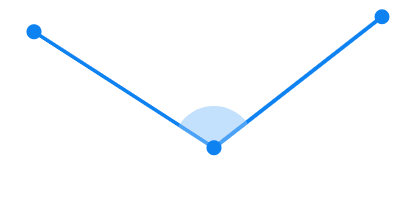
(e)
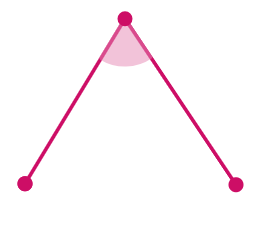
(f)
6. Find the degree measures of ∠BXE, ∠CXE, ∠AXB and ∠BXC.
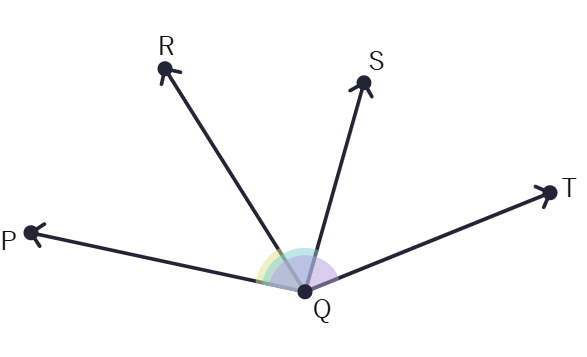
7. Find the degree measures of ∠PQR, ∠PQS and ∠PQT.
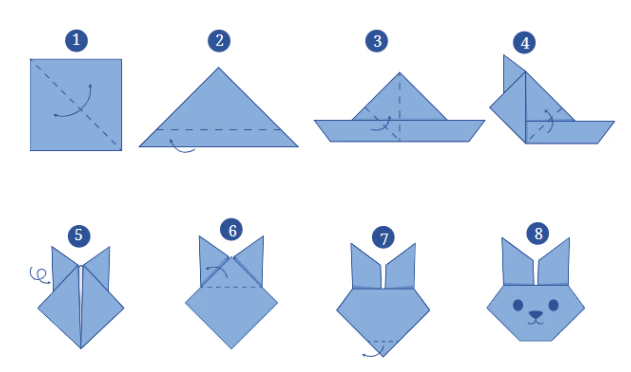
8. Make the paper craft as per the given instructions. Then, unfold and open the paper fully. Draw lines on the creases made and measure the angles formed.
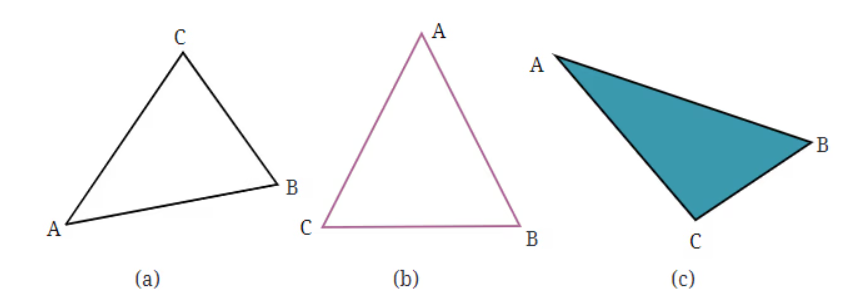
9. Measure all three angles of the triangle shown in Fig. 2.21 (a), and write the measures down near the respective angles. Now add up the three measures. What do you get? Do the same for the triangles in Fig. 2.21 (b) and (c). Try it for other triangles as well, and then make a conjecture for what happens in general! We will come back to why this happens in a later year.
Mind the Mistake, Mend the Mistake!
A student used a protractor to measure the angles as shown below. In each figure, identify the incorrect usage(s) of the protractor and discuss how the reading could have been made and think how it can be corrected.
Figure it Out
Where are the angles?
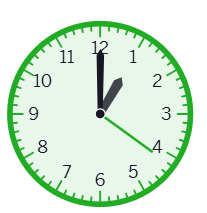
1. Angles in a clock:
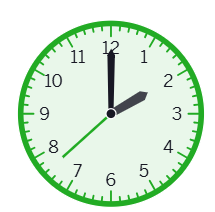
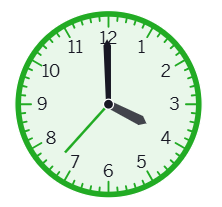
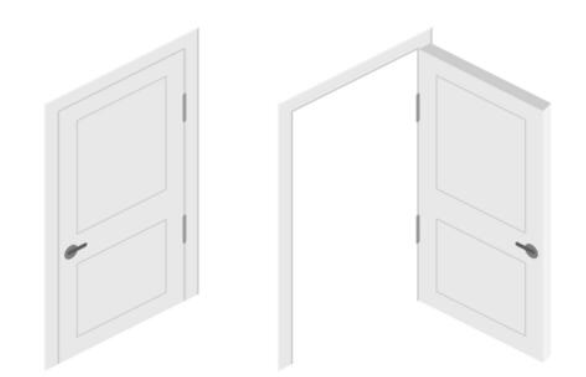
2. The angle of a door:
Is it possible to express the amount by which a door is opened using an angle? What will be the vertex of the angle and what will be the arms of the angle?
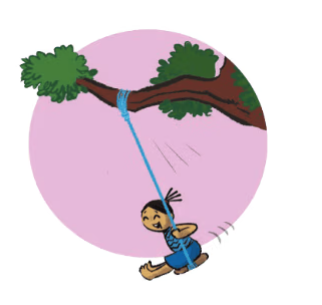
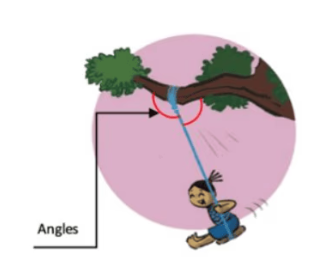
3. Vidya is enjoying her time on the swing. She notices that the greater the angle with which she starts the swinging, the greater is the speed she achieves on her swing. But where is the angle? Are you able to see any angle?
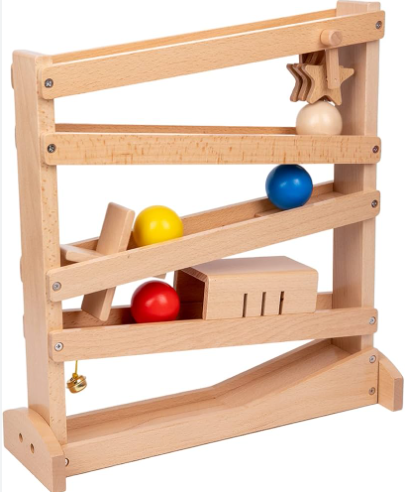
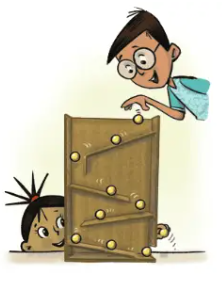
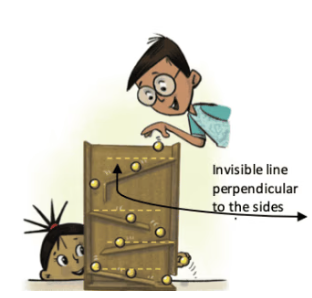
4. Here is a toy with slanting slabs attached to its sides; the greater the angles or slopes of the slabs, the faster the balls roll. Can angles be used to describe the slopes of the slabs? What are the arms of each angle? Which arm is visible and which is not?
5. Observe the images below where there is an insect and its rotated version. Can angles be used to describe the amount of rotation? How? What will be the arms of the angle and the vertex?
Hint: Observe the horizontal line touching the insects.