

Comparing Angles
Look at these animals opening their mouths. Do you see any angles here? If yes, mark the arms and vertex of each one. Some mouths are open wider than others; the more the turning of the jaws, the larger the angle! Can you arrange the angles in this picture from smallest to largest?
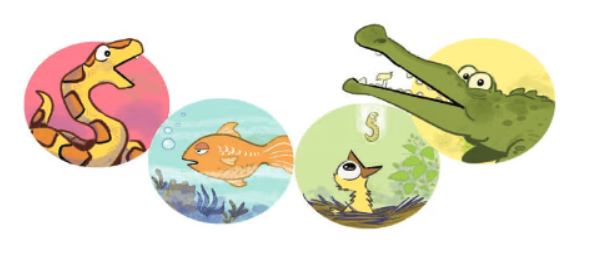
Is it always easy to compare two angles?
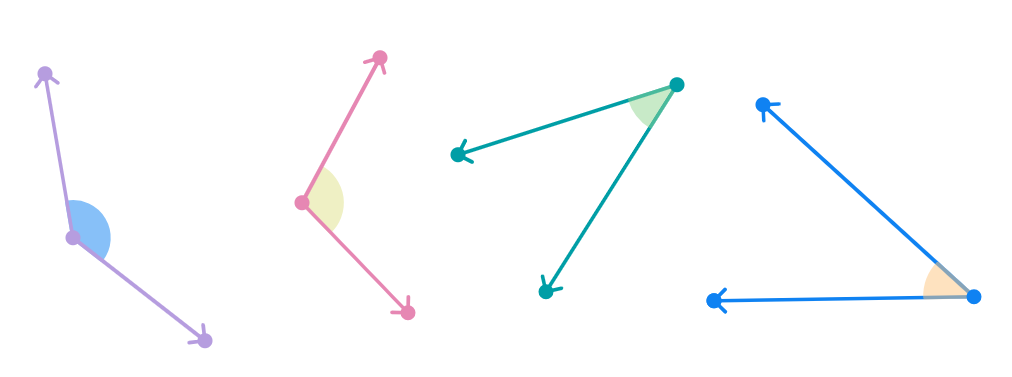
Here are some angles. Label each of the angles. How will you compare them?
Draw a few more angles; label them and compare.
Comparing angles by superimposition
Any two angles can be compared by placing them one over the other, i.e., by superimposition. While superimposing, the vertices of the angles must
After superimposition, it becomes clear which angle is smaller and which is larger.
The picture shows the two angles superimposed. It is now clear that ∠
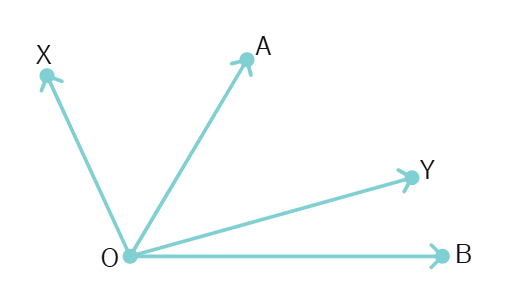
Equal angles: Now consider ∠AOB and ∠XOY in the figure. Which is greater?
The corners of both of these angles match and the arms overlap with each other, i.e., OA ↔ OX and OB ↔ OY. So, the angles are
The reason these angles are considered to be equal in size is because when we visualise each of these angles as being formed out of rotation, we can see that there is an equal amount of rotation needed to move OB to OA and OY to OX.
From the point of view of superimposition, when two angles are superimposed, and the common vertex and the two rays of both angles lie on top of each other, then the sizes of the angles are equal.
Where else do we use superimposition to compare?
Figure it Out
1. Fold a rectangular sheet of paper, then draw a line along the fold created. Name and compare the angles formed between the fold and the sides of the paper. Make different angles by folding a rectangular sheet of paper and compare the angles. Which is the largest and smallest angle you made?
Paper Fold
2. In each case, determine which angle is greater and why. Discuss with your friends on how you decided which one is greater.
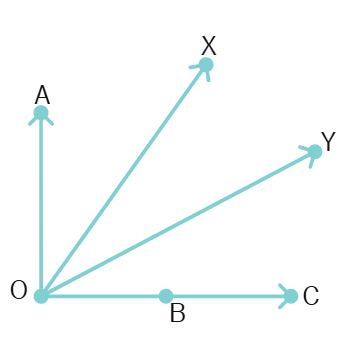
3. Which angle is greater: ∠XOY or ∠AOB? Give reasons.
Comparing angles without superimposition
Two cranes are arguing about who can open their mouth wider, i.e., who is making a bigger angle.
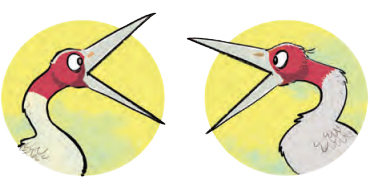
Let us first draw their angles. How do we know, which one is bigger? As seen before, one could trace these angles, superimpose them and then check. But can we do it without superimposition?
Suppose we have a transparent circle which can be moved and placed on figures. Can we use this for comparison?
Let us place the circular paper on the angle made by the first crane. The circle is placed in such a way that its centre is on the vertex of the angle. Let us mark the points A and B on the edge circle at the points where the arms of the angle pass through the circle.
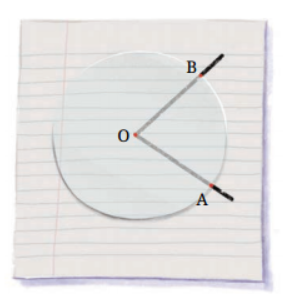
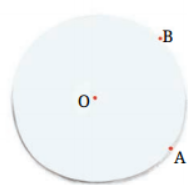
Can we use this to find out if this angle is greater than, or equal to or smaller than the angle made by the second crane?
Let us place it on the angle made by the second crane so that the vertex coincides with the centre of the circle and one of the arms passes through OA.
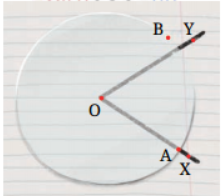
Which crane was making the bigger angle?
If you can make a circular piece of transparent paper, try this method to compare the angles in Fig. 2.10 with each other.