
Constructing a Copy Of An Angle of Unknown Measure
Sometimes, we need to replicate an angle without knowing its exact measure. Follow these steps to construct a copy of a given angle.
Steps of Construction:
1. Draw a Reference Line:

- Draw a straight line and mark a point P on it. This will be the vertex of the new angle.
2. Draw an Arc on the Given Angle:
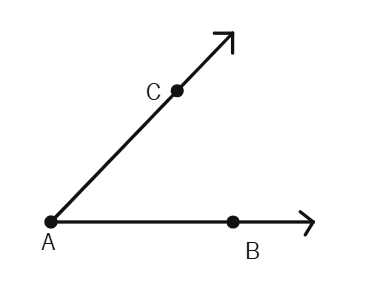
Place the compass pointer at A (the vertex of the given angle ∠BAC).
Draw an arc that intersects both rays (AC and AB) at points B and C.
3. Replicate the Arc on the New Angle:
Without changing the compass width, place the compass pointer at P.
Draw a similar arc intersecting the reference line at Q.
4. Measure the Distance Between the Intersections (BC):
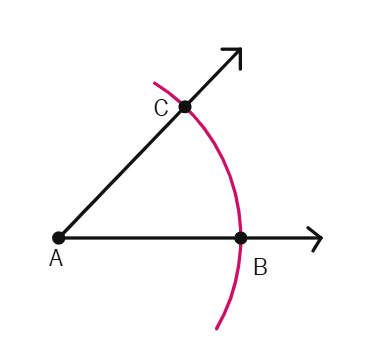
- Set the compass width to the distance BC (the segment between the two intersection points on the given angle).
5. Transfer the Measurement to the New Angle:
- Place the compass pointer at Q and draw an arc that intersects the previous arc at R.
6. Complete the Angle:
Join P to R with a straight line.
∠RPQ is the required angle, which is an exact copy of ∠BAC.
Thus, ∠QPR ≅ ∠BAC, meaning both angles have the same measure.