
Perimeter
Do you remember what the perimeter of a closed plane figure is?
Let us refresh our understanding! The perimeter of any closed plane figure is the distance covered along its boundary when you go around it once.
For a polygon, i.e., a
The perimeter of a polygon = the sum of the lengths of its all sides.
Let us revise the formulas for the perimeter of rectangles, squares, and triangles.
Perimeter of a rectangle
Consider a rectangle ABCD whose length and breadth are 12 cm and 8 cm, respectively. What is its perimeter?
Perimeter of the rectangle = Sum of the lengths of its four sides
= AB + BC + CD + DA
= AB + BC + AB + BC
=
=
= 2 × (
= 2 × (
=
Opposite sides of a rectangle are always equal. So, AB =
From this example, we see that—
Perimeter of a rectangle = length + breadth + length + breadth.
Perimeter of a rectangle =
The perimeter of a rectangle is twice the sum of its length and breadth.
Perimeter of a square
Debojeet wants to put coloured tape all around a square photo frame of side 1m as shown.
What will be the length of the coloured tape he requires?
Since Debojeet wants to put the coloured tape all around the square photo frame, he needs to find the perimeter of the photo frame.
Thus, the length of the tape required = perimeter of the square = sum of the lengths of all four sides of the square = 1 m + 1 m + 1 m + 1 m =
Now, we know that all four sides of a square are equal in
Therefore, in place of adding the lengths of each side, we can simply multiply the length of one side by
Thus, the length of the tape required = 4 × 1 m =
From this example, we see that
Perimeter of a square =
The perimeter of a square is quadruple the length of its side.
Consider a triangle having three given sides of lengths 4 cm, 5 cm and 7 cm. Find its perimeter.
Perimeter of the triangle = 4 cm + 5 cm + 7 cm =
Perimeter of a triangle = sum of the lengths of its
Example 1
1. Akshi wants to put lace all around a rectangular tablecloth that is 3 m long and 2 m wide. Find the length of the lace required.
Solution:
Length of the rectangular table cover =
Breadth of the rectangular table cover =
Akshi wants to put lace all around the tablecloth.
Therefore, the length of the lace required will be the perimeter of the
Now, the perimeter of the rectangular tablecloth = 2 × (length + breadth)
= 2 × (3 m + 2 m) = 2 ×
Hence, the length of the lace required is 10 m.
Example 2
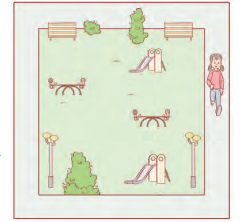
2. Find the distance travelled by Usha if she takes three rounds of a square park of side 75 m.
Solution:
Perimeter of the square park = 4 × length of a side = 4 ×
Distance covered by Usha in one round = 300 m.
Therefore, the total distance travelled by Usha in three rounds =
1. Find the missing terms:
a
a. Perimeter of a rectangle = 14 cm; breadth = 2 cm; length = ?.
The formula for the perimeter of a rectangle is: P = 2 X (L + B)
Given P =
14 = 2 x (L +
14 = 2L +
2L =
L =
b
b. Perimeter of a square = 20 cm; side of a length = ?.
The formula for the perimeter of a square is: P = 4 x Side
Given P =
Side =
c
c. Perimeter of a rectangle = 12 m; length = 3 m; breadth = ?.
The formula for the perimeter of a rectangle is: P = 2 X (L + B)
Given P =
12 = 2 x (
12 =
2B =
B =
2
2. A rectangle having sidelengths 5 cm and 3 cm is made using a piece of wire. If the wire is straightened and then bent to form a square, what will be the length of a side of the square?
The formula for the perimeter of a rectangle is: P = 2 X (L + B)
Given L =
Perimeter of the rectangle is P = 2 x (5 + 3) =
The formula for the perimeter of a square is: P = 4 x Side
When bent into a square, the perimeter remains the same.
Length of one side = 16 ÷ 4 =
3
3. Find the length of the third side of a triangle having a perimeter of 55 cm and having two sides of length 20 cm and 14 cm, respectively.
The perimeter is the sum of all sides.
P =
Using the formula: 55 =
Solving gives third side = 55 –
4
4. What would be the cost of fencing a rectangular park whose length is 150 m and breadth is 120 m, if the fence costs `40 per metre?
The formula for the perimeter of a rectangle is: P = 2 X (L + B)
The perimeter is P = 2 x (
= 2 x
Total cost = 540 x 40 =
The fencing will cost 21600 rupees.
5
5. A piece of string is 36 cm long. What will be the length of each side, if it is used to form:
a. A square,
The formula for the perimeter of a square is: P = 4 x Side
A square’s perimeter is P = 4 x side.
Using the formula:
side = 36 ÷ 4 =
Each side of the square is 9 cm.
b. A triangle with all sides of equal length, and
An equilateral triangle has 3 equal sides.
Side length =
Each side of the equilateral triangle is 12 cm.
c. A hexagon (a six sided closed figure) with sides of equal length?
Side length =
Each side of the hexagon is 6 cm.
6
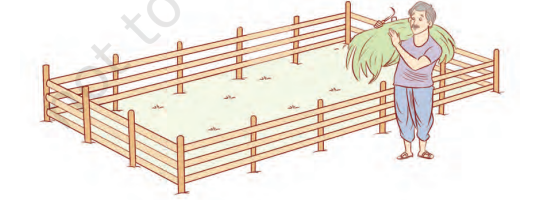
6. A farmer has a rectangular field having length 230 m and breadth 160 m. He wants to fence it with 3 rounds of rope as shown. What is the total length of rope needed?
The formula for the perimeter of a rectangle is: P = 2 X (L + B)
The perimeter of the field is P = 2 x (230 +
= 2 x 390 =
For 3 rounds, total rope needed is 3 x 780 =
1
1. Find out the total distance Akshi has covered in 5 rounds.
The outer track perimeter is 2 x (70 + 40) =
Akshi runs 5 rounds.
Total distance covered = 5 x 220 =
2
2. Find out the total distance Toshi has covered in 7 rounds. Who ran a longer distance?
The inner track perimeter is 2 x (60 + 30) =
Toshi runs 7 rounds. Total distance = 7 x 180 =
Toshi ran farther than Akshi’s 1100 m.
Deep Dive: In races, usually there is a common finish line for all the runners. Here are two square running tracks with the inner track of 100 m each side and outer track of 150 m each side.
The common finishing line for both runners is shown by the flags in the figure which are in the center of one of the sides of the tracks.
If the total race is of 350 m, then we have to find out where the starting positions of the two runners should be on these two tracks so that they both have a common finishing line after they run for 350 m. Mark the starting points of the runner on the inner track as ‘A’ and the runner on the outer track as ‘B’
Estimate and Verify
Take a rough sheet of paper or a sheet of newspaper. Make a few random shapes by cutting the paper in different ways. Estimate the total length of the boundaries of each shape then use a scale or measuring tape to measure and verify the perimeter for each shape.

Akshi says that the perimeter of this triangle shape is 9 units.
Toshi says it can’t be 9 units and the perimeter will be more than 9 units. What do you think?
This figure has lines of two different unit lengths. Measure the lengths of a red line and a blue line; are they same? We will call the red lines—straight lines and the blue lines—diagonal lines.
So, the perimeter of this triangle is 6 straight units + 3 diagonal units.
Wecan write this in a short form as: 6s + 3d units.
Write the perimeters of the figures below in terms of straight and diagonal units.
Like squares, closed figures that have all sides and all angles equal are called regular polygons. We studied the sequence of regular polygons as ‘Shape Sequence’ #1 in Chapter 1.
Examples of regular polygons are the equilateral triangle (where all three sides and all three angles are equal), regular pentagon (where all five sides and all five angles are equal), etc.
We know that for any triangle its perimeter is sum of all
Using this understanding, we can find the perimeter of an equilateral triangle.
Perimeter of an equilateral triangle = AB + BC + AC = AB + AB + AB = 3 times length of
Perimeter of an equilateral triangle = 3 × length of a side.
What is a similarity between a square and an equilateral triangle?
Find various objects from your surroundings that have regular shapes and find their perimeters.
Also, generalise your understanding for the perimeter of other regular polygons.
Discuss more about regular polygons and encourage students to come up with a general formula for the perimeter of a regular polygon.
Split and rejoin
A rectangular paper chit of dimension 6 cm × 4 cm is cut as shown into two equal pieces. These two pieces are joined in different ways.