
Easy Level Worksheet
Part A: Subjective Questions - Very Short Answer (1 Mark Each)
Note: Answer each question carefully. Draw neat diagrams where required.
In this easy level, we'll learn the basics of symmetry, lines of symmetry, and reflection.
Let's explore the beauty of symmetry in shapes and nature!
1. What is symmetry?
Symmetry is when one half of a shape is the
Perfect! Symmetry means balanced proportions.
2. What is a line of symmetry?
A line of symmetry is a line that
Excellent! Also called mirror line or axis of symmetry.
3. Give two examples of symmetrical shapes.
Example 1:
Example 2:
Great! Many geometric shapes have symmetry.
4. Which English letter has one vertical line of symmetry?
Examples:
Perfect! Letters like A, M, T, U, V, W, Y have vertical symmetry.
5. Which English letter has no line of symmetry?
Examples:
Correct! Letters like F, G, J, L, N, P, Q, R, S, Z have no line symmetry.
6. What is reflection symmetry?
Reflection symmetry is when one half is a
Excellent! Same as line symmetry.
7. Name a shape that has no line of symmetry.
Example:
Correct! Asymmetric shapes have no line of symmetry.
8. What is the line of symmetry in an equilateral triangle?
An equilateral triangle has
Each line goes from a
Perfect! Three lines of symmetry in equilateral triangle.
9. Write one example from nature that shows symmetry.
Example:
Great! Nature is full of symmetrical patterns.
10. Define mirror line.
A mirror line is the
Perfect! Same as line of symmetry.
Drag each shape to its correct number of symmetry lines:
Part A: Section B – Short Answer Questions (2 Marks Each)
Problem 1: How many lines of symmetry does a square have?
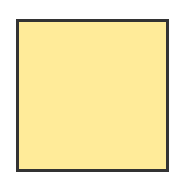
A square has
Type 1:
Type 2:
Type 3:
Perfect! Square has 4 lines of symmetry total.
Problem 2: How many lines of symmetry does a rectangle have?

A rectangle has
Line 1:
Line 2:
Excellent! Rectangle has 2 lines (no diagonal symmetry).
Problem 3: How many lines of symmetry does a circle have?
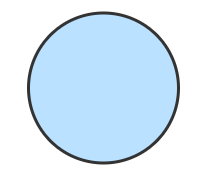
A circle has
Any
Perfect! Every diameter divides circle into equal halves.
Problem 4: How many lines of symmetry does an equilateral triangle have?
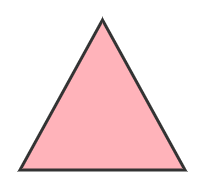
An equilateral triangle has
Each line connects a
Great! Three lines, one from each vertex.
Problem 5: How many lines of symmetry does a regular pentagon have?
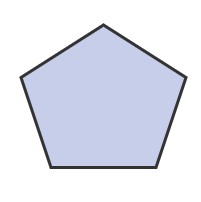
A regular pentagon has
Correct! Regular polygons have symmetry lines equal to their sides.
Part B: Objective Questions - Test Your Knowledge!
Answer these multiple choice questions:
6. Letter 'H' has:
(a) 1 (b) 2 (c) 0 (d) None
Correct! Letter H has 2 lines: one vertical and one horizontal.
7. Line symmetry divides a shape into:
(a) Equal halves (b) Unequal halves (c) Random parts (d) None
Perfect! Line of symmetry creates two equal mirror halves.
8. Mirror symmetry is also called:
(a) Reflection (b) Rotation (c) Translation (d) Distortion
Excellent! Mirror symmetry = Reflection symmetry = Line symmetry.
9. A square shows both line and rotational symmetry. (True/False)
Correct! Square has 4 lines of symmetry and rotational symmetry.
10. A circle has finite lines of symmetry. (True/False)
Perfect! Circle has infinite lines of symmetry, not finite.
🎉 Fantastic Work! You've Mastered Basic Symmetry!
Here's what you learned:
What is Symmetry?:
Definition:
- Balance and proportion in shapes
- One half is mirror image of other
- Divides shape into identical parts
Importance:
- Found everywhere in nature
- Used in art and design
- Helps identify patterns
Line of Symmetry:
Also called:
- Mirror line
- Axis of symmetry
- Line of reflection
Properties:
- Divides shape into two equal halves
- Each half is mirror image of other
- Can fold shape along this line perfectly
Number of Lines in Common Shapes:
Square:
- 4 lines of symmetry
- 2 diagonal lines
- 1 vertical line
- 1 horizontal line
Rectangle:
- 2 lines of symmetry
- 1 vertical line
- 1 horizontal line
- No diagonal symmetry
Circle:
- Infinite lines of symmetry
- Every diameter is a line of symmetry
- Most symmetrical shape
Equilateral Triangle:
- 3 lines of symmetry
- From each vertex to midpoint of opposite side
- All three lines meet at center
Regular Pentagon:
- 5 lines of symmetry
Regular Hexagon:
- 6 lines of symmetry
Pattern: Regular n-sided polygon has n lines of symmetry
Shapes with NO Line of Symmetry:
- Scalene triangle (all sides different)
- Parallelogram (except special cases)
- Trapezium (except isosceles)
- Most irregular shapes
Symmetry in Letters:
One vertical line:
- A, M, T, U, V, W, Y
One horizontal line:
- B, C, D, E, K
Two lines (vertical + horizontal):
- H, I, O, X
No line of symmetry:
- F, G, J, L, N, P, Q, R, S, Z
Reflection/Mirror Symmetry:
Concept:
- Same as line symmetry
- One half reflects to form other half
- Like looking in a mirror
Testing for symmetry:
- Fold shape along line
- If halves match perfectly → symmetrical
- If halves don't match → not symmetrical
Symmetry in Nature:
Examples:
- Butterfly wings
- Human face
- Flowers (petals)
- Leaves
- Starfish
- Snowflakes
Why symmetry in nature?
- Efficiency in growth
- Balance in structure
- Aesthetic appeal
Symmetry in Everyday Objects:
- Buildings (architecture)
- Furniture design
- Vehicle design
- Logo design
- Rangoli patterns
- Artwork
How to Draw Symmetrical Shapes:
- Draw half of the shape
- Mark the line of symmetry
- Reflect each point across the line
- Draw the mirror image
- Both halves should be identical
Common Mistakes to Avoid:
- Confusing symmetry with equality
- Counting wrong number of lines
- Missing diagonal lines in square
- Thinking rectangle has 4 lines
- Not checking mirror image carefully
Understanding symmetry helps appreciate beauty in mathematics, nature, and art!