

Exercise 12.3
1. Draw the following triangles and construct circumcircles for them.
(i) In ΔABC, AB = 6cm, BC = 7cm and ∠A = 60°
(ii) In ΔPQR, PQ = 5cm, QR = 6cm and RP = 8.2cm
(iii) In ΔXYZ, XY = 4.8cm, ∠X = 60° and ∠Y = 70°
Draw it in your notebook.
2. Draw two circles passing through A, B where AB = 5.4cm
Solution:
Steps for construction:
- Draw line segment AB =
cm
2. Draw the perpendicular bisector of AB
3. Mark any point
4. With C as centre and CA as radius, draw the
5. This circle passes through both
6. Mark another point
7. With D as centre and DA as radius, draw the
8. This circle also passes through both A and B
Note: Any circle passing through two points must have its centre on the
3. If two circles intersect at two points, then prove that their centres lie on the perpendicular bisector of the common chord.
Solution:
Let the two circles with centres O₁ and O₂ intersect at points
AB is the
To prove: O₁ and O₂ lie on the perpendicular bisector of AB
Proof:
Since A and B are points on the circle with centre O₁:
O₁A =
Therefore, O₁ is
Similarly, since A and B are points on the circle with centre O₂:
O₂A =
Therefore, O₂ is also
The locus of all points equidistant from two given points is the
Since both O₁ and O₂ are equidistant from A and B:
Both O₁ and O₂ lie on the
Hence proved.
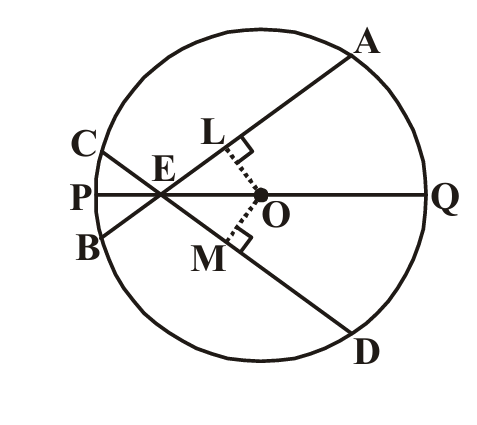
4. If two intersecting chords of a circle make equal angles with diameter passing through their point of intersection, prove that the chords are equal.
Solution:
Let AB and CD be two chords intersecting at point
Let EF be the diameter passing through P.
Given: ∠APE =
To prove: AB =
Proof:
Draw perpendiculars from centre O to chords AB and CD.
Let OM ⊥ AB and ON ⊥ CD.
Since the perpendicular from centre bisects the chord:
AM =
In the configuration, since the chords make equal angles with the diameter:
The perpendicular distances from centre O to both chords are
Therefore: OM =
Chords equidistant from the centre are
Therefore: AB =
Hence proved.
5. In the adjacent figure, AB is a chord of circle with centre O. CD is the diameter perpendicular to AB. Show that AD = BD.
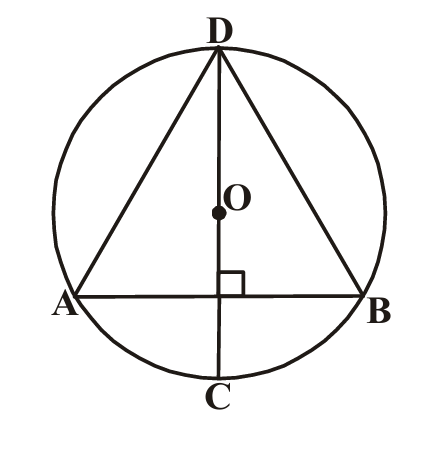
Solution:
Given: AB is a chord, CD is diameter ⊥ AB
To prove: AD =
Proof:
Since CD is perpendicular to chord AB:
CD
Let CD intersect AB at point
Then: AM =
In triangles AMD and BMD:
AM =
DM =
∠AMD = ∠
By
Therefore: AD =
Hence proved.