

Exercise 12.4
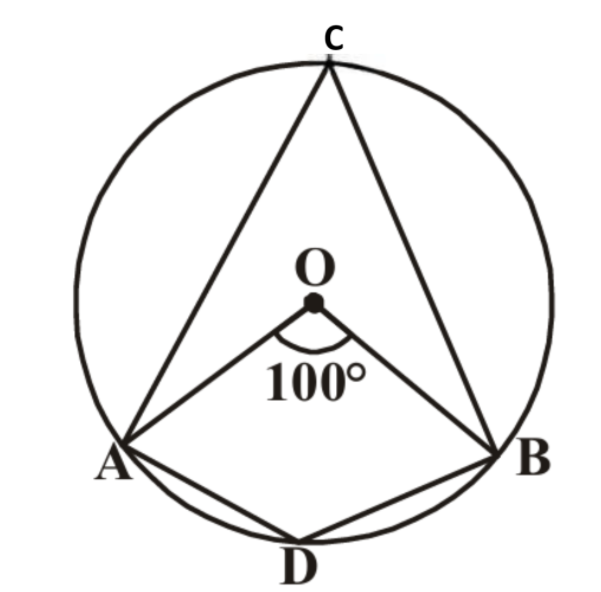
1. In the figure, 'O' is the centre of the circle. ∠AOB = 100°, find ∠ADB.
Solution:
Given: ∠AOB =
∠AOB is the
∠ADB is the
By the inscribed angle theorem:
Inscribed angle =
∠ADB =
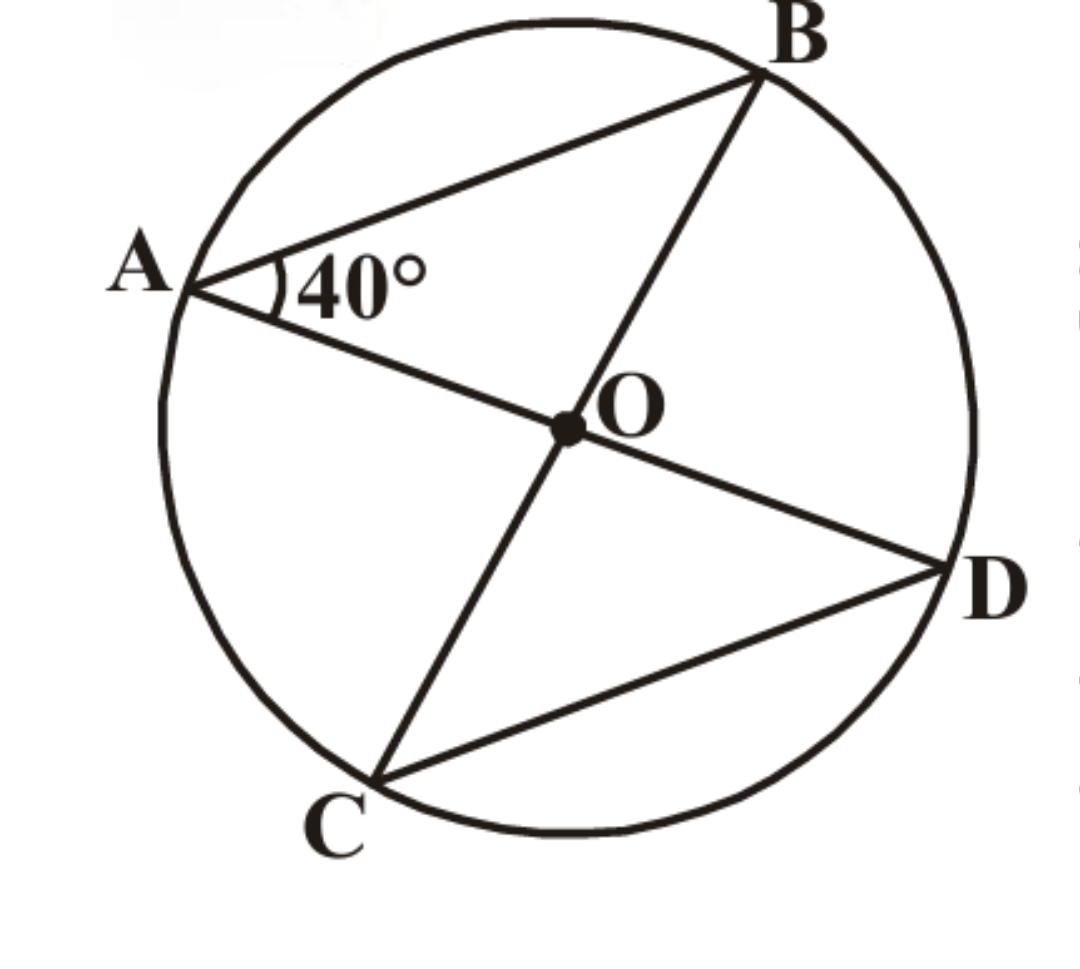
2. In the figure, ∠BAD = 40°, then find ∠BCD.
Solution:
Given: ∠BAD =
ABCD is a
In a cyclic quadrilateral, opposite angles are
Therefore: ∠BAD + ∠BCD =
∠BCD = 180° -
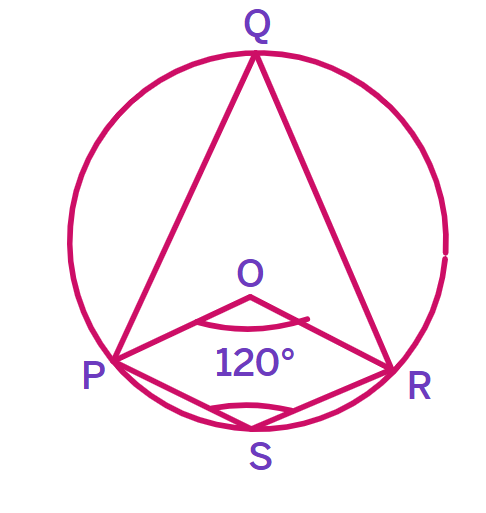
3. In the figure, O is the centre of the circle and ∠PQR = 120°. Find ∠POR and ∠PSR.
Solution:
Given: ∠PQR =
Finding ∠POR:
∠PQR is an
∠POR is the
Central angle =
∠POR = 2 × ∠PQR = 2 ×
Since 240° > 180°, we take the reflex angle.
The actual ∠POR = 360° - 240° =
Finding ∠PSR:
Both ∠PQR and ∠PSR are inscribed angles subtending the same arc
Inscribed angles subtending the same arc are
Therefore: ∠PSR = ∠PQR =
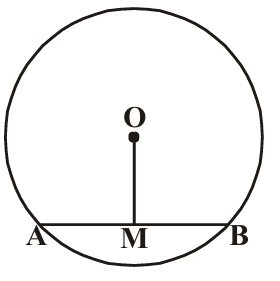
4. In the figure, 'O' is the centre of the circle. OM = 3cm and AB = 8cm. Find the radius of the circle.
Solution:
Given: OM =
OM is
The perpendicular from centre to a chord
Therefore: AM = MB = AB/2 =
In right triangle OMA:
OA² = OM² + AM² (Pythagorean theorem)
OA² =
OA = √
Since OA is a radius: radius =
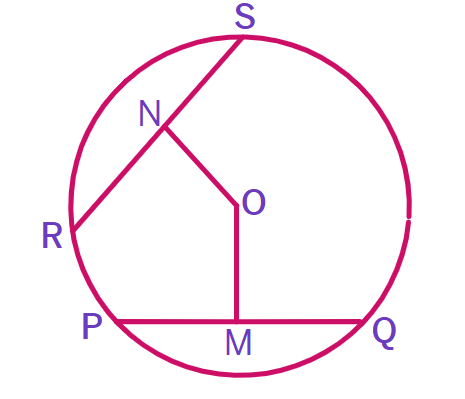
5. In the figure, 'O' is the centre of the circle and OM, ON are the perpendiculars from the centre to the chords PQ and RS. If OM = ON and PQ = 6cm. Find RS.
Solution:
Given: OM ⊥ PQ, ON ⊥ RS, OM =
Since OM = ON:
The chords PQ and RS are
Theorem: Chords equidistant from the centre are
Therefore: PQ =
Since PQ = 6 cm:
RS =
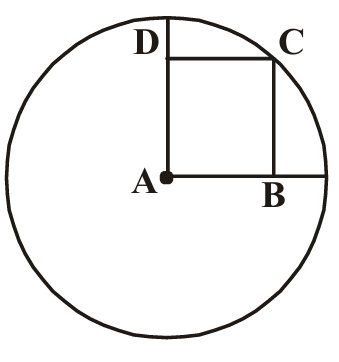
6. A is the centre of the circle and ABCD is a square. If BD = 4cm then find the radius of the circle.
Solution:
Given: A is the centre, ABCD is a
In square ABCD, the diagonals are
Since A is the centre of the circle and also the centre of square ABCD:
All vertices B, C, D are equidistant from A.
Therefore: AB = AC = AD =
In a square, if side length is s, then diagonal = s√
Let the side length of square = s
Then diagonal BD = s√2 =
s =
The radius = side length of square =
7. Draw a circle with any radius and then draw two chords equidistant from the centre.
Draw it in your notebook
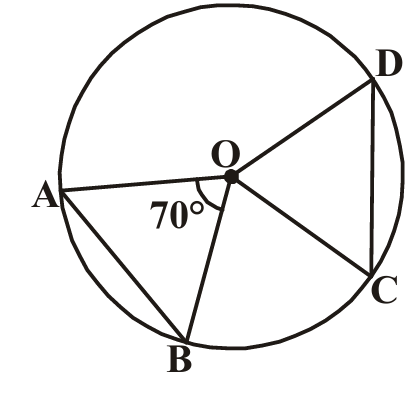
8. In the given figure 'O' is the centre of the circle and AB, CD are equal chords. If ∠AOB = 70°. Find the angles of the ΔOCD.
Solution:
Given: AB = CD (equal chords) and ∠AOB =
Since AB = CD are equal chords:
Equal chords subtend
Therefore: ∠AOB =
In triangle OCD:
OC = OD =
Therefore, triangle OCD is
In an isosceles triangle, base angles are
Let ∠OCD = ∠ODC = x
Sum of angles in triangle =
∠COD + ∠OCD + ∠ODC = 180°
70° + 2x = 180°
2x =
x =
Therefore: ∠COD =