
Area of a Polygon
When trying to find area of a random polygon, logically, we can simply split the given polygon into smaller familiar geometric shapes and then proceed to find the areas of the individual pieces before adding them up.
Figure (a)
Figure (b)
Above in Figure (a), we can draw the diagonals AC and AD which leads to the polygon being split into three smaller and non-congruent triangles. We can draw their corresponding heights and proceed to calculate the individual areas and add them up
(OR)
we can follow Figure (b), drawing just one diagonal (AD) and getting one trapezium and a triangle. From here on, the process is the same.
Example 1: The area of a trapezium shaped field is 480
- We know that, the area of a trapezium:
unit 2 - Substituting the values given to us in equation.
- Length of the second parallel side:
m - Thus, we have got the desired value.
Example 2: The area of a rhombus is 240
(ii) Polygon ABCDE is divided into parts. Find its area if:
AD = 8 cm , AH = 6 cm , AG = 4 cm
AF = 3 cm , BF = 2 cm
BF = 2 cm , CH = 3 cm , EG = 2.5 cm
Polygon ABCDE
- We can see from the above figure, that the polygon ABCDE has been divided into 3
and 1 . - The area of a triangle:
where b - base length and h - height length - The area of a trapezium:
where h - height , a and b - the length of the parallel sides. - Finding the individual areas: Area of ABF =
cm 2 cm 2 - Area of ADE =
cm 2 cm 2 - Total area sum:
cm 2 - We got the desired value.
(iii) Find the area of polygon MNOPQR, if MP = 9 cm, MD = 7 cm, MC = 6 cm, MB = 4 cm, MA = 2 cm NA, OC, QD and RB are perpendiculars to diagonal MP.
Example 3: There is a regular hexagon ABCDEF of side 5 cm. Aman and Riddhima divided it in two different ways as indicated in below figures. Find the area using both methods.
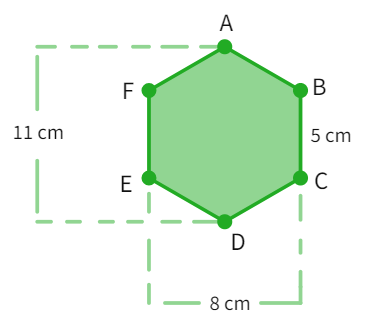
(a) Polygon ABCDEF
Aman's method
- Upon using the above given dimensions: Height of each trapezium =
cm - Substituting the value we get
- Area of one trapezium:
cm 2 - Area of polygon ABCDEF:
cm 2 - We have found the area using Aman's method.
Riddhima's method
- Upon using the above given dimensions: Height of each triangle =
cm - Substituting the value we get
- Area of each triangle:
cm 2 cm 2 - Area of polygon ABCDEF:
cm 2 - We have found the area using Ridhima's method.