

Area of a Quadrilateral
Any quadrilateral can be divided into two
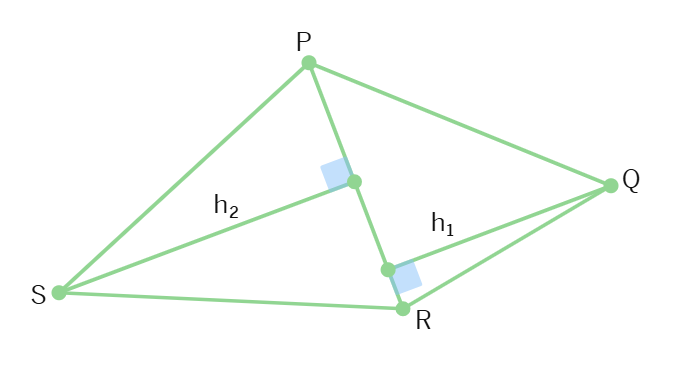
Consider quadrilateral PQRS:
Draw diagonal PR to split it into two triangles
From points Q and S, draw perpendicular lines to PR
Let's call these heights h₁ and h₂ respectively
Let's call the diagonal length 'L'
Thus, we have:
Area of triangle PQR =
Area of triangle RSP =
Total area of PQRS =
This can be written as:
Area =
A field has the shape of a quadrilateral WXYZ. A surveyor measures the diagonal WY as 100 meters. The perpendicular distances from points X and Z to this diagonal are 45 meters and 35 meters respectively. Find the area of the field.
We know: d =
Area =
An architect is designing a uniquely shaped courtyard DEFG. The diagonal EG is 24 meters, and the perpendicular heights from D and F to this diagonal are 8 meters and 12 meters respectively. (a) What is the area of the courtyard? (b) If the cost of flooring is Rs. 50 per square meter, what will be the total cost of flooring the courtyard?
(a) Area calculation: d =
Area =
(b) Cost calculation: Cost per square meter = Rs.
Total cost =