

Exercise 7.1
Theorem: In any triangle, the side opposite to the larger angle is longer.
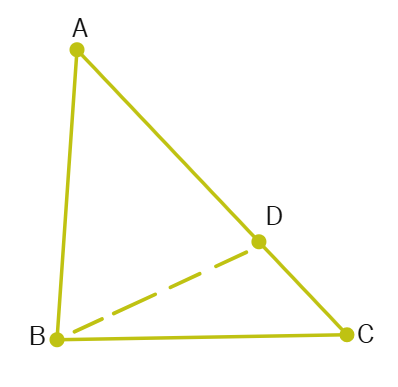
Consider a triangle ABC, where ∠B > ∠C. We need to prove that AC > AB (i.e., the side opposite the larger angle is longer).
On AC, extend the side such that D is a point on BC, and AD = AB.
Now, in ΔABD, we observe that AB = AD (by construction).
Since AD = AB, ΔABD is an
In a triangle, the side opposite a larger angle is longer, so:
Since AD = AB +
Which proves that the side opposite the larger angle is longer.
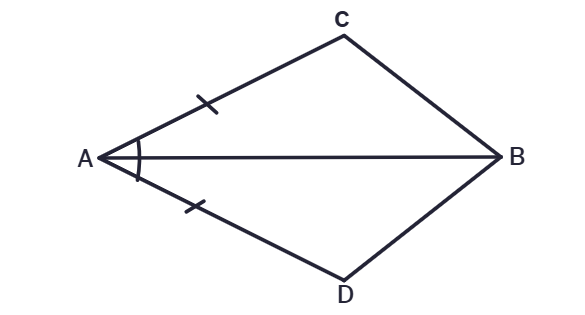
1. In quadrilateral ACBD, AC = AD and AB bisects ∠A. Show that ΔABC ≅ ΔABD. What can you say about BC and BD?
Solution:
Given:
AC =
To Prove:
ΔABC ≅ ΔABD
Proof:
Since AB bisects ∠A, it means that ∠CAB =
Now, consider triangles ΔABC and ΔABD:
AC =
∠CAB
AB = AB (Common side)
By the Side-Angle-Side (SAS) congruence rule, if two sides and the included angle of one triangle are equal to the corresponding two sides and the included angle of another triangle, then the triangles are
Therefore, ΔABC
What can be said about BC and BD?
Since ΔABC ≅ ΔABD, by the Corresponding Parts of Congruent Triangles (CPCT), corresponding sides and angles are
Therefore, BC =
In conclusion, ΔABC is congruent to ΔABD, and BC is equal to BD.
2. ABCD is a quadrilateral in which AD = BC and ∠DAB = ∠CBA. Prove that:
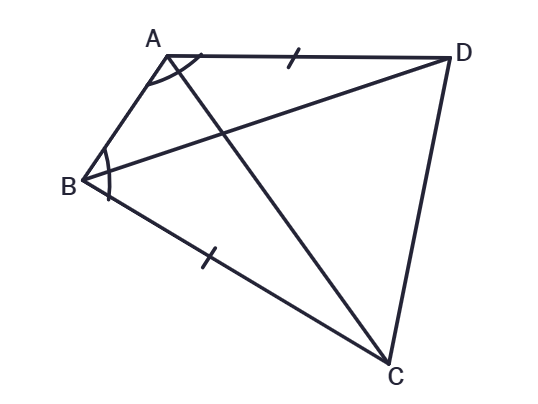
(i) ΔABD ≅ ΔBAC
(ii) BD = AC
(iii) ∠ABD = ∠BAC
Solution:
Given:
AD =
∠DAB =
To Prove:
(i) ΔABD ≅ ΔBAC
In ΔABD and ΔBAC,
Therefore, by
ΔABD ≅ ΔBAC
(ii) BD = AC
Since ΔABD ≅ ΔBAC, by
BD =
(iii) ∠ABD = ∠BAC
Since ΔABD ≅
∠ABD =
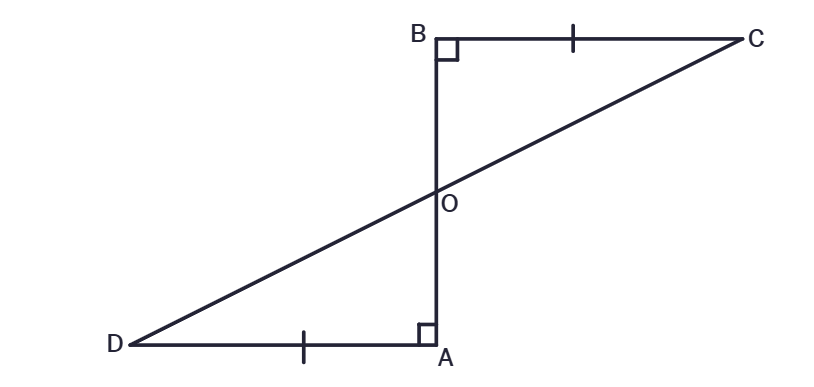
3. AD and BC are equal and perpendiculars to a line segment AB. Show that CD bisects AB.
Solution:
Given:
AD =
AD ⊥
BC ⊥
To Prove:
CD bisects
Proof:
In ΔAOD and ΔBOC,
∠DAO =
AD =
∠AOD =
Therefore, by
ΔAOD ≅
Since ΔAOD ≅ ΔBOC, by
AO =
Therefore, CD bisects
4. l and m are two parallel lines intersected by another pair of parallel lines p and q. Show that ΔABC ≅ ΔCDA
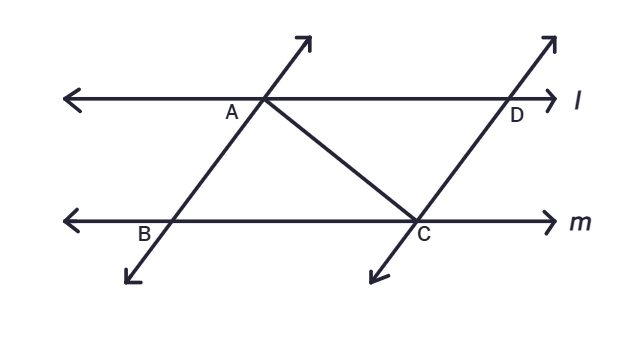
Solution:
Given:
l ||
p ||
To Prove:
ΔABC ≅
Proof:
In ΔABC and ΔCDA,
∠BAC =
AC =
∠BCA =
Therefore, by
ΔABC ≅ ΔCDA
5. In the adjacent figure, AC = AE, AB = AD and ∠BAD = ∠EAC. Show that BC = DE.
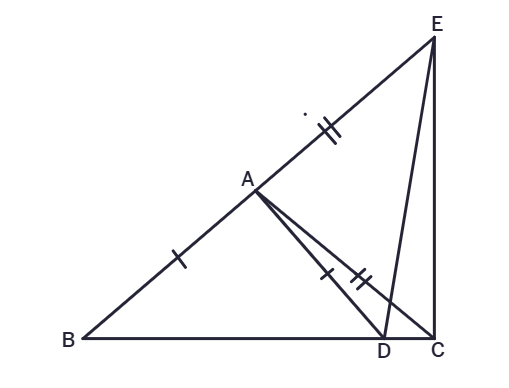
Solution:
Given:
AC =
AB =
∠BAD =
To Prove:
BC =
Proof:
∠BAD =
Adding ∠DAC to both sides,
∠BAD +
∠BAC =
In ΔABC and ΔADE,
AB =
AC =
∠BAC =
{.reveal(when="blank-4")}Therefore, by
ΔABC ≅ ΔADE
Since ΔABC ≅ ΔADE, by
BC =
6. In right triangle ABC, right angle is at C, M is the mid-point of hypotenuse AB. C is joined to M and produced to a point D such that DM = CM. Point D is joined to point B (see figure). Show that :
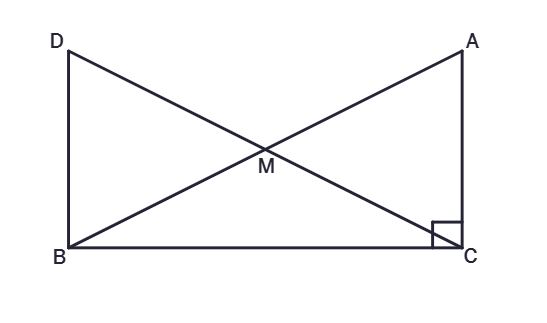
(i) ΔAMC ≅ ΔBMD
(ii) ∠DBC is a right angle
(iii) ΔDBC ≅ ΔACB
(iv) CM = 1/2 AB.
Solution:
Given:
∠ACB =
M is the midpoint of
DM =
To Prove:
Proof:
(i) ΔAMC ≅ ΔBMD
In ΔAMC and ΔBMD,
AM =
CM =
∠AMC =
Therefore, by
ΔAMC ≅ ΔBMD
(ii) ∠DBC is a right angle
Since ΔAMC ≅ ΔBMD, by
∠ACM =
AC =
∠ACB =
Since ∠ACB = 90°, ∠DBC =
(iii) ΔDBC ≅ ΔACB
In ΔDBC and ΔACB,
DB =
BC =
∠DBC =
Therefore, by
ΔDBC ≅ ΔACB
(iv) CM = 1/2 AB
Since ΔDBC ≅ ΔACB, by
DC =
DM = CM (Given)
DC =
2CM =
CM =
7. In the adjacent figure ABCD is a square and ΔAPB is an equilateral triangle. Prove that ΔAPD ≅ ΔBPC.
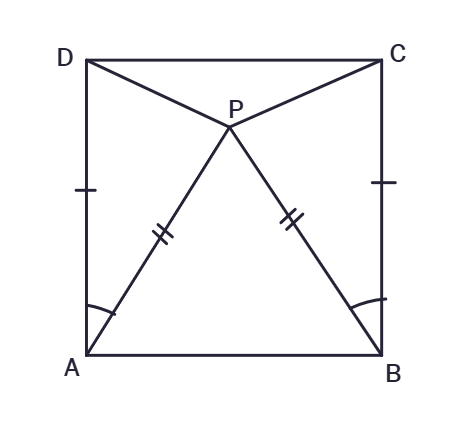
Solution:
Given:
ABCD is a
ΔAPB is an
To Prove:
ΔAPD ≅
Proof:
In ΔAPD and ΔBPC,
AD =
AP =
∠PAB =
∠PAD = ∠DAB - ∠PAB =
Similarly, ∠CBA =
∠PBA =
∠PBC = ∠CBA - ∠PBA =
Therefore, ∠PAD =
Thus, by
ΔAPD ≅ ΔBPC
8. In the adjacent figure ΔABC, D is the midpoint of BC. DE ⊥ AB, DF ⊥ AC and DE = DF. Show that ΔBED ≅ ΔCFD.
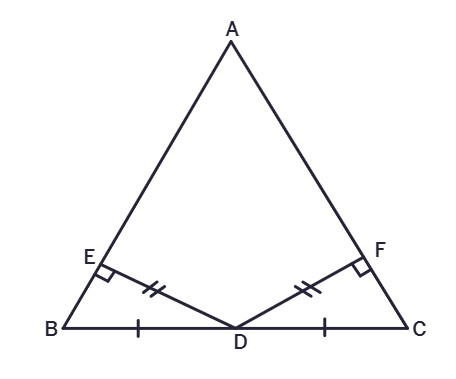
Solution:
Given:
D is the midpoint of
DE ⊥
DF ⊥
DE =
To Prove:
ΔBED ≅
Proof:
In ΔBED and ΔCFD,
∠BED =
BD =
∠BDE =
Therefore, by
ΔBED ≅ ΔCFD
9. If the bisector of an angle of a triangle also bisects the opposite side, prove that the triangle is isosceles.
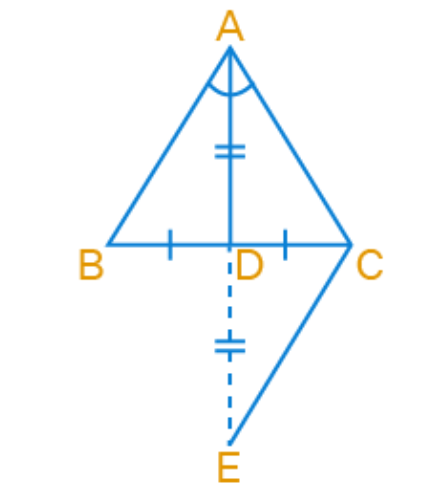
Solution:
Given:
Triangle ABC.
AD is the angle bisector of ∠BAC.
AD bisects
To Prove:
Triangle ABC is isosceles (AB = AC).
Construction:
Extend AD to point E such that AD =
Join CE.
Proof:
In ΔADB and ΔEDC:
BD =
∠ADB =
AD =
By
Therefore, AB =
Also, ∠BAD =
Given that AD is the bisector of ∠BAC, ∠BAD =
From above, ∠CAD =
In ΔAEC, ∠CAD = ∠CED, so AC =
From above, AB = CE and AC = CE. Therefore, AB =
Hence, triangle ABC is isosceles.
10. In the given figure ABC is a right triangle and right angled at B such that ∠BCA = 2∠BAC. Show that hypotenuse AC = 2BC. (Hint : Produce CB to a point D that BC = BD)
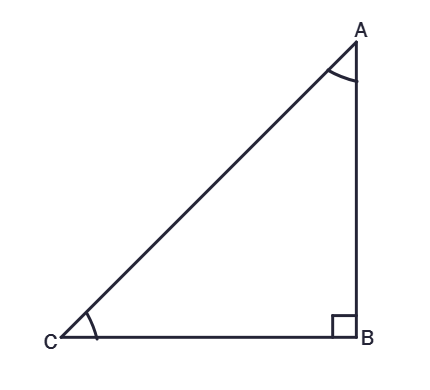
Solution:
Given:
ΔABC is a right triangle, ∠ABC =
∠BCA = 2∠
BC =
To Prove:
AC = 2
Proof:
In ΔABC and ΔABD,
BC =
∠ABC =
AB =
Therefore, by
ΔABC ≅ ΔABD
Since ΔABC ≅ ΔABD, by
AC =
∠BAC =
∠CAD = ∠BAC + ∠BAD = 2∠
∠BCA = 2∠BAC (Given)
∠CAD =
In ΔACD,
∠CAD = ∠ACD
AD =
AC = AD (Proved above)
AC = CD
CD = CB +
CD = BC + BC = 2
AC = 2BC