

Exercise 7.3
1. AD is an altitude of an isosceles triangle ABC in which AB = AC. Show that:
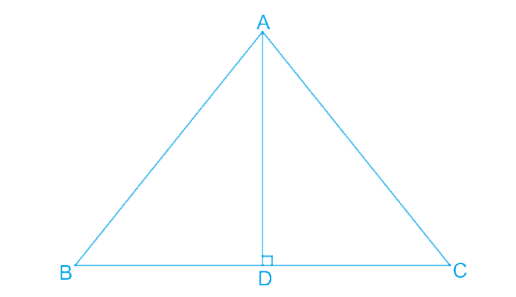
(i) AD bisects BC
(ii) AD bisects ∠A.
Solution:
Given:
ABC is an isosceles triangle with AB =
AD is the altitude from A to
Proof:
AD bisects
In ΔADB and ΔADC:
∠ADB = ∠ADC =
AB =
AD =
By RHS congruence rule, ΔADB ≅ ΔADC.
Therefore, BD =
AD bisects
Since ΔADB ≅ ΔADC (Proved above), ∠BAD =
Therefore, AD bisects ∠A.
2. Two sides AB, BC and median AM of one triangle ABC are respectively equal to sides PQ and QR and median PN of ΔPQR. Show that:
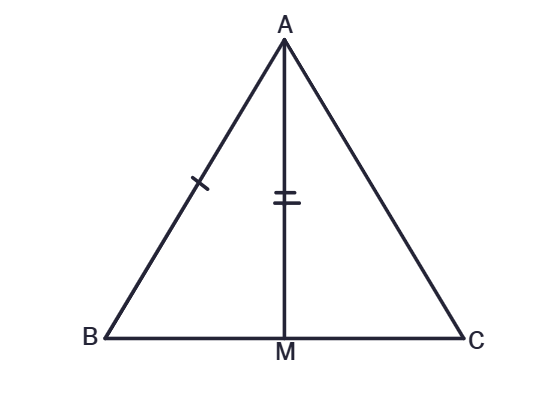
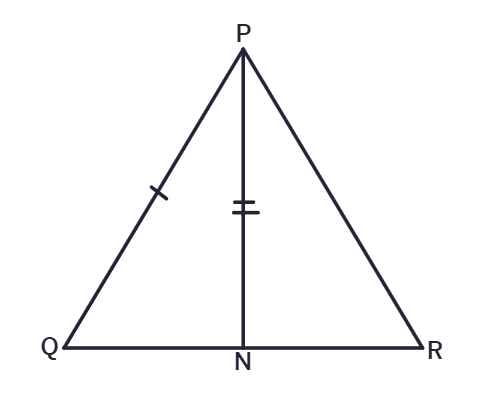
(i) ΔABM ≅ ΔPQN (ii) ΔABC ≅ ΔPQR
Solution:
AB =
BC =
AM =
(i) ΔABM ≅ ΔPQN
BM =
QN =
BC =
Therefore, BM =
AB =
AM =
By
(ii) ΔABC ≅ ΔPQR
ΔABM ≅ ΔPQN (Proved above)
∠ABM =
∠ABC =
AB =
BC =
By SAS congruence rule, ΔABC ≅
3. BE and CF are two equal altitudes of a triangle ABC. Using RHS congruence rule, prove that the triangle ABC is isosceles.
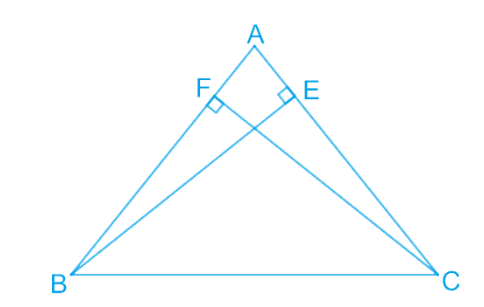
Solution:
Given:
BE and CF are altitudes of ΔABC.
BE =
To Prove:
ΔABC is isosceles (i.e., AB = AC).
Proof:
In ΔBCE and ΔCBF:
∠BEC = ∠CFB =
BC = BC (Common side)
BE =
By
Therefore, ∠BCE =
∠BCE is the same as ∠ACB, and ∠CBF is the same as ∠ABC.
So, ∠ACB =
In ΔABC, ∠ACB = ∠ABC. Therefore, AB =
Therefore, ΔABC is isosceles.
ABC is an isosceles triangle with AB = AC. Draw AP ⊥ BC to show that ∠B = ∠C.
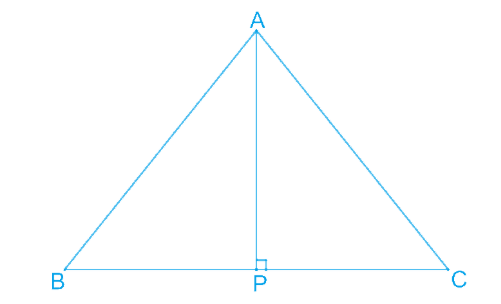
Solution:
Given:
ABC is an isosceles triangle with AB =
AP ⊥
To Prove:
∠B = ∠C
Proof:
In ΔABP and ΔACP:
∠APB = ∠APC =
AB =
AP = AP (Common side)
By
Therefore, ∠B =
∠B = ∠C in the isosceles triangle ABC.
5. ΔABC is an isosceles triangle in which AB = AC. Side BA is produced to D such that AD = AB. Show that ∠BCD is a right angle.
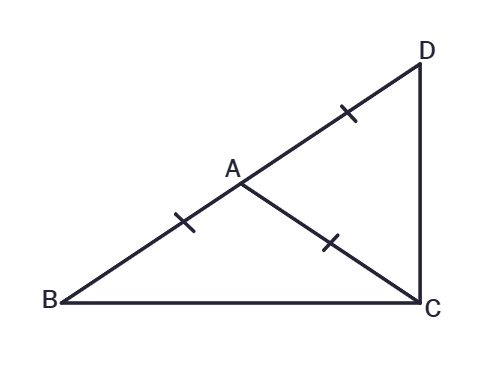
Solution:
Given:
ΔABC is isosceles with AB =
BA is produced to D such that AD =
To Prove:
∠BCD = 90°
Proof:
Given AB = AC, in ΔABC:
∠ABC =
Given AD =
∠ACD =
In ΔBCD, the sum of all angles is
∠BCD + ∠CDB +
∠DBC =
∠BCD + ∠ADC + ∠ABC = 180°
Substitute ∠ACB for ∠ABC and ∠ACD for ∠ADC:
∠BCD +
Where ∠BCD =
∠BCD +
∠BCD =
∠BCD =
Therefore, ∠BCD is a right angle.
6. ABC is a right-angled triangle in which ∠A = 90° and AB = AC. Show that ∠B = ∠C.
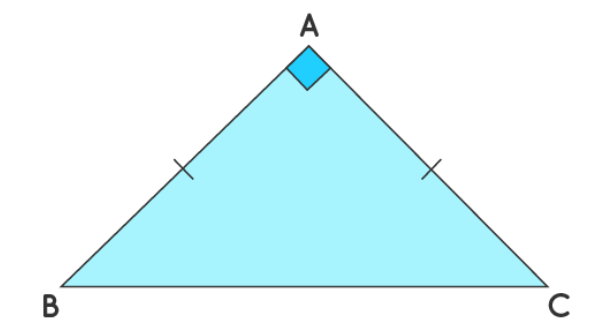
Solution:
Given:
ABC is a right-angled triangle.
∠A =
AB =
To Prove:
∠B = ∠C
Proof:
Since AB = AC, triangle ABC is an
In an isosceles triangle, the angles opposite to the equal sides are
∠B =
Therefore, in the right-angled triangle ABC, where AB = AC, it is shown that ∠B = ∠C.
Show that the angles of an equilateral triangle are 60° each.
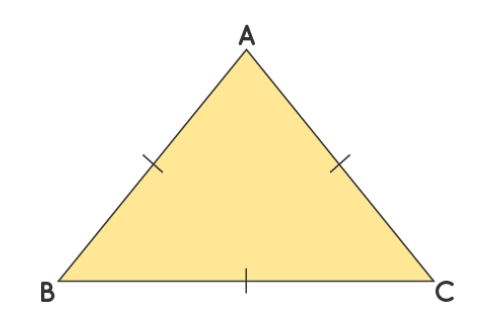
Solution:
Given:
Triangle ABC is an equilateral triangle. This means AB = BC =
To Prove:
∠A = ∠B = ∠C = 60°
Proof:
Since AB = BC, ∠C =
Since BC = CA, ∠A =
Therefore, ∠A = ∠B = ∠C.
Now, in ΔABC,
∠A + ∠B + ∠C =
Since ∠A = ∠B = ∠C, we can write:
∠A + ∠A + ∠A = 180°
∠A =
So, ∠A = ∠B = ∠C = 60°.
Therefore, the angles of an equilateral triangle are 60° each.
8. In the adjacent figure ΔABC is isosceles as AB=AC, BA and CA are produced to Q and P such that AQ=AP. Show that PB=QC.
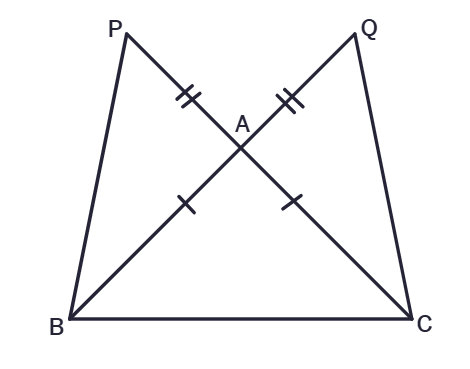
(Hint : Compare ΔAPB and ΔAQC)
Solution:
Given:
ΔABC is isosceles with AB =
BA is produced to
AQ =
To Prove:
PB = QC
Proof:
Consider ΔAPB and ΔAQC:
AP =
AB = AC (Given)
∠PAB =
Therefore, by
Hence, PB =
Conclusion:
We have shown that PB = QC.