

Exercise 11.1
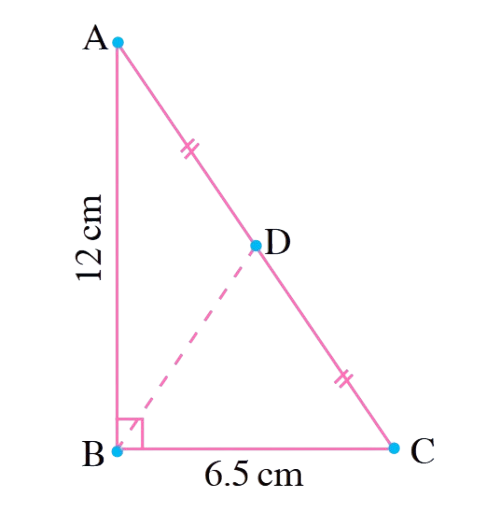
1. In ΔABC, ∠ABC = 90°, AD = DC, AB = 12cm and BC = 6.5 cm. Find the area of ΔADB.
Solution:
First, let's find AC using the Pythagorean theorem in right triangle ABC.
AC² = AB² + BC² =
AC² =
AC =
Since AD = DC, D is the
So AD = AC/2 =
To find the area of ΔADB, we need the height from D to AB.
Since D is the midpoint of AC, the height from D to AB is half the height from C to AB.
Height from C to AB =
Height from D to AB =
Area of ΔADB = (1/2) × base × height = (1/2) ×
Area of ΔADB =
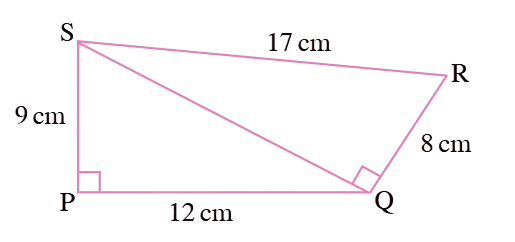
2. Find the area of a quadrilateral PQRS in which ∠QPS = ∠SQR = 90°, PQ = 12 cm, PS = 9 cm, QR = 8 cm and SR = 17 cm (Hint: PQRS has two parts).
Solution:
The quadrilateral can be divided into two right triangles: ΔPQS and ΔQRS.
For right triangle PQS:
PQ =
cm PS =
cm ∠QPS =
°
Area of ΔPQS = (1/2) × PQ × PS = (1/2) ×
For right triangle QRS:
QR =
cm SR =
cm ∠SQR =
°
We need to find QS using Pythagorean theorem in ΔPQS:
QS² = PQ² + PS² =
QS =
Now in right triangle QRS:
Area of ΔQRS = (1/2) × QR × QS = (1/2) ×
Total area of quadrilateral PQRS = Area of ΔPQS + Area of ΔQRS
=
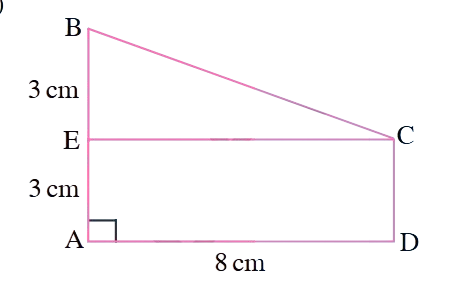
3. Find the area of trapezium ABCD as given in the figure in which ADCE is a rectangle. (Hint: ABCD has two parts).
Solution:
The trapezium ABCD can be divided into:
Rectangle ADCE
Triangle BCE
From the figure:
AD = EC =
cm (opposite sides of rectangle) AE = DC =
cm (opposite sides of rectangle) BE =
cm
Area of rectangle ADCE = length × width =
For triangle BCE:
- Base EC =
- Height BE =
Area of triangle BCE = (1/2) × base × height = (1/2) ×
Total area of trapezium ABCD = Area of rectangle ADCE + Area of triangle BCE
=
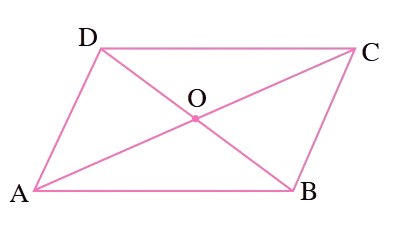
4. ABCD is a parallelogram. The diagonals AC and BD intersect each other at 'O'. Prove that ar(ΔAOD) = ar(ΔBOC). (Hint: Congruent figures have equal area).
Solution:
To prove: ar(ΔAOD) = ar(ΔBOC)
In parallelogram ABCD, we know that:
Opposite sides are
and Diagonals
each other
Since diagonals bisect each other at O:
- AO =
- BO =
In triangles ΔAOD and ΔBOC:
- AO =
- BO =
- ∠AOD =
By
ΔAOD ≅ Δ
Since congruent figures have
ar(ΔAOD) = ar(ΔBOC)
Hence proved.