

Exercise 11.3
1. In a triangle ABC (see figure), E is the midpoint of median AD, show that
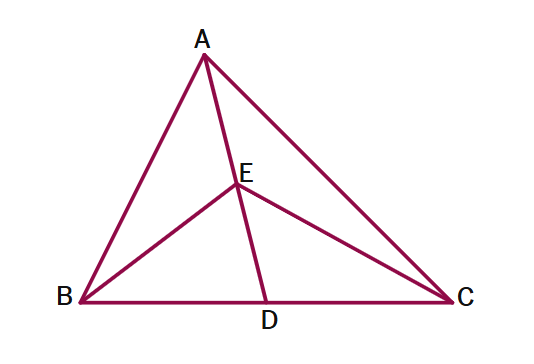
(i) ar(ΔABE) = ar(ΔACE)
(ii) ar(ΔABE) = (1/4)ar(ΔABC)
Solution:
(i) To prove: ar(ΔABE) = ar(ΔACE)
Since AD is a median of triangle ABC, D is the
Therefore: ar(ΔABD) = ar(ΔACD) =
Since E is the midpoint of AD:
- AE =
- Triangles ABE and ACE have equal heights from B and C to line
In triangle ABD: Since E is midpoint of AD, ar(ΔABE) =
In triangle ACD: Since E is midpoint of AD, ar(ΔACE) =
Since ar(ΔABD) = ar(ΔACD), we get: ar(ΔABE) = ar(ΔACE)
(ii) To prove: ar(ΔABE) = (1/4)ar(ΔABC)
From part (i): ar(ΔABE) = (1/2)ar(ΔABD)
Since ar(ΔABD) = (1/2)ar(ΔABC):
ar(ΔABE) = (1/2) ×
Hence both parts are proved.
2. Show that the diagonals of a parallelogram divide it into four triangles of equal area.
Solution:
Let ABCD be a parallelogram with diagonals AC and BD intersecting at O.
In a parallelogram, diagonals
So: AO =
The four triangles formed are: ΔAOB, ΔBOC, ΔCOD, ΔDOA
Comparing ΔAOB and ΔCOD:
AO =
(diagonals bisect each other) BO =
(diagonals bisect each other) ∠AOB =
(vertically opposite angles)
By
Therefore: ar(ΔAOB) = ar(ΔCOD)
Similarly, comparing ΔBOC and ΔDOA:
By SAS congruence: ΔBOC ≅ ΔDOA
Therefore: ar(ΔBOC) = ar(ΔDOA)
Comparing ΔAOB and ΔBOC:
Both triangles have the same base
Therefore: ar(ΔAOB) = ar(ΔBOC)
Hence: ar(ΔAOB) = ar(ΔBOC) = ar(ΔCOD) = ar(ΔDOA) =
3. In the figure, ΔABC and ΔABD are two triangles on the same base AB. If line segment CD is bisected by AB at O, show that ar(ΔABC) = ar(ΔABD).

Solution:
Given: Triangles ABC and ABD on the same base
This means: CO =
Since both triangles have the same base AB, we need to show they have equal heights.
Let h₁ = perpendicular distance from C to AB Let h₂ = perpendicular distance from D to AB
Since O is the midpoint of CD and O lies on AB:
The perpendicular from C to AB and perpendicular from D to AB are
This is because AB acts as the
Therefore: h₁ =
ar(ΔABC) = (1/2) × AB × h₁
ar(ΔABD) = (1/2) × AB × h₂
Since h₁ = h₂: ar(ΔABC) = ar(ΔABD)
Hence proved.
4. In the figure, ΔABC, D, E, F are the midpoints of sides BC, CA and AB respectively. Show that
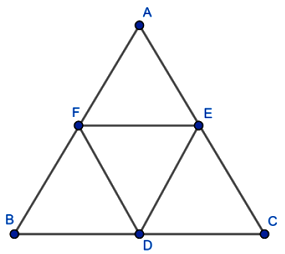
(i) BDEF is a parallelogram
(ii) ar(ΔDEF) = (1/4)ar(ΔABC)\
(iii) ar(BDEF) = (1/2)ar(ΔABC)
Solution:
Given: D, E, F are midpoints of BC, CA, AB respectively.
(i) To prove: BDEF is a parallelogram
By midpoint theorem in ΔABC:
- DE || AB and DE =
AB
- Since F is midpoint of AB: BF =
Therefore: DE || BF and DE =
Similarly: EF || BC and EF = (1/2)BC
Since D is midpoint of BC: BD =
Therefore: EF || BD and EF =
Since opposite sides are parallel and equal: BDEF is a
(ii) To prove: ar(ΔDEF) = (1/4)ar(ΔABC)
By midpoint theorem: DE = (1/2)AB, EF = (1/2)BC, DF = (1/2)AC
Triangle DEF is similar to triangle ABC with ratio
For similar triangles, ratio of areas = (ratio of sides)²
ar(ΔDEF)/ar(ΔABC) = (
Therefore: ar(ΔDEF) =
(iii) To prove: ar(BDEF) = (1/2)ar(ΔABC)
From the midpoint theorem, the four triangles formed are: ΔAEF, ΔBDF, ΔCDE, and ΔDEF - all have
Each triangle has area =
ar(BDEF) = ar(ΔBDF) + ar(ΔDEF) =
Hence all parts are proved.
5. In the figure D, E are points on the sides AB and AC respectively of ΔABC such that ar(ΔDBC) = ar(ΔEBC). Prove that DE || BC.
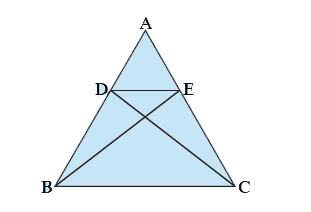
Solution:
Given: ar(ΔDBC) = ar(ΔEBC)
To prove: DE || BC
Both triangles DBC and EBC have the same base
Since ar(ΔDBC) = ar(ΔEBC) and both have the same base: The
This means D and E are at the same
Since D lies on AB and E lies on AC, and both are equidistant from BC:
The line DE is
Hence: DE || BC
Hence proved.
6. In the figure, XY is a line parallel to BC is drawn through A. If BE || CA and CF || BA are drawn to meet XY at E and F respectively. Show that ar(ΔABE) = ar(ΔACF).
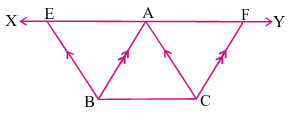
Solution:
Given: XY || BC, BE || CA, CF || BA
To prove: ar(ΔABE) = ar(ΔACF)
Since XY || BC and BE || AC:
ABEC is a
Since XY || BC and CF || AB:
ABFC is a
Both parallelograms ABEC and ABFC have the same base
Since XY || BC, points E and F are at the same
Therefore: ar(parallelogram ABEC) = ar(parallelogram ABFC)
Since triangles are half the area of parallelograms with same base and height:
ar(ΔABE) =
ar(ΔACF) =
Therefore: ar(ΔABE) = ar(ΔACF)
Hence proved.
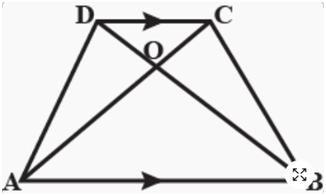
7. In the figure, diagonals AC and BD of a trapezium ABCD with AB || DC intersect each other at O. Prove that ar(ΔAOD) = ar(ΔBOC).
Solution:
Given: ABCD is a trapezium with AB || DC, diagonals AC and BD intersect at O.
To prove: ar(ΔAOD) = ar(ΔBOC)
Consider triangles ABC and ABD:
Both have the same base
Therefore: ar(ΔABC) = ar(ΔABD)
This can be written as:
ar(ΔABC) = ar(ΔABD)
ar(ΔAOB) + ar(ΔBOC) = ar(ΔAOB) + ar(ΔAOD)
Subtracting ar(ΔAOB) from both sides:
ar(ΔBOC) = ar(ΔAOD)
Therefore: ar(ΔAOD) = ar(ΔBOC)
Hence proved.
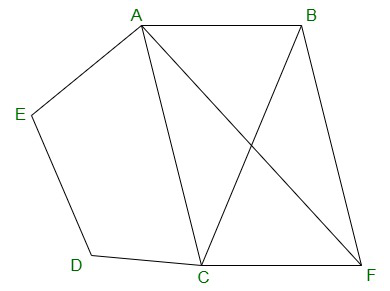
8. In the figure, ABCDE is a pentagon. A line through B parallel to AC meets DC produced at F. Show that (i) ar(ΔACB) = ar(ΔACF) (ii) ar(ΔEDF) = ar(ΔABCDE)
Solution:
(i) To prove: ar(ΔACB) = ar(ΔACF)
Given: BF || AC
Triangles ACB and ACF have the same base
Since BF || AC, points B and F are at the same
Triangles with the same base and equal heights have
Therefore: ar(ΔACB) = ar(ΔACF)
(ii) To prove: ar(ΔEDF) = ar(ΔABCDE)
From part (i): ar(ΔACB) = ar(ΔACF)
This means: ar(pentagon ABCDE) = ar(pentagon ABCDE) - ar(ΔACB) + ar(ΔACF)
= ar(quadrilateral ABDE) + ar(ΔACD) + ar(ΔACF) - ar(ΔACB)
= ar(quadrilateral ABDE) + ar(ΔACD) + ar(ΔACF) - ar(ΔACF)
= ar(ABDE) + ar(ΔACD) = ar(
Hence both parts are proved.
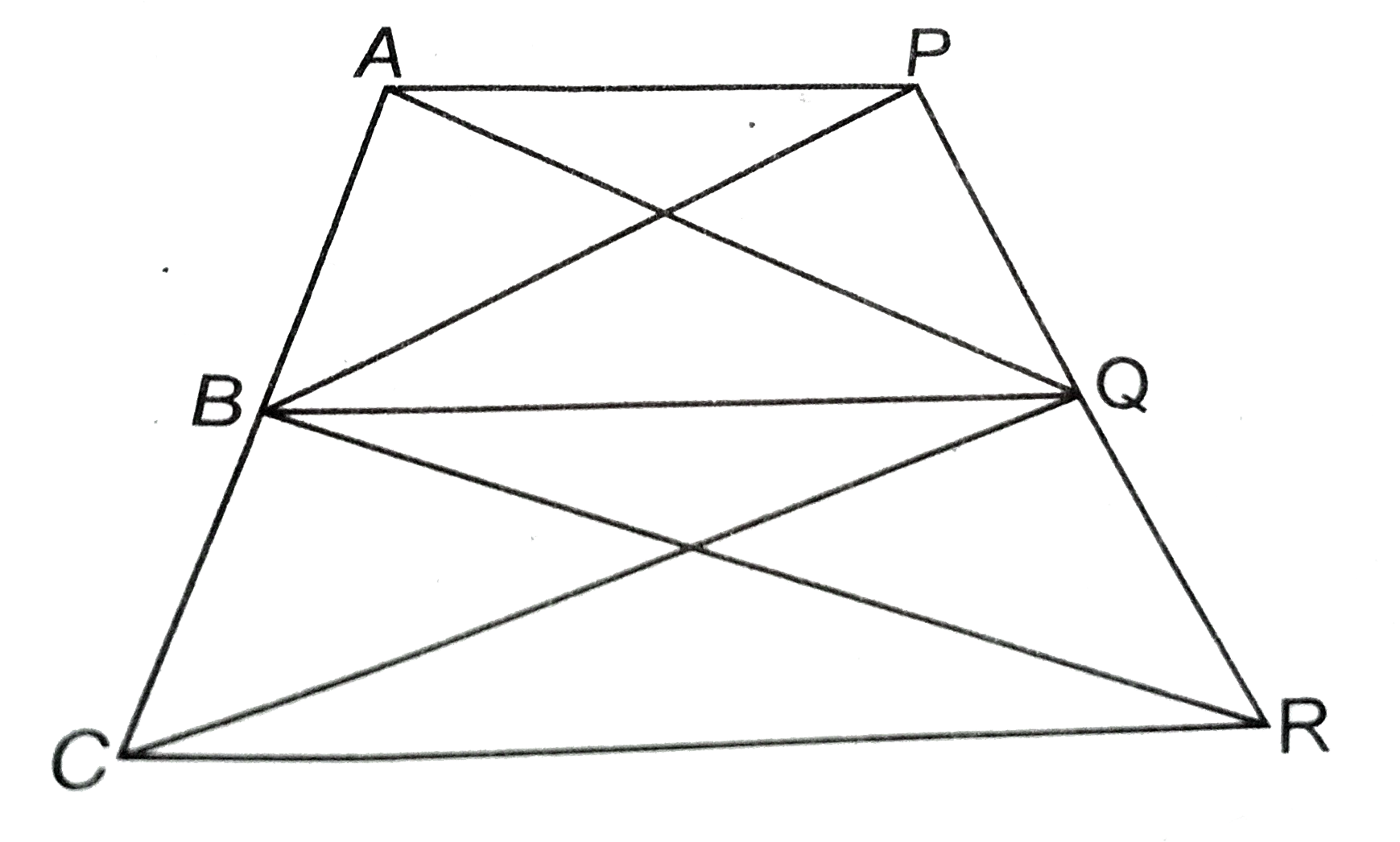
9. In the figure, if ar(ΔRAS) = ar(ΔRBS) and ar(ΔQRB) = ar(ΔPAS) then show that both the quadrilaterals PQSR and RSBA are trapeziums.
Solution:
Given: ar(ΔRAS) = ar(ΔRBS) and ar(ΔQRB) = ar(ΔPAS)
To prove PQSR is a trapezium:
From ar(ΔRAS) = ar(ΔRBS):
Both triangles have the same base
Since areas are equal with same base, points A and B are at
This means A and B lie on a line
Therefore: AB || RS, making PQSR a
To prove RSBA is a trapezium:
From ar(ΔQRB) = ar(ΔPAS):
We can rearrange the quadrilateral areas to show that certain sides are parallel.
Since ar(ΔRAS) = ar(ΔRBS), we already established that AB || RS.
The given conditions ensure that RSBA has one pair of
Therefore: RSBA is a
Hence both quadrilaterals are trapeziums.
10. A villager Ramayya has a plot of land in the shape of a quadrilateral. The grampanchayat of the village decided to take over some portion of his plot from one of the corners to construct a school. Ramayya agrees to the above proposal with the condition that he should be given equal amount of land in exchange of his land adjoining his plot so as to form a triangular plot. Explain how this proposal will be implemented. (Draw a rough sketch of plot).
Solution:
Let ABCD be Ramayya's quadrilateral plot.
Step 1: Land taken for school
Suppose the grampanchayat takes triangular portion
Step 2: Compensation land
To compensate, give Ramayya a triangular piece of land ΔABE where:
E is chosen such that ar(ΔABE) = ar(
) E is positioned to make the final plot triangular
Step 3: Implementation
Choose point E on the extension of CD such that:
- Triangle ABE has the same
- The final plot becomes triangle
Why this works:
- Land taken away = ar(
- Land given = ar(
- Net change =
- Final plot shape =
Construction: Draw a line through C parallel to AB, and extend it to meet the extension of AD at E. This ensures equal areas and creates a triangular final plot.