

Exercise 11.2
1. The area of parallelogram ABCD is 36 cm². Calculate the height of parallelogram ABEF if AB = 4.2 cm.
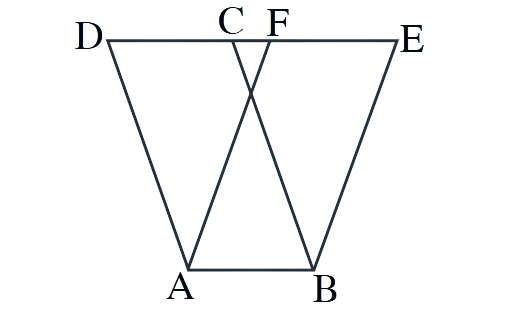
Solution:
Given: Area of parallelogram ABCD =
We know that Area of parallelogram = base × height
For parallelogram ABCD: 36 = AB × height from C to AB
Height from C to AB =
Since ABEF and ABCD share the same base AB and have the same height (F and C are at the same distance from AB):
Height of parallelogram ABEF =
2. ABCD is a parallelogram. AE is perpendicular on DC and CF is perpendicular on AD. If AB = 10 cm, AE = 8 cm and CF = 12 cm. Find AD.
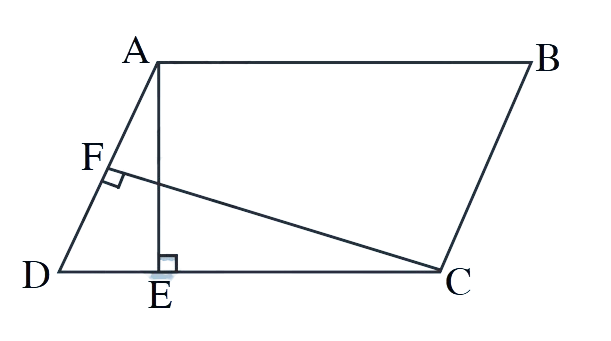
Solution:
Given: AB =
In a parallelogram, opposite sides are equal, so DC =
Area of parallelogram ABCD using base DC and height AE:
Area = DC × AE =
Area of parallelogram ABCD using base AD and height CF:
Area = AD × CF = AD ×
Since both expressions equal the same area:
AD =
3. If E, F, G and H are respectively the midpoints of the sides AB, BC, CD and AD of a parallelogram ABCD, show that ar(EFGH) = (1/2)ar(ABCD).
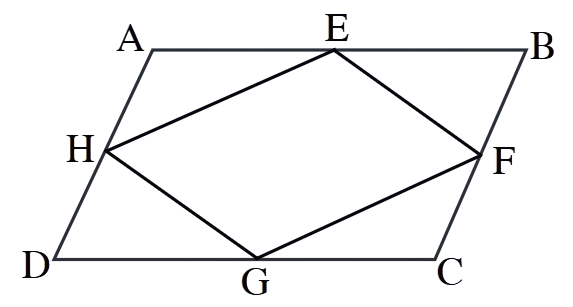
Solution:
To prove: ar(EFGH) =
Since E, F, G, H are midpoints of AB, BC, CD, AD respectively:
- AE =
- BF =
- CG =
- DH =
By the midpoint theorem, when we join midpoints of adjacent sides:
- EF is
- FG is
- GH is
- HE is
Since opposite sides are equal and parallel, EFGH is a
The parallelogram EFGH has sides equal to
By properties of midpoint quadrilaterals:
ar(EFGH) =
Hence proved.
4. What type of quadrilateral do you get, if you join ΔAPM, ΔDPQ, ΔOCN and ΔMNB in the example 3.
Solution:
From the construction in example 3, when we join the four triangles ΔAPM, ΔDPQ, ΔOCN and ΔMNB:
The quadrilateral formed by joining these triangles is a
This happens because:
- The triangles are formed by connecting midpoints
- The resulting figure has
- All four triangles have
5. P and Q are any two points lying on the sides DC and AD respectively of a parallelogram ABCD. Show that ar(ΔAPB) = ar(ΔBQC).
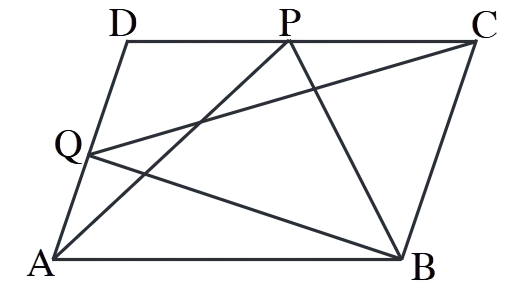
Solution:
To prove: ar(ΔAPB) = ar(ΔBQC)
Both triangles ΔAPB and ΔBQC have the same base
Since ABCD is a parallelogram:
- P lies on DC, so distance from P to AB equals the
- Q lies on AD, so distance from Q to BC equals the
Both triangles have:
- Equal bases: AB =
- Equal heights: distance from P to AB = distance from Q to BC =
Therefore: ar(ΔAPB) = ar(ΔBQC) = (1/2) × base ×
Hence proved.
6. P is a point in the interior of a parallelogram ABCD. Show that
(i) ar(ΔAPB) + ar(ΔPCD) = (1/2)ar(ABCD)
(ii) ar(ΔAPD) + ar(ΔPBC) = ar(ΔAPB) + ar(ΔPCD)
(Hint: Through P, draw a line parallel to AB)
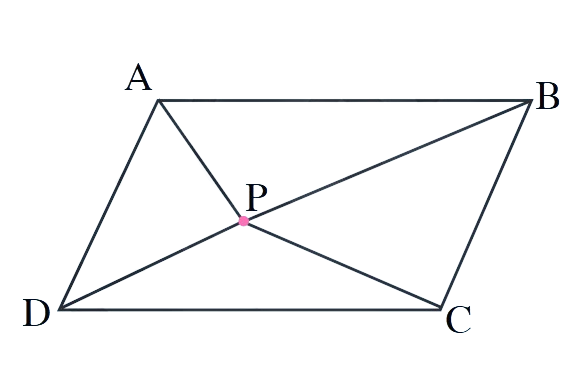
Solution:
Draw a line through P parallel to AB, meeting AD at M and BC at N.
(i) To prove: ar(ΔAPB) + ar(ΔPCD) = (1/2)ar(ABCD)
Since MN is parallel to AB:
- ABMN is a
- MNCD is a
ar(ΔAPB) = ar(ΔAMP) + ar(ΔPMB)
Since ABMN is a parallelogram: ar(ΔAPB) =
ar(ΔPCD) = ar(ΔPMC) + ar(ΔPCN)
Since MNCD is a parallelogram: ar(ΔPCD) =
ar(ΔAPB) + ar(ΔPCD) = (1/2)ar(ABMN) + (1/2)ar(MNCD) =
(ii) To prove: ar(ΔAPD) + ar(ΔPBC) = ar(ΔAPB) + ar(ΔPCD)
From part (i): ar(ΔAPB) + ar(ΔPCD) =
Similarly, ar(ΔAPD) + ar(ΔPBC) =
Therefore: ar(ΔAPD) + ar(ΔPBC) = ar(ΔAPB) + ar(ΔPCD)
Hence both parts are proved.
7. Prove that the area of a trapezium is half the sum of the parallel sides multiplied by the distance between them.
Solution:
Let ABCD be a trapezium with AB || CD, where AB and CD are the parallel sides.
Let h be the
Draw diagonal AC to divide the trapezium into two triangles: ΔABC and ΔACD.
Area of ΔABC = (1/2) × AB ×
Area of ΔACD = (1/2) × CD ×
Area of trapezium ABCD = Area of ΔABC + Area of ΔACD
= (1/2) × AB × h + (1/2) × CD × h
= (1/2) × h × (
= (1/2) × (sum of parallel sides) ×
Hence proved.
8. PQRS and ABRS are parallelograms and X is any point on the side BR. Show that (i) ar(PQRS) = ar(ABRS) (ii) ar(ΔAXS) = (1/2)ar(PQRS)
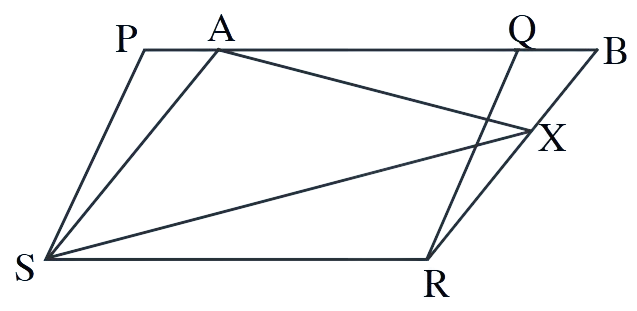
Solution:
(i) To prove: ar(PQRS) = ar(ABRS)
Both parallelograms PQRS and ABRS have the same base
Since PQ || RS and AB || RS, points P, Q and A, B lie on lines
Both parallelograms have the same
Therefore: ar(PQRS) = ar(ABRS) = base ×
(ii) To prove: ar(ΔAXS) = (1/2)ar(PQRS)
ΔAXS and parallelogram PQRS have the same base
Since X lies on BR and AB || RS, the height of ΔAXS from vertex X to base AS equals the
Area of triangle = (1/2) × base × height
Area of parallelogram = base × height
Therefore: ar(ΔAXS) =
Hence both parts are proved.
9. A farmer has a field in the form of a parallelogram PQRS as shown in the figure. He took the mid-point A on RS and joined it to points P and Q. In how many parts is the field divided? What are the shapes of these parts? The farmer plans to sow groundnuts in an area equal to the combined area of pulses and paddy. How should he proceed to sow the seeds and why?
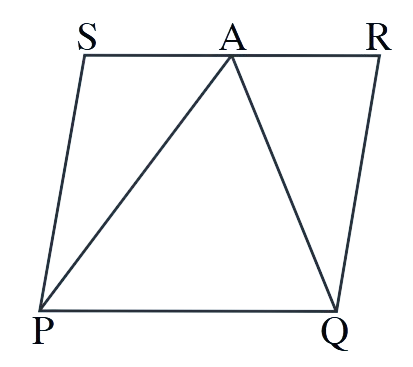
Solution:
When point A (midpoint of RS) is joined to P and Q:
Number of parts: The field is divided into
Shapes: The three parts are:
1. Triangle
2. Triangle
3. Triangle
Areas: Since A is the midpoint of RS:
- ar(ΔPAS) = ar(ΔPAQ) (same base PA, equal heights from S and Q)
- ar(ΔQAS) =
For groundnuts area = pulses area + paddy area:
If pulses are grown in ΔPAS and paddy in ΔQAS, then:
Groundnuts area = ar(ΔPAS) + ar(ΔQAS) = ar(
Reason: Since A is the midpoint, triangle PAQ has area equal to the combined area of triangles PAS and QAS.
Therefore, he should sow
10. Prove that the area of a rhombus is equal to half of the product of the diagonals.
Solution:
Let ABCD be a rhombus with diagonals AC and BD intersecting at O.
In a rhombus, the diagonals are
Let AC = d₁ and BD = d₂ be the lengths of the diagonals.
Since diagonals bisect each other:
- AO = OC =
- BO = OD =
The rhombus is divided into 4 right triangles: ΔAOB, ΔBOC, ΔCOD, ΔDOA.
Area of each triangle:
- ar(ΔAOB) = (1/2) × AO × BO = (1/2) × (d₁/2) × (d₂/2) =
- All four triangles have
Total area of rhombus = 4 × (d₁d₂/8) =
Therefore: Area of rhombus = (1/2) ×
Hence proved.