

Exercise 8.3
1. The opposite angles of a parallelogram are (3x - 2)° and (x + 48)°. Find the measure of each angle of the parallelogram.
Solution:
Key Property: Opposite angles of a parallelogram are
Therefore, we can set up an equation:
3x - 2 = x + 48
Solving for x:
x =
Now, substitute the value of x back into the expressions for the angles:
Angle 1: (3x - 2)° = (3 ×
Angle 2: (x + 48)° = (25 + 48)° =
Since opposite angles are
Therefore, each angle of the parallelogram measures 73°.
2. Find the measure of all the angles of a parallelogram if one angle is 24° less than twice the smallest angle.
Solution:
2. Find the measure of all the angles of a parallelogram if one angle is 24° less than twice the smallest angle.
Solution:
Let the smallest angle of the parallelogram be x.
According to the problem, one angle is 24° less than twice the smallest angle, so we express it as:
Larger angle = 2x -
Step 1: Use the sum of angles property
The sum of the interior angles of a parallelogram is always
Thus, we can write:
x + (
Step 2: Solve for x
x =
Step 3: Find the larger angle
2(
Step 4: Verify the angles
The two smaller angles are
The two larger angles are
Sum: 68 + 112 + 68 + 112 =
3. In the adjacent figure ABCD is a parallelogram and E is the midpoint of the side BC. If DE and AB are produced to meet at F, show that AF = 2AB.
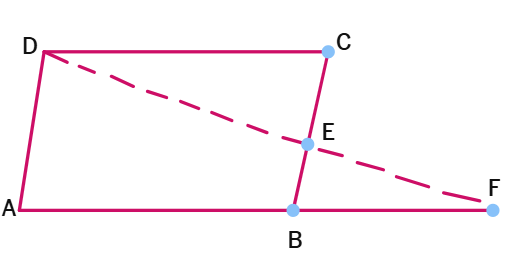
Solution:
Given:
ABCD is a parallelogram.
E is the midpoint of
DE and AB are produced to meet at
To Prove:
AF = 2AB
Proof:
In ΔDEC and ΔFEB:
∠DEC =
∠DCE =
CE =
By
Therefore, DC =
Since ABCD is a parallelogram, AB =
So, AB =
AF = AB +
Substitute FB = AB,
AF = AB +
AF =
4. In the adjacent figure ABCD is a parallelogram P and Q are the midpoints of sides AB and DC respectively. Show that PBCQ is also a parallelogram.
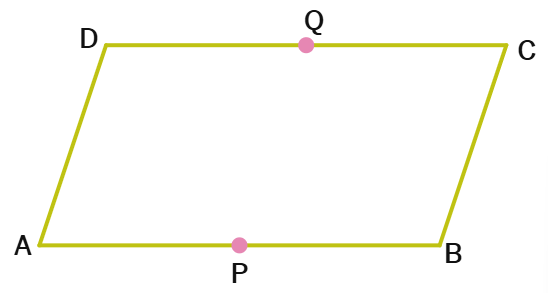
Solution:
Given:
ABCD is a parallelogram.
P is the midpoint of
Q is the midpoint of
To Prove:
PBCQ is a parallelogram.
Proof:
Since ABCD is a parallelogram, AB =
Since P and Q are midpoints, AP = PB =
Since AB = DC, PB =
Also, since AB || DC, PB || QC.
A quadrilateral with one pair of opposite sides equal and parallel is a
Therefore, PBCQ is a parallelogram.
5. ABC is an isosceles triangle in which AB = AC. AD bisects exterior angle QAC and CD || BA as shown in the figure. Show that:
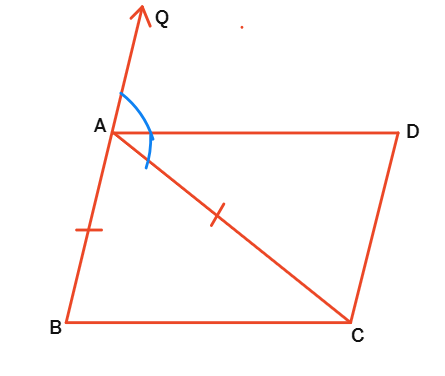
(i) ∠DAC = ∠BCA
(ii) ABCD is a parallelogram.
Solution:
Given:
ABC is an isosceles triangle with AB =
AD bisects exterior angle
CD ||
Proof:
(i) ∠DAC = ∠BCA
Since AB = AC, ∠ABC =
∠QAC = ∠ABC +
∠QAC =
AD bisects ∠QAC, so ∠DAC =
∠DAC = 1/2 (2∠BCA) = ∠BCA.
(ii) ABCD is a parallelogram
CD ||
∠DAC = ∠BCA (Proved).
∠BAC =
∠DAC =
∠DAC = ∠CDA (Alternate interior angles, since CD || BA).
∠BAC =
AB || CD and AC || BD (Since ∠BAC = ∠CDA).
A quadrilateral with both pairs of opposite sides parallel is a
Therefore, ABCD is a parallelogram.
6. ABCD is a parallelogram AP and CQ are perpendiculars drawn from vertices A and C on diagonal BD (see figure) show that
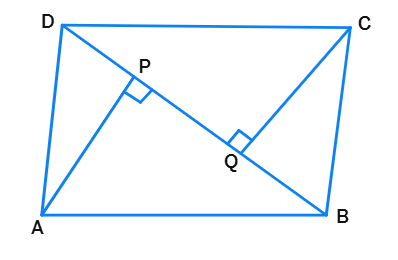
(i) ΔAPB ≅ ΔCQD
(ii) AP = CQ.
Solution:
Given:
ABCD is a parallelogram.
AP ⊥
CQ ⊥
Proof:
(i) ΔAPB ≅ ΔCQD
In ΔAPB and ΔCQD:
∠APB = ∠CQD =
AB =
∠ABP =
By AAS congruence rule, ΔAPB ≅ ΔCQD.
(ii) AP = CQ
Since ΔAPB ≅ ΔCQD (Proved), AP =
7. In Δs ABC and DEF, AB || DE; BC = EF and BC || EF. Vertices A, B and C are joined to vertices D, E and F respectively (see figure). Show that:
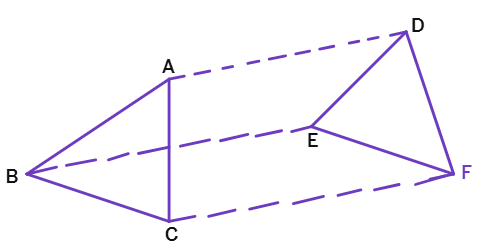
(i) ABED is a parallelogram
(ii) BCFE is a parallelogram
(iii) AC = DF
(iv) ΔABC ≅ ΔDEF.
Solution:
Given:
AB ||
BC =
BC ||
Proof:
(i). ABED is a parallelogram:
AB || DE (Given)
BE =
A quadrilateral with one pair of opposite sides parallel and equal is a
Therefore, ABED is a parallelogram.
(ii). BCFE is a parallelogram:
BC ||
BC =
A quadrilateral with one pair of opposite sides parallel and equal is a
Therefore, BCFE is a parallelogram.
(iii). AC = DF:
ABED is a parallelogram (Proved), so AD =
BCFE is a parallelogram (Proved), so CF =
Therefore, AD =
In ΔABC and ΔDEF:
AB =
BC =
∠ABC =
By
Therefore, AC =
(iv). ΔABC ≅ ΔDEF:
AB =
BC =
AC =
By
8. ABCD is a parallelogram. AC and BD are the diagonals intersect at O. P and Q are the points of tri section of the diagonal BD. Prove that CQ || AP and also AC bisects PQ (see figure).
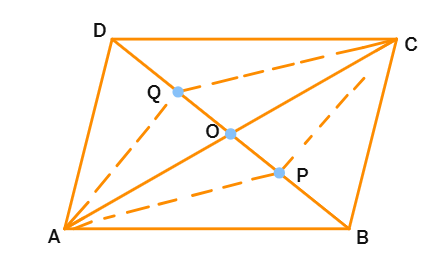
Solution:
Given:
ABCD is a parallelogram.
AC and BD are diagonals intersecting at
P and Q are points of trisection of
To Prove:
CQ || AP
AC bisects PQ
Proof:
Since ABCD is a parallelogram, O is the midpoint of BD.
Since P and Q trisect BD, BP = PQ =
Therefore, OP =
In ΔAOQ and ΔCOP:
AO =
∠AOQ =
OP =
By
Therefore, ∠OAQ =
Since ∠OAQ = ∠OCP, AP ||
Let AC intersect PQ at M.
In ΔOMQ and ΔOMP:
∠MOQ =
OM = OM (Common side)
By
Therefore, PM =
Hence, AC bisects PQ.
9. ABCD is a square. E, F, G and H are the mid points of AB, BC, CD and DA respectively. Such that AE=BF=CG=DH. Prove that EFGH is a square.
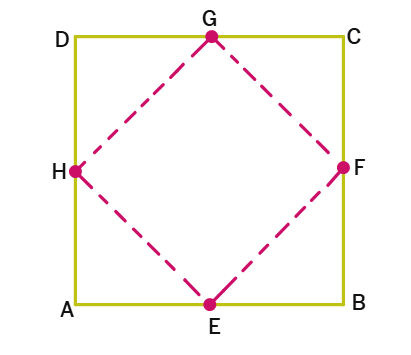
Solution:
Given:
ABCD is a square.
E, F, G, H are midpoints of AB, BC, CD, DA respectively.
AE = BF = CG = DH.
To Prove EFGH is a square:
Proof:
Since E, F, G, H are midpoints, AE =
In ΔAEH and ΔBFE:
AE = BF (Given)
AH =
∠A = ∠B =
By
Therefore, EH =
Similarly, we can prove EF = FG = GH = HE.
Thus, EFGH is a
In ΔAEH, ∠AEH + ∠AHE =
In ΔBFE, ∠BFE + ∠BEF =
Since ΔAEH ≅ ΔBFE, ∠AEH =
∠HEF = 180° - (∠AEH + ∠BEF) = 180° - (∠AEH + ∠AHE) = 180° -
Similarly, ∠EFG = ∠FGH = ∠GHE =
Since EFGH is a rhombus with all angles 90°, EFGH is a