

Across the Line
Take a piece of square paper and fold it in different ways. Now, on the creases formed by the folds, draw lines using a pencil and a scale. You will notice different lines on the paper. Take any pair of lines and observe their relationship with each other. Do they meet? If they do not meet within the paper, do you think they would meet if they were extended beyond the paper?
In this chapter, we will explore the relationship between lines on a plane surface. The table top, your piece of paper, the blackboard, and the bulletin board are all examples of
Let us observe a pair of lines that meet each other. You will notice that they meet at a point. When a pair of lines meet each other at a point on a plane surface, we say that the lines intersect each other. Let us observe what happens when two lines intersect.
How many angles do they form?
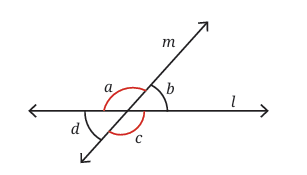
In the given figure, where line l intersects line m, we can see that
Can two straight lines intersect at more than one point?
No, two straight lines cannot intersect at more than one point.
Why can't they intersect at two points?
If two straight lines intersected at two different points, say point A and point B, then by the definition of a straight line, there is only
Two distinct straight lines can intersect at a maximum of one point only.
Activity 1
Draw two lines on a plain sheet of paper so that they intersect.
Measure the four angles formed with a protractor. Draw four such pairs of intersecting lines and measure the angles formed at the points of intersection.
What patterns do you observe among these angles?
In the figure above, if ∠a is 120°, can you figure out the measurements of ∠b, ∠c and ∠d, without drawing and measuring them?
We know that ∠a and ∠b together measure
So, if ∠a is 120°, then ∠b must be
Similarly, ∠b and ∠c together measure
Therefore, in the figure, ∠a and ∠c measure 120°, and ∠b and ∠d measure 60°.
When two lines intersect each other and form four angles, labelled a, b, c and d, as shown in the figure, then ∠a and ∠c are
Is this always true for any pair of intersecting lines?
Check this for different measures of ∠a. Using these measurements, can you reason whether this property holds true for any measure of ∠a?
We can generalise our reasoning, without assuming the values of ∠a.
Since straight angles measure 180°, we must have:
∠a + ∠
Hence, ∠b and ∠d are always
Similarly, ∠b + ∠a = ∠b + ∠c = 180°, so ∠a and ∠c must be
Adjacent angles, like ∠a and ∠b, formed by two lines intersecting each other, are called linear pairs. Linear pairs always add up to
Opposite angles, like ∠b and ∠d, formed by two lines intersecting each other, are called vertically opposite angles. Vertically opposite angles are always
From the above reasoning, we conclude that whenever two lines intersect, vertically opposite angles are equal. Such a justification is called _a proof in mathematics.
Figure it Out
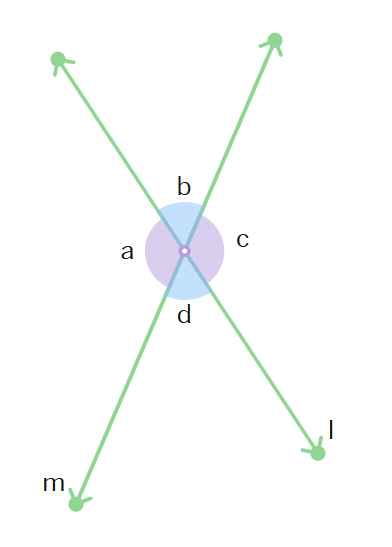
List all the linear pairs and vertically opposite angles you observe in the below figure:
| Angle Type | List of Angles |
|---|---|
| Linear Pairs | ∠a and ∠ |
| Pairs of Vertically Opposite Angles | ∠ |
Measurements and Geometry
You might have noticed that when you measure linear pairs, sometimes they may not add up to 180°. Or, when you measure vertically opposite angles they may be unequal sometimes. What are the reasons for this?
There could be different reasons:
Measurement errors because of improper use of measuring instruments — in this case, a
Variation in the thickness of the lines drawn. The “ideal” line in geometry does not have any thickness! But it
In geometry, we create ideal versions of “lines” and other shapes we see around us, and analyse the relationships between them.
For example, we know that the angle formed by a straight line is 180°. So, if another line divides this angle into two parts, both parts should add up to
We arrive at this simply through reasoning and not by measurement. When we measure, it might not be exactly so, for the reasons mentioned above. Still the measurements come out very close to what we predict, because of which geometry finds widespread application in different disciplines such as physics, art, engineering and architecture.