

Drawing Parallel Lines
Can you draw a pair of parallel lines using a ruler and a set square? The figure below shows how you can do it.
Draw a line l with a scale. By sliding your set square you can make two lines
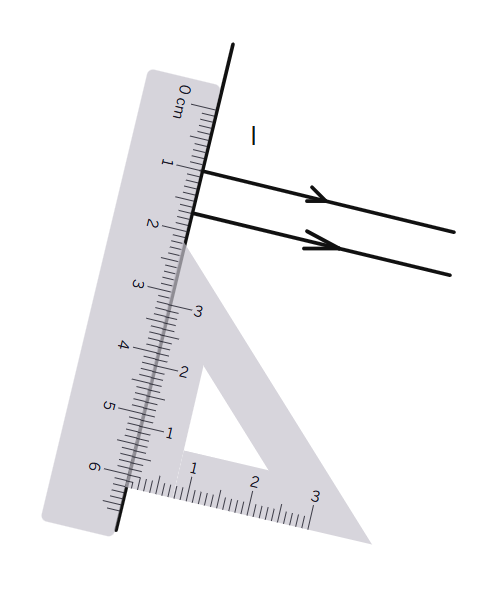
Are these two lines parallel to each other? How are we sure that they are parallel to each other? What angles are formed between these lines and line l?
Since we used a set square, the angles measure
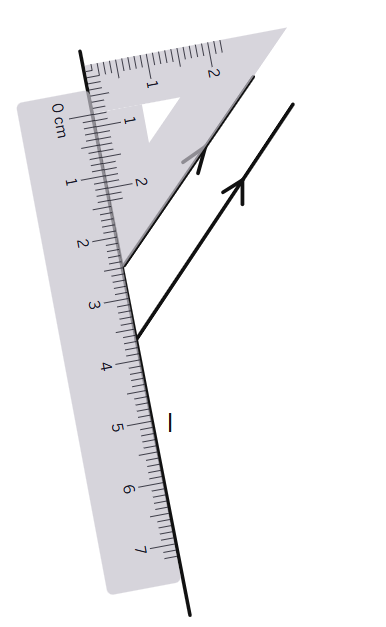
As we know these are corresponding angles and they are equal, we can be sure that the lines are
Draw two more parallel lines using the long side of the set square as shown above.
How do you know these two lines are parallel? We have used the same edge and the same set-square orientation for making both the lines.
Can you check if the corresponding angles are equal?
Figure it Out
Can you draw a line parallel to l, that goes through point A? How will you do it with the tools from your geometry box? Describe your method.
Making Parallel Lines through Paper Folding
Let us try to do the same with paper folding. For a line l (given as a crease), how do we make a line parallel to l such that it passes through point A?
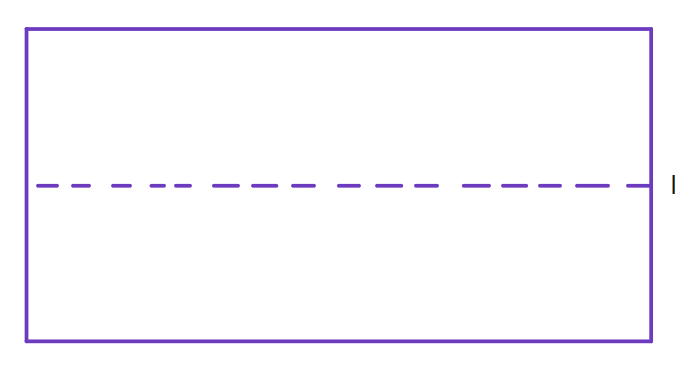
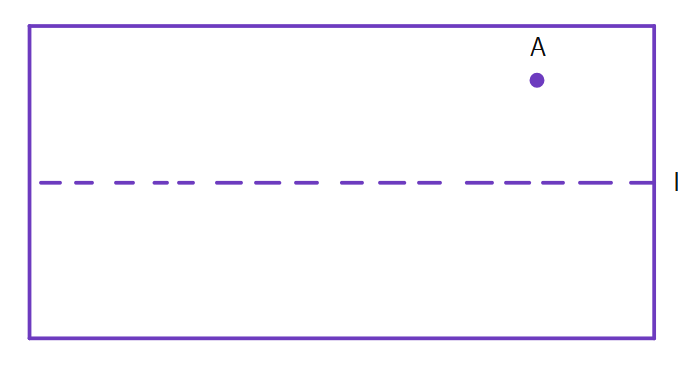
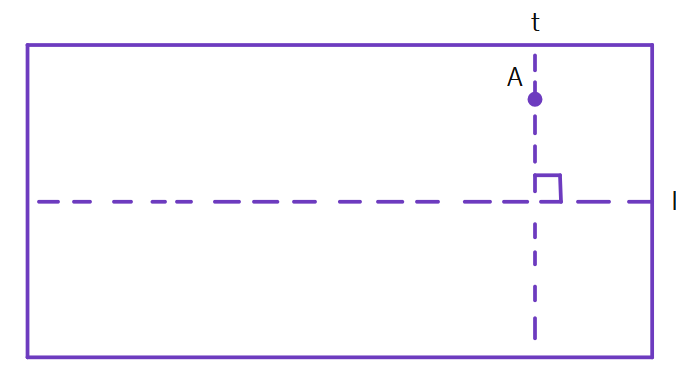
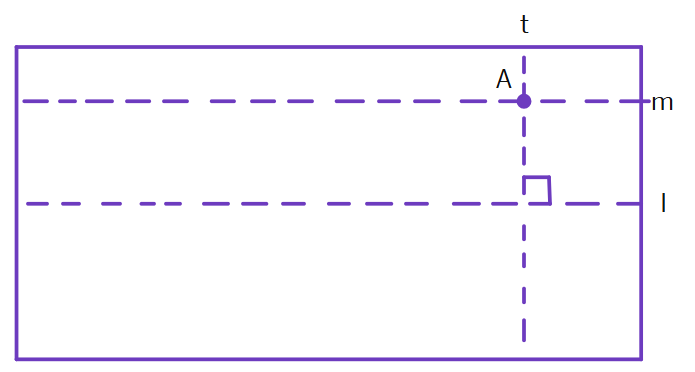
We know how to fold a piece of paper to get a line perpendicular to l. Now, try to fold a perpendicular to l such that it passes through point A. Let us call this new crease t.
Now, fold a line perpendicular to t passing through A again. Let us call this line m. The lines l and m are
Why are lines l and m parallel to each other? Because they are