

Parallel and Perpendicular Lines in Paper Folding
Activity 2
Take a plain square sheet of paper (use a newspaper for this activity).
How would you describe the opposite edges of the sheet? They are
to each other. How would you describe the adjacent edges of the sheet? The adjacent edges are
to each other. They meet at a . They form angles. Fold the sheet horizontally in half. A new
is formed. How many parallel lines do you see now?
parallel lines (the top edge, the fold line, and the bottom edge). How does the new line segment relate to the vertical sides? The new line segment is to the vertical sides. Make one more horizontal fold in the folded sheet. How many parallel lines do you see now?
parallel lines. What will happen if you do it once more? How many parallel lines will you get?
parallel lines.
Is there a pattern?
Check if the pattern extends further, if you make another horizontal fold.
Make a vertical fold in the square sheet. This new vertical line is
to the previous horizontal lines. Fold the sheet along a diagonal. Can you find a fold that creates a line parallel to the diagonal line?
, folding along the other diagonal creates a line to the first diagonal (both diagonals are parallel to themselves when the square is folded appropriately, or you can create a parallel line by folding a corner to meet the diagonal at a specific point).
Here is another activity for you to try.
Take a square sheet of paper, fold it in the middle and unfold it.
Fold the edges towards the centre line and unfold them.
Fold the top right and bottom left corners onto the creased line to create triangles.
The triangles should not cross the crease lines.
Are a, b and c (fold lines) parallel to p, q and r (original creases) respectively? Why or why not?
, a, b, and c are parallel to p, q, and r respectively. This is because when we fold the corners onto the creased lines, the fold lines (a, b, c) are created at the same angle as the original creases (p, q, r), making them parallel to each other.
Notations
In mathematics, we use an arrow mark (>) to show that a set of lines is parallel. If there is more than one set of parallel lines, the second set is shown with two arrow marks and so on. Perpendicular lines are marked with a square angle between them.
Figure it Out
1. Draw some lines perpendicular to the lines given on the dot paper in the figure.
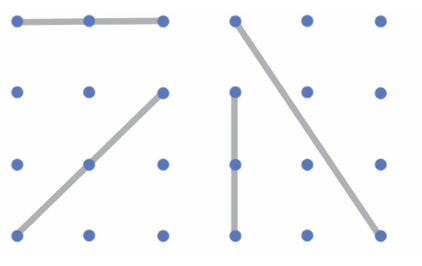
Solution:
2. In the figure below, mark the parallel lines using the notation given above (single arrow, double arrow etc.). Mark the angle between perpendicular lines with a square symbol.
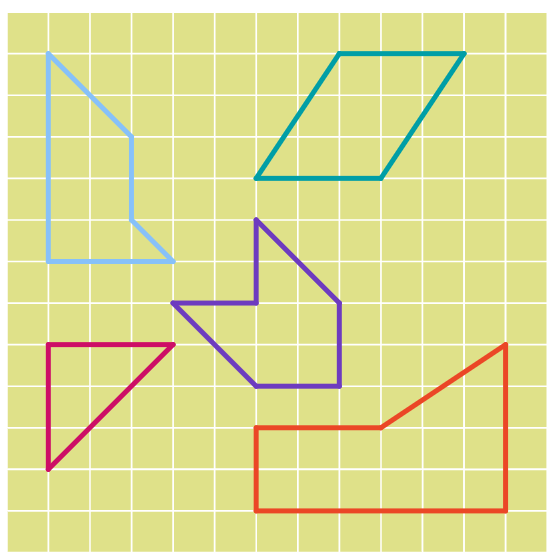
(a) How did you spot the perpendicular lines? A pair of lines which were meeting at a
(b) How did you spot the parallel lines? Lines in a given figure which has the same inclination with the
3. In the dot paper following, draw different sets of parallel lines. The line segments can be of different lengths but should have dots as endpoints.
4. Using your sense of how parallel lines look, try to draw lines parallel to the line segments on this dot paper.
(a) Did you find it challenging to draw some of them?
(b) Which ones?
The most challenging ones would be:
The orange/yellow diagonal line (steep slope on the left side) - it doesn't align neatly with obvious dot patterns The teal/cyan line (upper left area) - similar issue with an awkward angle The red/orange line (upper right) - moderate diagonal that requires careful counting
(c) How did you do it?
Count the pattern: For any line segment, count how many dots it moves horizontally and vertically. For example, if a line goes "right 4 dots, up 2 dots," that's the pattern. Start at a new point: Pick any dot on the grid where you want your parallel line to start. Repeat the same movement: Use the exact same horizontal and vertical movement pattern. If the original went "right 4, up 2," your new line should also go "right 4, up 2." Verify: Parallel lines maintain constant separation, so you can check by measuring the perpendicular distance at different points.
5. In the figure, which line is parallel to line a: line b or line c? How do you decide this?
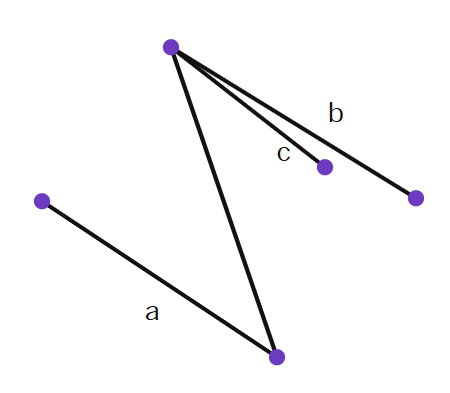
Solution: Line
From previous exercises we observed that sometimes it is difficult to be sure whether two lines are parallel. To determine this we use the idea of transversals.