

Corresponding Angles
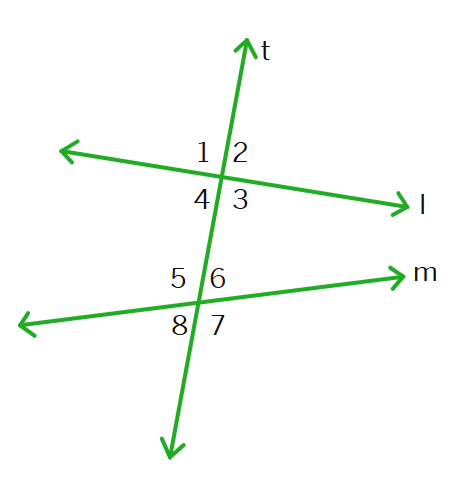
In the figure, we notice that the transversal t forms two sets of angles: one with line l and another with line m. There are angles in the first set that correspond to angles in the second set based on their position. ∠1 and ∠5 are called corresponding angles. Similarly, ∠2 and ∠
Activity 3
Draw a pair of lines and a transversal such that they form two distinct angles.
Step 1: Draw a line l and a transversal t intersecting it at point X.
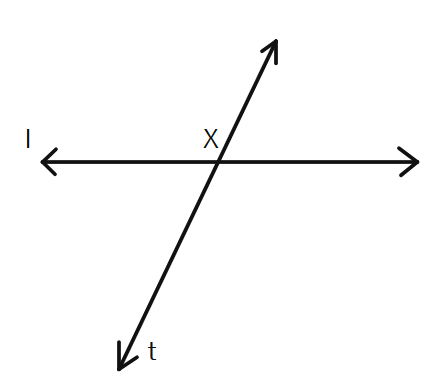
Step 2: Measure ∠a formed by lines l and t (let us say it is 60°).
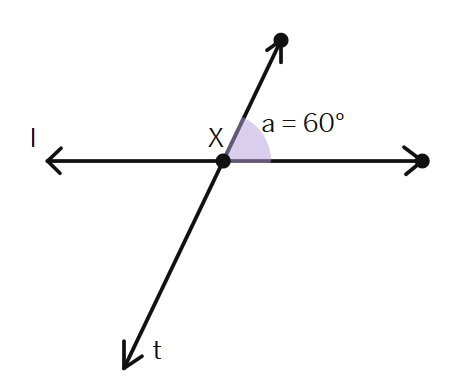
How many distinct angles have formed now?
If one angle is 60°, the other angle of the linear pair should be
So, when we draw another line intersecting the transversal t, we wish to form only two angles, 60° and 120°.
Step 3: Mark a point Y on line t.
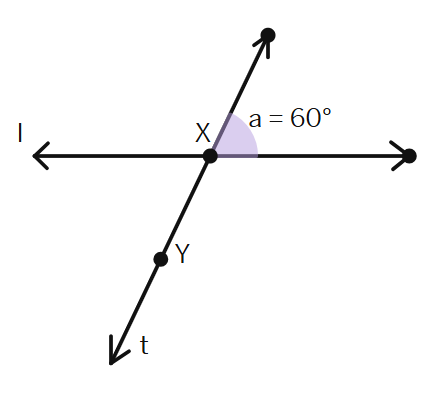
Step 4: Draw a line m through point Y that forms a 60° angle to line t. This can be done either by copying ∠a with a tracing paper or you can use a protractor to measure the angles.
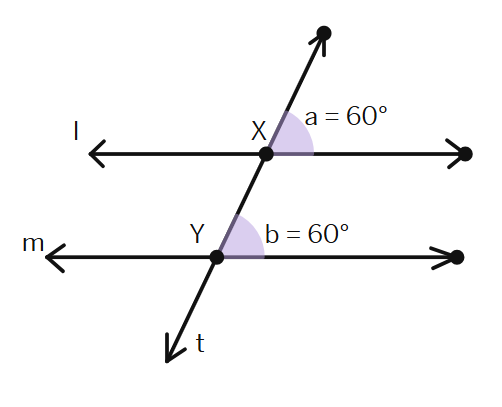
What do you observe about lines l and m? Do they appear to be parallel to each other?
Yes, they do appear to be parallel to each other.
Angles, ∠a and ∠b are corresponding angles formed by the transversal t on lines l and m. These corresponding angles are equal to each other.
From this we can observe:
When the corresponding angles formed by a transversal on a pair of lines are equal to each other, then the pair of lines are parallel to each other.
Suppose, we have a transversal intersecting two parallel lines. What can be said about the corresponding angles? When a transversal intersects two parallel lines, the corresponding angles are
Activity 4
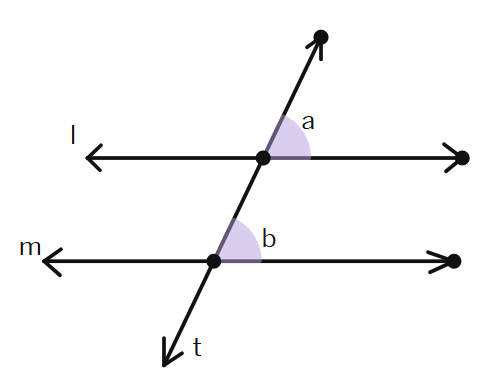
The figure has a pair of parallel lines l and m. Line t is the transversal across these two lines. ∠a and ∠b are
Take a tracing paper and trace ∠a on it. Now place this tracing paper over ∠b and see if the angles align exactly. You will observe that the angles match. Check the other corresponding angles in the figure using a protractor. Are all the corresponding angles equal to each other?
Corresponding angles formed by a transversal intersecting a pair of parallel lines are always equal to each other.
Activity 5
In the figure, draw a transversal t to the lines l and m such that one pair of corresponding angles is equal. You can measure the angles with a protractor.
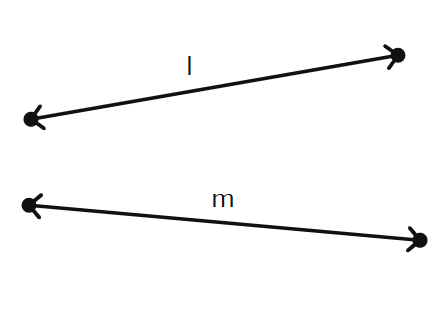
Are you finding it hard to draw a transversal such that the corresponding angles are equal?
When a pair of lines are not parallel to each other, the corresponding angles formed by a transversal can never be equal to each other.