

Transversals
We saw what happens when two lines intersect in different ways. Let us explore what happens when one line intersects two different lines.
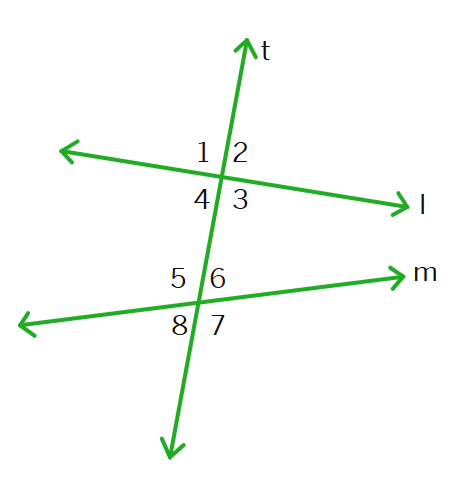
In the figure, line t intersects lines l and m. t is called a transversal. Notice that
Is it possible for all the eight angles to have different measurements? Why, why not?
The angles will have different measurements only if the lines l and m are not parallel.
What about five different angles: 6, 5, 4, 3 and 2? 2 and
In the figure, since ∠1 and ∠
Are there other pairs of vertically opposite angles? We can see that there are a total of
Thus, when a transversal intersects two lines, it forms eight angles with a maximum of four distinct angle measures.